
Technological innovation has had a great impact on how music is produced, delivered and even consumed. The introduction of digital media, virtual reality (VR), and immersive audio technologies has increased the opportunities to express music and engage the audience even outside physical concert halls. Contemporary music performances are becoming more and more digitalized, giving musicians and spectators a chance to communicate in virtual spaces and produce multisensory and immersive experiences. The developments have brought about new performance practices that incorporate the use of spatial audio systems, virtual instruments and networked collaboration platforms. Immersive technologies are audio, visual, and interactive technologies that are used to create systems that simulate real-life situations or generate completely new digital performance conditions. Immersive environments in musical performance allow artists and listeners to engage in common virtual environments in which sound and image are actively combined. Turchet et al. [1] propose that virtual reality and augmented reality technologies, known as extended reality technologies, transform the creation and experience of music performance because they allow the creation of interactive spaces in real time, where performers and listeners can interact.
The use of virtual reality has gained significance especially in the creation of immersive musical experiences. VR technology enables performers and spectators to interact with music performance in terms of avatars and audio that are spatially simulated in a digital space. These environments include modelling of concert halls, soundscaping experiments, and fully imaginary worlds of performance. Studies have shown that VR concert technologies have been gaining more and more popularity because of the opportunity to reproduce the experience of live performances and because these technologies allow people all over the world to be involved in them remotely [2]. One of the most important elements of immersive musical spaces is spatial audio technology, which is sound reproduction in three-dimensional space. In contrast to conventional stereo audio systems, spatial audio enables the listener to feel that the sound is forward, back, and moving, and thus makes virtual environments look more like the real world. Immersive audio capture and rendering technologies make it possible to reproduce sound realistically, which contributes to the effect of virtual performance spaces becoming more realistic [3]. This has made immersive audio technologies a focus in designing virtual music experiences.
Another factor that has led to the emergence of the musical metaverse is the development of immersive music technologies, which explains virtual environments in which musicians and audiences engage with each other using digital avatars and common immersive spaces. In such settings, concerts, joint acts and interactive music experiences can be held without any geographical limitations [4]. The musical metaverse thus is the new dimension of digital music performance and interaction with the audience. Besides virtual environments, virtual instrument performance (VIP) systems have also been developed using immersive technologies. The systems enable musicians to play in virtual environments, with digitalizations of musical instruments, by means of gesture interaction, motion tracking and real-time audio synthesis. Kyriakou et al. [5] state that VIP technologies increase the expressiveness of music performance by enabling musicians to control the sounds present in digital environments using both physical gestures and virtual instrument interfaces. Networked music performance systems also contribute to immersive musical collaboration, as they enable musicians in other geographical locations to play together in real time. These performances are augmented by VR environments, which are virtual environments where students are able to interact visually and acoustically regardless of physical distance [6]. Through these technologies, new kinds of international collaboration in music are possible, which were impossible in the traditional performance setting.
The inclusion of immersive technologies into the performance of music also carries with it technical and artistic challenges. Networked performances may also suffer from audio latency, synchronization problems and spatial audio rendering limitations [7]. Also, immersive technologies need dedicated hardware and software infrastructure, which can make them inaccessible to some performers and audiences. In spite of these difficulties, immersive technologies are likely to become even more relevant in the future of music performance. Virtual spaces provide musicians with the means of trying new art forms and developing new interactive experiences combining both physical and digital aspects. With the ongoing development of digital platforms, immersive audio technologies and virtual environments will probably become an essential part of current musical performance practice.
Since immersive media technologies are evolving at a rather huge pace, it is necessary to discuss the way the technologies affect musical performance and engagement with the audience. Although the individual aspects of immersive audio or virtual environments have been researched before, there is still a necessity to research the overall impact of the technologies on musical performance today. Thus, the current paper will examine the use of immersive audio technologies and virtual environments in contemporary music performance. In particular, the research questions discussed in the study are as follows:
The study will provide a contribution to the emerging body of research on immersive media, digital music technologies, and virtual performance environments by answering these questions.
Immersive audio technologies are aimed at recreating sound environments and making them real by reproducing sound sources in a three-dimensional space. Such technologies consist of spatial audio systems, binaural rendering, and object-based audio technologies that make it possible to localize sound and move it in the virtual space correctly [3], [8]. Immersive audio makes the listener feel more present and immersed and is especially significant in the context of virtual reality and interactive performances involving digital performances. It has been found out that spatial audio is of utmost importance in creating immersion within virtual space. Hedges et al. [9] point out that the use of immersive audio devices like binaural sound rendering and head-related transfer functions (HRTF) and other immersive audio technologies in virtual environments can greatly enhance the realism of the effect, as it mimics the natural processing of sound by humans. Such technologies allow the user to feel the direction and distance of sound more precisely, and this provides an additional boost to the experience of virtual music performances. The interactive music environment also requires spatial audio in which performers and audiences interact in digital environments. Research on immersive audio systems suggests that sound reproduction in the right space enables musicians to locate virtual sound sources in a performance space, which allows musical performances to involve interaction between performers and their audience [10].
Networked music performance has been enhanced tremendously by virtual reality technologies. Networked music performance systems allow musicians to play together and cooperate in real time, although they might be in different geographical regions. VR worlds boost such collaborations by offering common virtual rooms in which musicians can be physically and audibly connected [6]. Recent reports have shown that VR concerts are on the rise since digital media has seen musicians being able to entertain audiences around the world. The VR concert platforms enable the audience to see the performances in various ways, communicate with the performers using avatars, and have access to immersive virtual concert spaces [2]. These environments recreate the social elements of live concerts and also add new interactive elements that cannot be implemented in traditional performance venues. Immersive audio combined with VR technologies also increases the degree of realism of virtual concerts. Spatial audio enables viewers to listen to sounds of various origins in the virtual environment, which makes the listening experience more realistic and captivating [11].
The musical metaverse is a new term for immersive music experience that has become a new paradigm. The musical metaverse can be defined as a continuity of virtual worlds in which individuals communicate via avatars and engage in joint creative work, such as doing music and composing music [4]. The musical metaverse enables performers to design interactive musical spaces where audiences can experience soundscapes, gain control over musical components and be actively involved in performances. Such settings are a departure from inactive listening sessions to active engagements over music. Immersive technologies of the musical metaverse also introduce a new style of artistic expression. As an illustration, interactive systems based on gestures enable the performers to manipulate virtual instruments and sound effects by means of body movements and motion tracking technologies [12]. These technologies help musicians to make dynamic performances that involve visual and auditory experiences.
The present research uses the systematic literature review approach to analyze the purpose of immersive audio technologies and virtual environments in contemporary musical performance. This strategy is aimed at summarizing the existing research results and locating the most important technological advances, performance patterns, and issues related to the immersive digital music environment. The literature review is dedicated to scholarly journal articles devoted to immersive audio technologies, virtual reality music performance, spatial audio systems, and networked music collaboration. Academic databases such as IEEE Xplore, SpringerLink, ResearchGate, and Google Scholar were used to identify the relevant sources.
Research articles were chosen to meet the following criteria:
The identified publications were then analyzed through a thematic analysis approach after the applicable publications were identified. The literature was divided into the major themes, which are immersive audio technologies, virtual performance environments, networked collaboration systems and musical metaverse. The thematic analysis made it possible to find patterns and connections between immersive audio technologies and new practices in musical performances. Further, the review has considered technological constraints and issues with immersive digital music spaces. This paper is a synthesis of scholarly articles that offer a broad overview of the transformation of contemporary musical performance by immersive audio technologies and virtual environments.
The literature review shows that immersive audio technologies and virtual environments play an important role in modern practices of music performance, in terms of improved audience interaction, new modes of musical co-operation and broadened creative opportunities for performers. The findings indicate that there are four significant trends, which are the emergence of virtual reality music performances, the role of spatial audio technologies, the creation of virtual instruments and gestural interaction systems, and the immersive environments in which music collaboration over a network can develop.
The use of virtual reality (VR) concert platforms has become one of the most important trends in digital music. VR technologies enable artists and audiences to communicate in common virtual environments that replicate the experience of a live performance with a series of other interactive features [2]. Research indicates that immersion in VR concerts enables people to navigate between virtual spaces, interact with musicians with an avatar, and listen to music at different spatial points, enhancing immersion and presence [11]. The advent of 360-degree internet-based solutions has helped to create the opportunity for artists to present their performances to the world without the physical constraints. Loveridge [13] notes that in virtual music environments, musicians can generate performances which involve both motion capture and avatar representation with a spatial audio system. The format of this digital art has increased artistic experimentation and participation of the audience. The studies of extended reality (XR) technologies also prove that immersive musical spaces and performances are the combination of visual immersion and spatial sound design to build an interactive digital performance [1], [4]. These virtual spaces enable the audiences to traverse freely through the performance space and hear the sound at various points around the virtual space.
All of these technologies help to create immersive music spaces which combine sound, images, and interaction. Table 1 shows the most important AI tools, immersive audio tools, and virtual environment platforms that are applied in modern musical performance. The technologies facilitate the processes of artistic creation and business in the sphere of the music industry. Unreal Engine and Unity are used to design an entire concert experience, and the listening experience of the audience is further improved with the help of spatial audio technologies like Dolby Atmos. The additional application of AI-generated music and virtual social platforms can also facilitate new versions of digital performance and listening.
| Tool / Platform | Technology Type | Application in Musical Performance | Business Process Support |
|---|---|---|---|
| Unity 3D | VR/AR Development Platform | Creates immersive virtual concert environments and interactive stages | Used by music companies to design virtual concerts, digital events, and immersive audience experiences |
| Unreal Engine | Real-time 3D creation platform | Enables high-quality virtual performance environments with real-time graphics and spatial sound | Supports virtual event production, marketing events, and digital content creation |
| Dolby Atmos | Spatial Audio Technology | Provides immersive 3D sound experiences in music performances | Enhances digital streaming experiences and supports premium audio content distribution |
| Wave Field Synthesis (WFS) | Spatial Audio System | Recreates realistic sound fields in immersive environments | Used in immersive concert venues and sound installations to improve audience engagement |
| Max/MSP | Interactive audio programming software | Enables real-time sound synthesis and interactive music performances | Used by composers and production companies for experimental audio design and performance innovation |
| Ableton Live | Digital Audio Workstation (DAW) | Supports live electronic music performance and interactive sound manipulation | Used for music production, live performance management, and collaborative composition |
| OpenAI MuseNet / AI Music Generators | AI Music Generation | Generates musical compositions and assists with creative experimentation | Supports music content production and reduces creative development time |
| Meta Horizon Worlds | Virtual Social Platform | Hosts immersive VR concerts and collaborative performance spaces | Enables monetization of virtual concerts and digital event platforms |
| VRChat | Virtual Social Environment | Allows musicians to perform in virtual spaces using avatars | Supports fan engagement and community building through immersive events |
| Spatial.io | Collaborative Virtual Environment | Enables virtual music exhibitions and interactive performances | Used for digital marketing events and immersive brand experiences |
| Sound Particles | 3D Audio Software | Creates immersive sound environments for virtual performances | Used in film, gaming, and immersive music production industries |
| Reaper with Ambisonics Plugins | Audio Production Software | Produces spatial audio recordings for immersive music experiences | Supports advanced sound design workflows and spatial audio production |
| Source: Author synthesis on the basis of literature review | |||
Immersive musical experiences are focused on spatial audio technologies. In contrast to conventional stereo sound systems, immersive audio technologies permit placing and moving sound sources in three-dimensional space [3]. The spatial representation is very useful in making virtual spaces seem more realistic and present to the listener. The study indicates that spatial sound enhances the direction, distance, and motion of the sound sources, promoting the overall immersive experience [10]. Research on the perception of audio in VR spaces proves that correctly reproduced spatial sound ensures the level of involvement and immersion of users to a large extent [9], [11]. Head-related transfer functions (HRTF) and binaural audio systems are frequently employed in spatial audio systems that attempt to recapture the perception of sound in real environments experienced by human beings. These technologies make it possible to experience immersive listening which is almost the same as natural acoustics [3]. Consequently, spatial audio has gained prominence in the production of immersive musical sounds and the design of the appearance of virtual concerts.
The use of virtual instrument performance systems is another significant development that was found in the literature. Such systems enable musicians to play with digital instruments in virtual space and, in many cases, with the help of gesture recognition or motion tracking devices [5]. Studies have established that virtual instruments enable musicians to control the parameters of sound like pitch, spatial location and timbre through physical actions. This practice broadens the descriptive capabilities of music performance and allows the introduction of new models of interaction between musicians and digital spaces [14]. The performance environments that are based on gestures also enable musicians to regulate audio and visual effects in tandem. Romero and Leite [12] show that gestural interaction systems allow performers to create immersive audiovisual performances that combine body movement with sound design.
Networked music performance systems convey an experience of collaborating in real time between musicians in disparate geographical locations. The virtual reality worlds improve these collaborations by offering common virtual stages where performers can collaborate visually and audibly [6]. It is argued that VR spaces enhance the sense of presence of remote performers, enabling them to feel the spatial location as well as movement of others in the virtual performance zone [15]. Such environments provide a platform for music cooperation around the world that was not easily accessible before due to geographical distance. Technical issues of latency and synchronization are also associated with networked performance systems, however. According to Giacomelli et al. [7], audio latency may disrupt the timing of a musical interaction between a live performance and collaborative performance. These issues have to be handled by upgrading network infrastructure and audio processing technologies.
The results of this research paper illustrate that the emerging technologies of immersive audio and virtual environments are changing modern musical performance by providing new opportunities for artistic expression, collaboration and audience interactions. To begin with, immersive audio technologies contribute to the realism of virtual performance environments to a great extent. Spatial audio devices enable the reproduction of sound in three-dimensional space, which creates an immersive experience of listening to sound, which is very similar to acoustic physical spaces [3]. It has been found that immersive audio enhances the user experience and increases the emotional reaction in online space, especially when used in conjunction with interactive visual content [9], [11].
Second, virtual reality technologies increase the opportunities for musical interaction. VR concert platforms enable users to view shows from different angles and also engage with performers with digital avatars [2], [16]. These platforms recreate many features of live concerts and also add some new interactive features depriving the audience of more engagement [13]. Third, immersive technologies allow new types of musical creation. Performance systems based on virtual instruments enable the performers to control digital sound setups via body movements and gestures [5]. This physical movement and digital sound design integration produces new forms of performances that integrate music, visual art and interactive media.
Additionally, immersive technologies facilitate international cooperation in music. Networked music performance systems enable musicians in other regions of the world to collaborate in common virtual spaces [6]. The systems open up new chances for cross-cultural cooperation and experimental creativity. The other significant implication is the creation of the musical metaverse, which is a long-term virtual world in which users may engage in interactive music experiences. The musical metaverse enables composers to create immersive live performances, collaborative sound spaces and interactive performances, integrating music and digital narrative [4], [17]–[19].
In spite of these opportunities, there are also challenges of immersive musical technologies [20]. Audio latency, spatial sound rendering, hardware accessibility, and other technical constraints can have an impact on the quality of immersive music experiences [7]. Also, immersive technologies need to have special tools, including VR devices and spatial sound systems, which can be inaccessible to certain audiences [21], [22]. However, the ongoing evolution of immersive audio systems and VR technologies implies that the digital environment will gain an even greater significance in the future of musical performance. With the increasing availability and development of immersive technologies, artists can now develop new work that can be a blend of digitally interactive and classic musical performance.
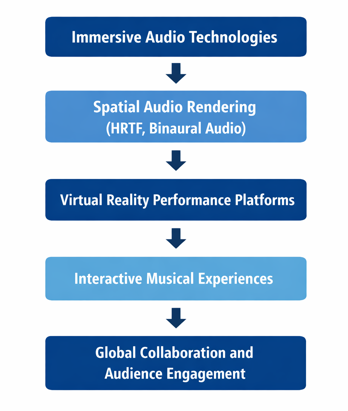
The framework below in Figure 1 shows how interactive virtual music performances are created with the help of immersive audio technologies and increase the engagement of the global audience.
This paper has explored the application of immersive audio technologies and virtual worlds in contemporary music performance. The results prove that immersive technologies considerably improve musical experiences as they allow the creation of the spatial audio environment, interactive virtual performance and collaboration in a global network. Spatial audio technologies enhance virtual music experiences by providing a sense of reality and immersion for a listener through precise sound localization and dynamic sound environments. The virtual reality platforms also extend the opportunities of digital music performance by offering bigger virtual places where musicians and listeners can interact with each other via avatars and through virtual environments. The concept of the musical metaverse is the next step in the history of immersive musical experiences, which can provide possibilities for creative expression and active participation of the audience. Nevertheless, latency, constraints in spatial audio rendering, and accessibility of hardware are some of the technical issues that need to be managed to achieve the potential of immersive music technologies. The upcoming research must consider empirical research on the experience of the audience in immersive music environments and examine how the latest technologies, including artificial intelligence and advanced spatial audio technologies, can be employed to further augment digital music performances. In general, the world of musical performance is transforming with the use of immersive audio technologies and virtual worlds, which provide new opportunities to be creative, collaborate, and interact with the audience in the digital age.
This study did not involve human participants, animals, or the collection or processing of personal or sensitive data. The research was based exclusively on publicly available digital artifacts. Therefore, ethical approval and informed consent were not required.
Not applicable.
The authors declare no competing interests.
There is no specific funding to support this research.
No original datasets were generated or analyzed in this study. The research is based exclusively on a systematic review and qualitative analysis of publicly available scientific literature and published sources. The sources reviewed are accessible through their respective publishers and academic databases.