
Sport is not merely a collection of physical techniques; it is also a social practice through which communities define discipline, excellence, competition, identity, and acceptable conduct. Modern competitive sport can generate important health, educational, cultural, and social benefits, yet highly commercialized and performance-oriented environments may also produce ethical tensions concerning status, winning, body image, and the use of performance-enhancing substances. Medical literature has documented substantial health risks associated with several classes of performance-enhancing drugs, particularly when they are used at supraphysiological doses or in combination [1], [2]. These contemporary concerns make historically integrated models of physical training and ethical formation relevant to the philosophy of sport, provided that such traditions are examined critically rather than idealized.
Iranian Pahlavani and Zurkhaneh traditions offer one such model. UNESCO describes Pahlevani and Zoorkhanei rituals as a combination of gymnastic and martial movements, symbolic instruments, epic and mystical poetry, music, ethical instruction, and community relationships. The ritual is performed in a domed Zurkhaneh containing a sunken arena, while the morshed directs the exercise through rhythmic drumming and recitation [3]. The tradition was inscribed in 2010 on UNESCO’s Representative List of the Intangible Cultural Heritage of Humanity, which emphasizes its intergenerational transmission and contribution to social solidarity [3]. Scholarly accounts similarly describe the Zurkhaneh as an evolving institution in which wrestling, physical culture, masculine sociability, religious symbolism, and ideals of heroic conduct became intertwined [4], [5].
The ethical vocabulary associated with this institution is often expressed through the Persian and Arabic concepts of javanmardi and futuwwa. In the history of Persian and Islamic ethics, these concepts refer to traditions of chivalrous conduct characterized by generosity, loyalty, self-restraint, service, courage, and concern for others [6], [7]. Within Zurkhaneh practice, such ideals have frequently been connected to religious and heroic models, particularly Imam Ali in Shi’i contexts and Puriya-ye Vali in the cultural memory of wrestling [4], [8]. Peer-reviewed research on Zurkhaneh ethics has therefore argued that the institution should be studied not only as a form of traditional exercise but also as a social and moral environment in which athletic identity is shaped through ritual, narrative, hierarchy, and shared values [8], [9].
Architecture contributes directly to this educational environment. The physical descent into the gowd, the central position of the exercise pit, the elevated sardam, the surrounding seating, the controlled entrance sequence, and the relationship between the morshed and participants create a setting in which spatial form and ritual conduct reinforce one another. Research on religious symbolism in Zurkhaneh architecture has examined the role of sacred numbers, spatial hierarchy, and symbolic interpretation in the built environment [10]. Nevertheless, historical continuity must be approached cautiously. The origin of the Zurkhaneh remains uncertain, and direct institutional descent from pre-Islamic or Mithraic temples cannot be established conclusively. Encyclopaedia Iranica notes that the institution’s vocabulary, ethos, and ritual hierarchy recall futuwwa and Sufism, while the historical relationship remains complex and subject to interpretation [4]. Comparisons with Mithraic spaces are therefore best understood as scholarly interpretations of symbolic and formal parallels rather than proof of an uninterrupted architectural lineage [10], [11].
The purpose of the present review is to examine how philosophical, religious, ethical, and architectural elements have been brought together in explanations of Zurkhaneh culture. It addresses four related questions: how futuwwa/javanmardi is connected to athletic conduct; how Islamic, Sufi, and Shi’i concepts entered the ethical interpretation of Pahlavani practice; how the architecture and symbolic equipment of the Zurkhaneh participate in moral communication; and which aspects of this tradition remain conceptually relevant to contemporary sport. The objective is not to argue that traditional sport was uniformly virtuous or that contemporary sport is inherently morally deficient. Rather, the review identifies a historically significant model in which physical excellence was explicitly discussed together with humility, discipline, social responsibility, and ethical self-formation [5], [9].
Scholarship on Zurkhaneh has developed across history, anthropology, religious studies, architecture, sport ethics, cultural heritage, and the history of physical culture. Earlier literature often attempted to identify a single ancient origin for the institution, whereas more recent research emphasizes historical transformation and the need to distinguish cultural memory from demonstrable institutional continuity. Chehabi’s overview in Encyclopaedia Iranica remains an important reference because it describes the Zurkhaneh as a traditional urban gymnasium while explicitly noting that the institution has continually evolved [4]. Its rituals, terminology, grades, and ethos show affinities with futuwwa, Sufism, wrestling guilds, Shi’i symbolism, and wider regional traditions of athletic sociability; however, the precise historical pathway through which these elements were combined remains uncertain.
Rochard’s recent monograph provides a major contemporary reassessment. Drawing on long-term ethnographic engagement and historical scholarship, Rochard examines the Zurkhaneh not as a timeless cultural essence but as a changing social institution whose practitioners have negotiated multiple identities, moral expectations, and forms of public representation [5]. This perspective is important because it allows ethical ideals to be taken seriously without assuming that every practitioner or historical period embodied them in the same way. It also cautions against reducing the institution to a simple opposition between an ethically pure past and a morally impoverished present.
The formal recognition of Pahlavani and Zoorkhanei rituals by UNESCO has strengthened international attention to the relationship among physical culture, ritual, oral tradition, music, social cohesion, and ethical instruction [3]. UNESCO’s documentation identifies the morshed, the sunken arena, symbolic sporting instruments, epic and Gnostic poetry, religious principles, and the transmission of chivalrous values as integral elements of the heritage. This description confirms that the cultural significance of Zurkhaneh cannot be understood solely through the mechanics of exercise.
Research by Azizi, Mohammadi, and Deimary has examined futuwwa, Islamic generosity, chivalry, and moral teaching in Zurkhaneh sport, emphasizing ethical principles such as justice, compassion, brotherhood, restraint, and service [8]. A subsequent study by Mohammadi, Azizi, and Deimary developed this argument further by analyzing the role of ancient sport and Zurkhaneh in the promotion of religious and ethical virtues [9]. These studies are directly relevant to the present review because they show how sporting instruments, ritual practice, epic and religious poetry, architecture, and exemplary figures collectively contribute to the formation of athletic and heroic identity.
Architectural symbolism has also received specific attention. Deimary and Mohammadi examined the expression of religious beliefs through sacred numbers in Zurkhaneh architecture and sport and argued that built form and ritual symbolism should be interpreted together [10]. Their analysis provides a basis for discussing the gowd, dome, entrance hierarchy, sardam, and symbolic ordering of space without treating architectural features as merely decorative.
The ethical background of Zurkhaneh also requires scholarship beyond sport history. Zakeri’s account of javanmardi in Encyclopaedia Iranica explains that futuwwa/javanmardi refers both to social associations and to an ethical orientation emphasizing altruism, magnanimity, generosity, and loyalty [6]. Ridgeon’s study of Persian Sufi chivalry traces the ethical and textual development of javanmardi and presents major medieval futuwwa texts in translation [7]. Al-Sulami’s classical tradition of Sufi chivalry likewise provides an influential formulation of self-discipline, generosity, hospitality, and the overcoming of ego [12]. These sources provide a firmer basis for interpreting the moral language of chivalry than incomplete or unverifiable bibliographic entries.
A further strand of scholarship concerns the possible relationship between Zurkhaneh symbolism and older Iranian religious traditions. Comparative studies have noted similarities between the cave-like or sunken character of some Zurkhanehs and descriptions of Mithraic sacred spaces, while architectural scholarship has developed symbolic readings of water, fire, numbers, celestial imagery, and ritual descent [10]. Yet modern scholarship on Mithraism emphasizes the complexity of reconstructing the cult and the absence of evidence for simple lines of institutional continuity [11]. The Iranian deity Mithra itself is historically associated with covenant, alliance, truth, and order, but should not be simplistically equated with every later form of Mithraism or with Zurkhaneh ritual [13]. Accordingly, the present review treats claims of Mithraic influence as a historiographical and symbolic interpretation rather than as an uncontested historical fact.
Taken together, this literature demonstrates that Zurkhaneh is best approached as a layered cultural institution. Its significance lies at the intersection of physical training, heroic memory, religious symbolism, ethical formation, architecture, music, oral performance, and community life. The present study builds on these verified strands of scholarship to examine how Islamic rules and ethics have been expressed not only through explicit moral instruction but also through spatial organization, ritual hierarchy, bodily practice, and symbolic sporting equipment.
This article adopts a qualitative narrative-review approach designed for a topic whose evidence is distributed across several disciplines and source types. The subject cannot be reconstructed adequately through sport-science literature alone because the Zurkhaneh is simultaneously an athletic institution, an architectural setting, a ritual environment, a vehicle of oral and musical performance, and a site in which religious and ethical meanings have been expressed. The review therefore draws on peer-reviewed sport-philosophy and architectural studies, historical and anthropological scholarship, major reference works in Iranian studies, cultural-heritage documentation, and scholarly editions or translations of material concerning futuwwa and javanmardi. The objective is interpretive synthesis rather than meta-analysis, bibliometric measurement, or causal evaluation.
Source selection followed three substantive criteria. First, a source had to address Zurkhaneh, Pahlavani, Iranian wrestling culture, futuwwa/javanmardi, relevant architectural symbolism, or a directly related historical-religious concept. Second, preference was given to sources whose bibliographic identity could be independently verified through a publisher, established scholarly reference work, official cultural organization, or indexed academic journal. Third, when a claim concerned a contested historical genealogy, sources were selected that made the limits of the evidence visible rather than merely repeating a traditional origin narrative. This criterion was particularly important for claims concerning Mithraism, pre-Islamic continuity, and the direct institutional ancestry of the Zurkhaneh.
The review distinguishes four levels of evidence. The first level consists of documented descriptions of the Zurkhaneh as an institution: its architecture, exercises, hierarchy, music, terminology, and historical transformation. UNESCO’s heritage documentation and Chehabi’s Encyclopaedia Iranica entry are especially important at this level because they provide independently identifiable descriptions of the ritual complex [3], [4]. Rochard’s monograph adds a contemporary historical-anthropological reassessment based on extensive engagement with the Zurkhaneh milieu [5].
The second level concerns ethical interpretation. Here the principal question is not whether a ritual or movement existed, but what moral meaning practitioners and scholars have attributed to it. Peer-reviewed work by Azizi, Mohammadi, and Deimary and by Mohammadi, Azizi, and Deimary provides direct analysis of chivalry, religious virtues, and ethical formation within Zurkhaneh sport [8], [9]. These studies are read together with wider scholarship on Persian javanmardi and Sufi futuwwa, particularly Zakeri and Ridgeon [6], [7]. This approach helps prevent the ethical vocabulary of Zurkhaneh from being treated as if it emerged independently of broader Islamic and Persian moral traditions.
The third level concerns symbolic and architectural interpretation. Deimary and Mohammadi’s analysis of sacred numbers and religious symbolism provides a verified academic basis for examining how formal features of Zurkhaneh architecture have been interpreted [10]. Symbolic claims are nevertheless separated from material-historical proof. A sunken arena may acquire a meaning of humility within a community even if that meaning cannot be demonstrated to have determined the building’s earliest architectural form. The review therefore treats symbolic meaning as culturally consequential without assuming that every later interpretation identifies the original cause of a feature.
The fourth level concerns deep historical comparison. Claims involving Mithra, Mithraism, pre-Islamic religion, and ancient Iranian traditions are evaluated with particular caution. Schmidt’s account of the Iranian deity Mithra and Beck’s analysis of Mithraism demonstrate that these subjects involve complex philological and archaeological debates [11], [13]. Accordingly, similarities between Zurkhaneh and cave-like ritual architecture, solar symbolism, fire, water, or graded initiation are reported as interpretations found in the literature and not as conclusive proof of uninterrupted institutional transmission.
The review also applies a distinction between normative and descriptive evidence. Normative texts state how an honorable person ought to behave; ethnographic or historical descriptions indicate what people actually did. A futuwwa text that praises generosity establishes generosity as an ethical ideal, not the empirical generosity of every athlete. Similarly, a contemporary description of respect rituals in a Zurkhaneh does not prove identical practice across all periods or regions. Maintaining this distinction is essential when discussing moral history.
Religious quotations and traditions present an additional methodological problem. Many circulated Persian and secondary-language compilations reproduce hadiths, sayings, and narratives in paraphrased form. Table 1 is therefore retained as evidence of the religious material used within the ethical interpretation of chivalry, but it is explicitly not presented as a critical hadith edition. Where authenticity or exact wording becomes central to a theological argument, specialist verification in the original-language source is required. This review is concerned primarily with how such traditions have functioned in Zurkhaneh-related moral discourse.
Finally, the review does not assume that contemporary sport and traditional Zurkhaneh can be compared through a simple moral binary. Medical research on performance-enhancing drugs is used only to establish that some contemporary performance practices carry documented health risks [1], [2]. It is not used to claim that modern sport as a whole is morally corrupt. Correspondingly, the historical presence of ethical ideals in Zurkhaneh is not used to claim that all traditional practitioners behaved virtuously. The analytical purpose is to compare institutional logics: one model explicitly integrates moral narration with physical training, and this integration can be examined for its relevance to current discussions of sport ethics.
A rigorous interpretation of Zurkhaneh culture requires attention to the ethical vocabulary through which physical strength was given social and spiritual meaning. The most important terms are futuwwa and its Persian counterpart javanmardi. The Arabic noun futuwwa is derived from fata, “young man,” but in Islamic ethical and mystical literature the term developed meanings that extended far beyond chronological youth. It came to designate an ideal of honorable conduct expressed through generosity, loyalty, courage, self-restraint, service, protection of the vulnerable, and the willingness to subordinate personal advantage to a larger moral obligation [6], [7]. The term therefore describes both an ethical orientation and, in different historical contexts, forms of association in which such ideals were taught and performed.
The conceptual history of javanmardi is especially relevant to Iranian physical culture. Zakeri emphasizes that futuwwa/javanmardi developed through heterogeneous associations and should not be reduced to a single institutional form [6]. Ridgeon’s study of Persian Sufi ethics similarly shows that chivalric ideals changed across time and were interpreted differently by Sufi authors, artisans, social groups, and religious communities [7]. The ethical tradition nevertheless displays a recurrent concern with overcoming egocentrism. Generosity is meaningful because it limits attachment to property; courage is morally valuable when it protects others rather than displaying domination; strength is praiseworthy when it is disciplined; and social status becomes ethically legitimate only when accompanied by service.
These principles correspond closely to the normative image of the pahlavan in Zurkhaneh culture. The pahlavan is not simply a physically powerful wrestler. In the idealized moral vocabulary of the institution, physical ability must be accompanied by restraint, humility, fairness, truthfulness, and concern for the community [8], [9]. This distinction explains why Iranian cultural memory can celebrate an athlete not merely for victories but for conduct interpreted as generous or honorable. The enduring reputation of Puriya-ye Vali is an important example of this union between wrestling ability and moral exemplarity [4], [5].
It is important, however, to distinguish normative ideals from historical behavior. The presence of a code of chivalry does not prove that every wrestler, guild, or Zurkhaneh community always acted according to that code. Ethical texts are prescriptive by nature: they describe the person one ought to become. Their significance for this study lies precisely in that normative function. They supplied a vocabulary through which the exercise of strength could be judged. Strength without justice could be condemned as domination; seniority without generosity could be interpreted as arrogance; and victory without self-control could be treated as ethically incomplete.
Persian and Islamic literary traditions provided important media for transmitting these values. Epic poetry, mystical verse, moral anecdotes, Qur’anic narratives, and traditions attributed to religious authorities were incorporated into a wider language of courage, generosity, fidelity, and self-mastery. In the Qur’an, forms of the word fata occur in several passages, including narratives concerning the Companions of the Cave and references to young men whose identity is associated with faith or service. Later ethical literature interpreted such usages within broader discussions of spiritual youthfulness and honorable conduct [6], [7].
Within the Zurkhaneh, literary transmission is not separate from exercise. The morshed recites epic, religious, and moral poetry while maintaining rhythm on the zarb. UNESCO specifically identifies this poetic and musical component as part of the intangible heritage of Pahlavani and Zoorkhanei rituals [3]. The words heard during exercise can therefore function as an interpretive frame for the movements themselves. A physical action is not experienced only as muscular effort; it may be accompanied by references to courage, religious memory, heroic exemplars, humility, or service. The combination of sound, movement, hierarchy, and shared attention makes the Zurkhaneh a pedagogical environment in which moral language is repeatedly associated with bodily practice.
The Shahnameh occupies an especially important place in the heroic imagination of Iranian culture. Its narratives of conflict, loyalty, courage, justice, and the defense of community provide a repertoire through which physical strength can be interpreted as part of a larger moral drama. Zurkhaneh recitation also draws on religious material, particularly in Shi’i settings, where Imam Ali functions as an exemplary figure of courage, justice, and chivalry [4], [9]. The relationship is not simply doctrinal. Repetition of names, blessings, narratives, and poems embeds religious and heroic memory within the temporal structure of the exercise session.
Classical Sufi futuwwa literature provides another important ethical background. Al-Sulami’s chivalric tradition emphasizes generosity, hospitality, self-discipline, friendship, and the overcoming of the ego [12]. Ridgeon’s translations and historical study show how later Persian authors elaborated comparable themes and linked them to social conduct, religious discipline, and the responsibilities of masters and disciples [7]. Such literature helps explain why the vocabulary of Zurkhaneh ethics repeatedly moves between bodily strength and moral self-command.
A recurring theme in these sources is the reinterpretation of “strength.” Physical power is acknowledged, but ethical superiority is associated with control of anger, fidelity to promises, protection of the weak, fairness, generosity, and the capacity to resist selfish impulses. This moralization of strength is crucial for understanding the philosophical role of wrestling. Wrestling offers an immediate and visible contest of bodies; futuwwa introduces a second contest, the struggle to govern one’s own conduct. The physical opponent and the moral struggle are therefore conceptually linked without being identical.
The traditions assembled in Table 1 illustrate how later Zurkhaneh and chivalric literature associated self-control, competition, bravery, and bodily exercise with religious ethical teaching. The table should not be treated as a critical hadith edition: authenticity, wording, and chains of transmission require specialist verification in the original Arabic and Persian sources. Its purpose here is historiographical. It demonstrates the kinds of religious formulations that have been used in the ethical interpretation of Pahlavani and Zurkhaneh practice [7], [8], [12].
The cumulative effect of these literary and religious traditions is to define athletic excellence as a combination of bodily and ethical capacities. In this model, the exemplary athlete does not merely perform difficult movements or defeat an opponent. The athlete must also learn when not to use strength, how to respect others, how to accept hierarchy without arrogance, how to receive recognition without excessive pride, and how to connect personal capability to social responsibility. These principles provide the conceptual foundation for the architectural and ritual analysis developed in the following sections.
The term Zurkhaneh literally denotes a “house of strength,” but the institution cannot be understood simply as an early gymnasium. Historically, it combined physical exercise, wrestling, music, poetry, hierarchy, sociability, and moral symbolism. The chronology of its emergence remains uncertain. Modern scholarship therefore cautions against presenting any single origin narrative as definitive [4], [5]. The institution known from the early modern and modern periods was the product of historical layering, and different components may have different genealogies.
Some Iranian scholarship has interpreted aspects of Zurkhaneh form and symbolism in relation to pre-Islamic Iranian traditions, especially Mithraic or Mehr-related religious imagery. These interpretations commonly point to cave-like space, descent below ground level, ritual hierarchy, the symbolic importance of light or fire, and the use of platforms around a central ceremonial area [10]. Such comparisons are intellectually significant because they reveal how later Iranian writers understood cultural continuity. They should not, however, be converted into a claim of proven direct descent. Research on Mithraism itself stresses that its history is difficult to reconstruct and that the relationship between Iranian Mithra and the Roman mysteries of Mithras remains complex [11], [13].
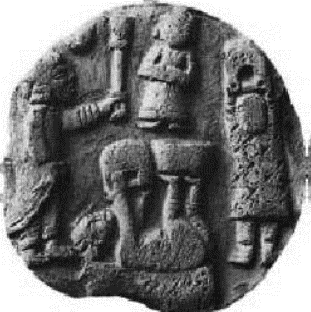
The Iranian deity Mithra is historically associated with covenant, alliance, vigilance, truth, and social order. Schmidt’s analysis of the Indo-Iranian tradition emphasizes the connection of Mithra with agreements and alliances rather than a simple identification with the sun [13]. Later religious history and Western Mithraic traditions developed additional solar and cosmic associations. This distinction is important for architectural interpretation: claims that every solar, underground, or cave-like feature of a Zurkhaneh derives directly from Mithraism exceed the available evidence.
Figure 1 reproduces the historical visual material supplied with the manuscript. It is used here as an illustration of the broader antiquity of athletic representation in Iranian cultural history rather than as direct archaeological proof of Zurkhaneh continuity.
| Row | Hadith translation | Theme |
|---|---|---|
| 1 | The Prophet (PBUH) said: A warrior is not someone who dominates people. Rather, he is the one who conquers himself. | Qualities of a warrior |
| 2 | The Prophet (PBUH) taught that a true warrior is one who experiences anger, even when the face reddens and the body reacts strongly, yet succeeds in controlling that anger. | Qualities of a warrior |
| 3 | The Prophet (PBUH) said: A wrestler is not merely one who throws an opponent to the ground; rather, the true strong person is one who controls the self when angry. | Qualities of a warrior |
| 4 | Prophet (pbuh): “O people!… Who do you think is a wrestler? They said: A strong and vigorous person whose side is not brought to the ground. He said: “But the real warrior is the one whose heart is punched by Satan and his anger rises and his blood boils; But let him remember God and let his anger fall on the ground with patience. | Qualities of a warrior |
| 5 | Imam Sadiq (peace be upon him): The Prophet of God passed by some people who were busy lifting a stone. He asked: “What are you doing?” They said: We will try. He said: Do you want me to tell you who is the strongest and bravest among you? They said: Yes, O Messenger of God! He said: “The strongest and bravest of you is the one who, when he is happy, does not commit sin and wrongdoing, and when he is angry, his anger does not turn him away from speaking the truth, and when he finds strength, he does not take anything unjustly.” | Qualities of a warrior |
| 6 | The Prophet (PBUH) said: A warrior is not someone who dominates people. Rather, he is the one who conquers himself. | Qualities of a warrior |
| 7 | Imam Ali (peace be upon him): How brave is an innocent person and how fearful is a suspect and an accused! | Bravery |
| 8 | Imam Ali (a.s.): Fear the honorable person, whenever you are humbled, and the tolerant, whenever you injure her, and the brave, whenever you hurt her. | Bravery |
| 9 | Imam Ali (a.s.) wrote to Malik: “Also, stay with the lord of Marwat and those who are from honorable and worthy families and have good backgrounds, and then those who are brave, brave, forgiving and generous, because they are the mine of generosity and honor.” | Bravery |
| 10 | Balkhi’s brother asked Imam Sadiq (AS) about Fatwat. He said: “What are you [yourself] saying?” Shaqiq said: If it is granted to us, we will be thankful and if it is denied to us, we will be patient. Imam Sadiq (a.s.) said: “Dogs in Medina do the same!” Shaqiq said: O son of the daughter of the Prophet of God! What do you think is futuwwa? He said: “If it is granted to us, we will sacrifice, and if it is withheld from us, we will give thanks.” | Futuwwa |
| 11 | Imam Baqir (a.s.): In the Battle of Badr, a herald called “Rizwan” called out in the sky: “There is no sword but Zulfiqar and no young man but Ali.” | Futuwwa |
| 12 | Imam Sadiq (a.s.) said to a man: Who are you calling fati? He said: To the youth. Hazrat said: No; fata is a believer. The companions of the cave were all adults, but God Almighty called them fataya (young men, young men) because of their faith. | Futuwwa |
| 13 | God’s Prophet (PBUH): When the Resurrection occurs, Ali will be called by seven names: O Sadiq! O Dal (guide) O devotee! O leader! O Mahdi! Oh fati! (young man) O Ali! You and your followers will enter heaven without calculation. | Futuwwa |
| 14 | The Prophet (PBUH) said to Ali (PBUH): If you see a man committing prostitution [what would you do]? He said: I will cover him. He said: If you see him again? He said: I will cover him up to three times with Ezar and Radim. So the Prophet (PBUH) said: “There is no man except Ali.” And he said: “Cover for your brothers.” | Futuwwa |
| 15 | When the sword of the Commander of the Faithful (AS) broke, he came to the Messenger of God and said: O Messenger of God! Man fights with weapons; But my sword is broken. The Prophet of God gave him his sword (Zulfiqar) and said: “Fight with this.” Whoever attacked the Prophet of God, Ali (a.s.) would stop him and his enemies would sit back when they saw him. In this way, the Prophet brought himself to the side of Uhud and stood. The war was one-sided. The companions of the Prophet (PBUH) were confused. But Ali (AS) continued to fight with the enemy until he received ninety wounds on his face, head, chest, abdomen, hands, and legs, and the enemies avoided approaching him. They heard a messenger calling from the sky: “There is no sword but Zulfikar and no young man but Ali.” Gabriel descended on the Prophet and said: “O Muhammad! I swear to God that this is mawasat (sacrifice). The Prophet said: “The reason is that I am from him and he is from me.” Gabriel said: And I am also one of you. | Futuwwa |
| 17 | Prophet (PBUH): Today you are in preparation and tomorrow in the competition field. The prize of this competition is heaven and the finish line [for the loser] is fire. | Competition |
| 18 | Imam Baqir (peace be upon her) said: There is no greed like competing for status, no justice like fairness, no aggression like oppression, and no oppression like following the whims of the soul | Competition |
| 19 | Imam Ali (a.s.): Verily, the world has turned its back and called farewell, and the Hereafter has turned and appears suddenly. Know that today is the day of training and preparation, and tomorrow is the day of the competition and goal, heaven, and the end of the losers is hell. | Competition |
| 20 | Imam Ali (a.s.): For the believer, the world is a field of striving, action is the means of effort, death is a transition, and Paradise is the reward. | Competition |
| 21 | Ibn Malik was asked: Did you compete over anything during the time of the Prophet (PBUH)? He said: Yes. The Messenger of God set his horse as a prize and [himself] won the race and was pleased with that. | Competition |
| 22 | Know that the only race worth competing is righteousness and nothing else is worth competing. Everything that man owns in this world will be destroyed and [only] good deeds will remain in the sight of God. Soon you will be the companion of regret when you will be ashamed on the day of God’s reckoning. Do you know what day it is? Think about it well and know that it is the day of separation. This separation is not like other separations because there is no hope of meeting again. | Competition |
| 23 | 1,187 / 5,000 The Prophet (pbuh) said to Ali (pbuh): “O Ali! I entrusted you with the execution of this competition among the people. Ali (a.s.) came out and called Saraqa bin Malik and said: “O Saraqa! What the Prophet (PBUH) put on me in the execution of the competition, I put on your neck. So when you reach the place where the horses are moving, line up the horses and shout: Is there anyone who has not bridled his horse, or has a child with him, or has not saddled his horse? If no one answers, say takbeer three times and with the third takbeer command to move. God makes victorious whom He wills. Ali (a.s.) himself would sit at the end of the race and draw a line and sit two men face to face on both sides of the line, so that the line faces their toes and the horses pass between the two men and give them both The man said: “If one of the horses or two ears or one ear or the rein crosses the line, consider it the winner and give the prize to him, and if you are in doubt, consider both the winners and divide the prize, and if two horses They reached the line together, make the smaller horse the criterion [of victory] and [know that] in Islam, jalab (hurting the horse and shouting at the horse in order to increase its speed) and janab (carrying an auxiliary horse that (using it in the middle of the race) and shaghar (helping one of the contestants) are prohibited. | Competition |
| 24 | Imam Hassan Mojtaba (a.s.) looked at the people who were playing and laughing on the day of Eid al-Fitr. Turning to his companions, he said: “The Almighty God created the month of Ramadan as a field for the competition of His creatures, so that by obeying God, they may surpass God’s pleasure.” An advanced group won and a backward group was deprived. Therefore, it is surprising and funny for the actor on the day when the good people are rewarded and the short-handed people fail. I swear to God, if the curtain goes away, the good doer will be engaged in his good deeds and the evil doer will be caught in his evil deeds. | Competition |
| 25 | Imam Ali (peace be upon him): For the believer, the world is an arena of striving, action is the means of effort, death is a transition, and Paradise is the reward | Competition |
| 26 | The Prophet (PBUH) said: It is not permissible to compete except in three cases: camel riding, horse racing, or archery. | Competition |
| 27 | Know that the only race worth competing is righteousness and nothing else is worth competing. Everything that man owns in this world will be destroyed and [only] good deeds will remain in the sight of God. Soon you will be the companion of regret when you will be ashamed on the day of God’s reckoning. Do you know what day it is? Think about it well and know that it is the day of separation. This separation is not like other separations because there is no hope of meeting again. | Competition |
| 28 | Imam Ali (peace be upon him): The true loser is the one who loses the self, whereas the fortunate person is the one whose faith and conduct remain sound. | Competition |
| 29 | The Prophet of God (peace and blessings be upon him), said: The loser is that servant in whose heart the Almighty God has not placed mercy towards humans. | Competition |
| 30 | Imam Ali (a.s.): “If you have no choice but to compete, then compete in acquiring favorable traits and noble dispositions. | Competition |
| 31 | Imam Ali (peace be upon him): The competition of the wise and those who have a heart is in purifying their actions. | Competition |
| 32 | The Messenger of God, may God bless her and grant her peace, said: Horse racing is permissible | SPORT |
| 33 | Imam Ali (peace be upon him): The Prophet of God gave permission to hold a horse-riding competition and he himself conducted it and set a [prize] of seven shekels of silver. | SPORT |
| 34 | The Prophet (PBUH): Among your pastimes, the angels only participate in horse riding and archery. | SPORT |
| 35 | Al-Munaqib, Ibn Shahr Ashub – quoted by Ishaq Ibn Bashar -: Ruqana Ibn Abd Ibn Zayd Ibn Hashim was one of the most powerful people of Quraish. One day the Prophet (PBUH) said to him in a hard and rocky land: “O Rukana! Aren’t you afraid of God that you won’t accept my invitation?” He said: “If I know the truth, I will follow you.” The Prophet (pbuh) said: “If I beat you to the ground in Kushti, will you know that I am right?” He said: “Yes.” The Prophet (PBUH) said: “Get up so we can fight.” Rukane got up and they fought. Because the Prophet (PBUH) attacked him. They laid him on his side, Rakaneh said: “Let’s take a boat once more.” | Wrestling |
| 36 | Imam Baqir (a.s.): “Abu Talib used to gather his sons and the sons of his brothers and get them to fight, and this was the Arab way of life. Ali (a.s.) would roll up his sleeves and, even though he was young, he would wrestle with his older and younger brothers and older and younger cousins and beat them all to the ground. His father used to say: “Ali has won” and thus, he called him “Zaheer (victorious)”. When he grew up, he would fight with strong men and beat them to the ground, and [in the battlefields] he would take the oppressor’s hand and pull him towards him and kill him, and sometimes he would take his belt and throw him into the air and Sometimes he yells at a moving horse and turns it back. | Wrestling |
| 37 | Imam Zayn al-Abdin (a.s.): The Prophet (pbuh) said to those two (Imam Hasan and Imam Hussain, peace be upon him): “Get up right now and fight.” The two got up to take a boat. fatamah (a.s.) who had left [the house] for some work, entered them and heard the Prophet (p.b.u.h.) say: “Again, O Hassan! Hold Hussain tightly and knock him to the ground” he said to his father: “Amazing father! Do you provoke this on the other? Do you provoke the older one against the younger one? The Prophet (PBUH) said to her: “My dear daughter! Aren’t you happy that I say: O Hassan! Hold Hussain tightly and knock him to the ground; While my friend Gabriel says: O Hussein! Hold Hasan tightly and knock him to the ground?” | Wrestling |
Table 1 should be read as an interpretive compilation of traditions used in the ethical literature of futuwwa and Zurkhaneh studies rather than as a critical edition of hadith. The wording and chains of transmission should be checked against specialist Arabic and Persian editions when the theological authenticity of an individual narration is material to the argument [7], [8], [12].
The safest historical conclusion is therefore a layered one. Physical training, wrestling, weapon symbolism, heroic narratives, and religious meanings all have deep histories in Iran, but the recognizable Zurkhaneh institution emerged through later combinations of these elements. The value of pre-Islamic comparisons lies in understanding the symbolic resources available to later communities, not in assuming an unchanged institution spanning millennia [4], [5].
The transition from heroic and martial memory to explicitly Islamic ethical interpretation is visible in the literature surrounding futuwwa. Traditions concerning self-control, courage, competition, generosity, and wrestling were repeatedly cited by later writers to demonstrate that bodily strength should be governed by religious ethics. Table 1 presents a compilation of such materials as they have been used in Zurkhaneh-oriented ethical literature.
After the Islamic conquest of Iran, older practices of wrestling and physical culture continued within new political, religious, and social contexts. It is difficult to identify a single moment at which these practices became “the Zurkhaneh.” Chehabi suggests that the institution’s terminology, ethos, and hierarchy show affinities with futuwwa and Sufism and that wrestling groups may have adopted elements of these traditions during the later medieval period [4]. This interpretation is more cautious than narratives that describe the Zurkhaneh as a direct military organization created for resistance to a particular dynasty.
By the medieval period, professional wrestlers, urban associations, artisans, Sufi networks, and traditions of javanmardi were all present in Iranian society. The figure of Pahlavan Mahmud of Khwarazm, widely remembered in Iran as Puriya-ye Vali, became an important symbol of the synthesis between wrestling and moral-spiritual reputation [4], [5]. His cultural memory is significant because it demonstrates how the identity of the wrestler could be elevated from physical performer to ethical exemplar.
During the Safavid and Qajar periods, wrestling and courtly or urban patronage became increasingly visible in historical records. Zurkhanehs operated within cities and were connected with wider patterns of neighborhood sociability. Their relationship with political authority varied: rulers and elites could patronize wrestlers, while local communities also sustained their own institutions. The existence of official or semi-official champions should therefore be understood alongside the more local social functions of athletic associations [4], [5].
Modernization transformed these relationships. From the twentieth century onward, international freestyle and Greco-Roman wrestling developed as standardized competitive sports with weight classes, formal federations, and international rules. Chehabi notes that wrestling, once the central competitive culmination of the Zurkhaneh session, gradually became more independent from the gowd as modern competitive formats expanded [4]. This change did not eliminate Pahlavani wrestling, but it altered the institutional relationship between traditional physical culture and modern sport.
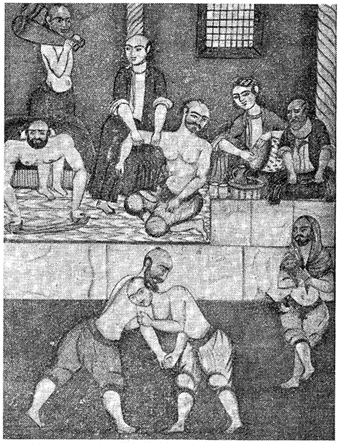
The historical representation shown in Figure 2 provides a visual reference for the enclosed, communal environment discussed here. The image should be interpreted as historical illustration rather than as evidence for a single standardized architectural form.
The relationship between Zurkhaneh culture and Sufism is most evident in its ethical language, forms of hierarchy, use of poetry, and emphasis on discipline of the self. Futuwwa traditions developed in close interaction with Sufi ethics, although they were never confined exclusively to Sufism [6], [7]. Concepts such as generosity, service, humility, control of desire, respect for the master, and fraternity offered a moral vocabulary that could readily be applied to the social world of wrestlers and athletic associations.
Zurkhaneh ritual also became strongly marked by Twelver Shi’i symbolism. Chehabi describes veneration of Imam Ali as a major feature of traditional Zurkhaneh practice, with blessings upon the Prophet and references to Shi’i sacred history integrated into exercise sessions [4]. Imam Ali’s cultural image as both warrior and just moral authority provides an especially powerful model for an institution concerned with the ethical regulation of strength. The ideal athlete can therefore be represented simultaneously as physically capable, religiously disciplined, and obligated to protect rather than oppress.
These religious layers did not erase earlier Iranian heroic traditions. Instead, epic, national, Sufi, and Shi’i materials were combined and reinterpreted. The Shahnameh, invocations of Imam Ali, stories of Puriya-ye Vali, and the ethics of javanmardi could coexist within the same cultural environment. This coexistence is one reason that Zurkhaneh should be interpreted as a historically layered institution rather than as the expression of a single theological system [5], [9].
The result was an athletic culture in which ritual participation communicated belonging and responsibility. Hierarchy established who led, who requested permission, and who was honored; poetry supplied moral and heroic narratives; music synchronized bodies; and religious invocations located strength within a larger moral universe. These practices help explain why the philosophical significance of Zurkhaneh cannot be separated from its architecture.
Traditional Zurkhanehs were embedded in the social geography of Iranian towns and cities rather than functioning only as isolated sporting halls. Historical descriptions frequently associate them with dense urban neighborhoods and with other communal institutions such as bazaars, bathhouses, religious buildings, and coffeehouses. Chehabi notes that the architecture of the traditional Zurkhaneh resembled that of public bathhouses and that the institution formed part of the urban social environment [4]. This spatial integration matters because moral education in the Zurkhaneh was not conceived as a private exercise. The pahlavan was expected to occupy a visible position in relation to the wider community.
The characteristic interior is organized around the gowd, a sunken exercise arena surrounded by places for participants or spectators. UNESCO’s description of Pahlevani and Zoorkhanei rituals identifies the sacred domed structure, octagonal sunken arena, audience seating, symbolic instruments, and leadership of the morshed as defining features of the heritage [3]. The spatial arrangement creates a strong distinction between the exercise zone and the surrounding level. Participants descend physically into the area of practice while remaining visible to the community assembled around them.
Scholars have offered symbolic interpretations of this descent. It has been associated with humility because even a powerful athlete performs below the level of those who observe. It has also been compared with older Iranian and Mithraic cave symbolism. Such readings are valuable as interpretations of meaning, but they should not be treated as direct proof of architectural descent [10], [11]. The architectural evidence is more securely used to show that movement through the building creates an embodied hierarchy: one enters, descends, requests permission, takes a place in relation to senior practitioners, and performs within a collectively supervised space.
The sardam is the elevated position occupied by the morshed, who coordinates the session through voice, poetry, rhythm, and the beating of the zarb. Its height gives the leader visual and acoustic command of the gowd. The morshed is therefore not simply a musician. He regulates tempo, acknowledges respected arrivals, guides transitions between exercises, and frames physical practice through heroic and religious recitation [3], [4].
The contrast between the elevated sardam and the lowered gowd produces a visible hierarchy, but that hierarchy is not solely about status. Ideally, authority carries pedagogical responsibility. The leader is expected to maintain order, preserve ritual continuity, and direct attention toward the ethical meaning of the practice. Objects historically displayed around the sardam—including images or instruments associated with warriors, heroes, and religious memory—further reinforce the connection between physical exercise and the moral narratives of the institution [5], [9].
The gowd is the main arena of collective exercise. Traditional examples are polygonal and sunken, although exact geometry and dimensions vary. The octagonal form is frequently emphasized in heritage descriptions and has generated numerous symbolic interpretations involving sacred numbers, Shi’i references, celestial order, and Iranian architectural symbolism [3], [10]. Such meanings should be understood as part of the interpretive tradition surrounding Zurkhaneh rather than as a single universally fixed code.
The social meaning of the gowd is clearer. Entry into the exercise space is governed by etiquette. Seniority, experience, permission, and ritual cleanliness historically shaped participation. The athlete does not simply step onto an anonymous training floor; entry signifies acceptance into a temporarily ordered social world. In this sense, the gowd disciplines both movement and conduct.
The low or controlled entrance traditionally associated with many Zurkhanehs has also been interpreted ethically. Passing through a constrained entrance can require a bodily gesture resembling a bow, and later explanations connect this posture with humility. Whether or not every architectural form was intentionally designed for that symbolic purpose, the interpretation itself became part of the moral pedagogy of the institution. Architectural features acquire ethical meaning when communities repeatedly narrate and perform them as such.
The bell used by the morshed is both a practical and symbolic instrument. Practically, it marks moments of attention, honors distinguished participants, and helps structure the sequence of the session. Symbolically, it participates in a broader soundscape together with the zarb, recited poetry, blessings, and collective responses. The athlete therefore trains within an acoustic as well as a physical architecture.
Some writers have compared the bell and other Zurkhaneh elements with features attributed to older Iranian or Mithraic ritual environments [10]. Because the history of Mithraism and its relationship to Iranian Mithra worship are themselves complex, such comparisons require caution [11], [13]. The stronger conclusion is that the Zurkhaneh became a symbolic environment in which sound, light, level, enclosure, objects, and movement were interpreted together.
Taken as a whole, Zurkhaneh architecture can therefore be understood as a form of embodied moral communication. The building does not teach through written rules alone. It organizes who sees whom, who occupies the center, who leads from above, how one enters, how one requests permission, and how individual performance remains exposed to collective observation. The ethical ideals of humility, respect, discipline, and responsibility are thus reinforced by spatial and ritual structure [8], [9].
Zurkhaneh exercises combine conditioning, rhythm, coordination, strength, balance, and historically, wrestling. Many of the principal instruments are conventionally interpreted through analogies with weapons or equipment associated with martial life. These interpretations connect bodily training to a heroic narrative in which the athlete prepares not simply to display strength but to use strength responsibly. UNESCO likewise describes the instruments of Pahlavani practice as symbolizing ancient weapons [3].
The sequence of exercise is socially regulated. Traditional practice distinguishes levels of experience and seniority, and individual exercises are performed within a collective order. Chehabi notes that practitioners historically advanced through recognized grades and that requests for permission were part of the etiquette surrounding individual performance [4]. This organization transforms training into a lesson in social positioning: athletic competence is displayed, but it is displayed within rules concerning precedence, recognition, and respect.
Music and poetry are essential to the performance. The morshed establishes rhythm with the zarb and accompanies exercise with epic, religious, or moral recitation. The athlete’s movement is consequently synchronized not only with other bodies but also with a shared cultural narrative [3], [9]. The relationship between instrument, movement, and language gives Zurkhaneh practice its distinctive educational character.
The sang consists of heavy shield-like boards lifted while the athlete lies on the back. The movement develops upper-body strength and control and has traditionally been interpreted through the symbolism of the warrior’s shield. The analogy is important because it turns a resistance exercise into a mnemonic device: the object recalls protection and combat even when used in a non-combat training environment [3], [4].
The ethical interpretation of the exercise lies not in the object itself but in the narrative surrounding it. A shield symbolizes defense as much as force. Within the moral vocabulary of Pahlavani culture, the strong person is ideally one who can defend the vulnerable and resist injustice. The physical burden of the sang can therefore be interpreted as compatible with a larger ethic of responsibility.
Rapid turning or charkh is among the characteristic individual exercises of the Zurkhaneh. It requires balance, spatial awareness, coordination, and control. Comparisons have sometimes been made with Sufi turning, although the practices should not be treated as identical. The important commonality is that rotation can be interpreted beyond its mechanical function and incorporated into spiritual or symbolic language [4], [5].
Traditional etiquette surrounding individual performance is particularly significant here. Athletes request permission and perform in relation to seniority. Chehabi observes that the ordering of individual exercises could express humility in a manner that differs from ordinary expectations of precedence [4]. The athletic act thus carries a social lesson about how distinction should be negotiated.
Wrestling historically formed the competitive core of Zurkhaneh culture. It provided a direct test of strength, technique, endurance, judgment, and emotional control. Chehabi notes that wrestling was once the culminating event of the Zurkhaneh session and that its institutional relationship with the Zurkhaneh weakened as modern freestyle and Greco-Roman wrestling became established [4]. Pahlavani wrestling nevertheless retained an important symbolic relationship to the older tradition.
The philosophy of futuwwa gives wrestling a particularly rich ethical interpretation. Victory over another body is visible and measurable, but the tradition repeatedly emphasizes a second form of victory: control over anger, arrogance, greed, and the desire to humiliate an opponent. For this reason, wrestling is frequently used as a metaphor for the struggle against the undisciplined self [7], [8]. The opponent is respected because the contest provides the conditions through which skill and character are tested.
This interpretation also explains the importance of ritual conduct before and after wrestling. Salutations, permission, respect for seniority, and restrictions against humiliating behavior communicate that competition is bounded by a moral relationship. A wrestler who wins physically but violates the ethical order can therefore fail to embody the ideal of the pahlavan.
The mil consists of heavy wooden clubs swung in controlled patterns. Its form is conventionally associated with the mace, while the kabbadeh is a heavy bow-shaped iron instrument whose design evokes the martial bow [3], [4]. These analogies make the historical memory of combat materially present within exercise.
Training with these instruments requires coordination and disciplined technique rather than uncontrolled force. The athlete must learn how to handle weight, rhythm, momentum, and space safely in relation to others. Their pedagogical value therefore extends beyond muscular development. The instruments teach that power is effective only when governed by technique and timing.
The hierarchy of performance further reinforces this message. Senior practitioners may use heavier equipment and occupy recognized positions within the ritual order, while novices learn progressively. Ideally, seniority is not merely privilege; it carries an obligation to model conduct. The visible difference between novice and experienced athlete makes the Zurkhaneh a setting for apprenticeship in both movement and etiquette.
Across these exercises, the central pattern is consistent. Physical objects and movements are repeatedly interpreted through a moral vocabulary. The sang can evoke protection, the mil and kabbadeh controlled martial power, spinning disciplined balance, and wrestling mastery of both technique and emotion. This symbolic organization distinguishes the Zurkhaneh from a purely instrumental training space and prepares the ground for its explicit moral principles.
The moral dimension of Zurkhaneh culture is expressed through a network of expectations rather than a single written code. Historical and contemporary descriptions repeatedly associate the ideal pahlavan with humility, truthfulness, courage, generosity, loyalty, self-restraint, respect for elders, hospitality, protection of the vulnerable, and service to the community [3], [8], [9]. These principles overlap substantially with the ethical vocabulary of futuwwa/javanmardi [6], [7].
Moral formation occurs through repeated practice. The athlete requests permission, accepts correction, performs under observation, yields precedence according to ritual convention, hears poetry and religious invocations, and encounters physical symbols associated with heroic memory. Ethics is therefore embedded in routine rather than presented only as abstract instruction. The following principles summarize the main values articulated in the literature.
Heroic literature frequently links physical courage to the defense of community and homeland. The Shahnameh, which forms part of the literary environment of Zurkhaneh recitation, provides a major cultural repertoire of loyalty, courage, conflict, and responsibility. Within Pahlavani interpretation, physical strength can therefore be represented as socially meaningful when it is directed toward protection rather than private domination [3], [9].
Modern scholarship should distinguish this cultural patriotism from exclusionary nationalism. The historically important point is that the athlete’s body was imagined as having obligations beyond the self. Community, neighborhood, and collective memory supplied a moral context for strength.
Chastity in futuwwa literature belongs to the broader discipline of desire. It is linked to control of the gaze, speech, sexuality, and conduct rather than merely to dress [7], [12]. In the Zurkhaneh context, bodily exposure during exercise coexisted historically with strict moral expectations concerning behavior. This combination demonstrates that physical display and ethical restraint were not necessarily understood as opposites.
The contemporary relevance of this principle is best expressed as respect for bodily dignity, boundaries, and self-control. Historical gender restrictions associated with traditional Zurkhaneh practice should be analysed as part of the institution’s social history rather than reproduced uncritically as universal moral requirements [5].
Traditional accounts often associate Zurkhaneh exercise with early-morning practice, religious observance, and disciplined routine. The ethical significance of early rising lies in the cultivation of regularity and self-command. Training requires the athlete to organize time, accept repetition, and continue practice beyond immediate pleasure.
Discipline in this sense is not merely obedience to an external authority. It is the capacity to govern one’s habits in accordance with chosen obligations. This understanding is consistent with the wider futuwwa emphasis on self-mastery [7].
Iranian heroic and religious narratives often organize moral experience through contrasts between justice and oppression, truth and falsehood, disciplined conduct and destructive desire. Zurkhaneh ethics translates this symbolic opposition into expectations about the use of strength. The ideal athlete should support the weak, oppose injustice, and avoid using physical capacity to humiliate or exploit others [8], [9].
The principle is therefore both inward and outward. Inwardly, the athlete resists anger, vanity, and selfish impulse. Outwardly, the athlete is expected to act responsibly in relation to other people. This dual interpretation explains why stories of heroic combat can coexist with teachings about patience and restraint.
Truthfulness is a foundational element of javanmardi. A person whose public reputation depends on courage but whose speech cannot be trusted fails the ethical ideal of the pahlavan. Classical chivalric literature repeatedly connects honor with honesty, fidelity, and reliability [6], [7].
Within an athletic community, truthfulness also has practical significance. Training depends on trust among partners, fair acknowledgment of victory and defeat, and confidence that senior figures will exercise authority responsibly. Moral reputation is therefore created through repeated credible conduct rather than through strength alone.
Keeping promises is closely related to truthfulness but places greater emphasis on continuity over time. The language of covenant has deep importance in Islamic ethics and in Iranian religious history. Mithra itself was historically associated with covenant and alliance in ancient Iranian tradition [13], while Islamic chivalric literature gives promise-keeping an explicitly moral and religious significance [7].
In the Zurkhaneh, this principle can be interpreted through loyalty to teachers, fellow athletes, communal obligations, and the ethical expectations attached to the status of pahlavan. A reputation for reliability converts personal honor into social trust.
Hospitality is a recurring virtue in Persian and Sufi ethical literature. It expresses generosity by requiring the host to make room for another person’s needs. In chivalric ethics, hospitality is valuable precisely because it moves resources away from exclusive self-interest [7], [12].
Traditional Zurkhanehs were communal spaces in which spectators, novices, senior athletes, and local supporters interacted. Hospitality therefore belongs naturally to the social character of the institution. It helps explain why the Zurkhaneh historically functioned as more than a private training facility.
Chivalric ethics often values the protection of another person’s dignity. This includes avoiding unnecessary exposure of faults, refraining from humiliating others, and treating entrusted information responsibly [7], [12]. Such discretion is particularly important in communities organized around reputation and honor.
Within a training environment, confidentiality also creates psychological safety. Athletes must be able to make mistakes, receive correction, and develop competence without being subjected to needless humiliation. The historical language of protecting secrets can thus be understood more broadly as an ethic of responsible social trust.
Protection of weaker members of society is among the most recognizable ideals of javanmardi. The hero is not merely the person capable of defeating strong opponents; moral superiority is demonstrated by using strength on behalf of those who lack equivalent power [6], [8]. UNESCO’s account of Pahlavani also emphasizes the strong relationship of practitioner groups with local communities and their assistance to people in need [3].
This principle is particularly important for contemporary interpretation because it converts athletic power into social responsibility. Strength gains ethical value through the purposes it serves.
Traditional Zurkhaneh developed historically as a male social institution, and its vocabulary of javanmardi is closely tied to culturally specific ideas of manhood. Courage, generosity, self-control, protection, and responsibility were represented as qualities of the honorable man. Modern scholarship, however, should distinguish the ethical content of these virtues from historical gender exclusivity [5].
Values such as fairness, courage, generosity, humility, and service are not inherently male. Contemporary engagement with Zurkhaneh ethics can therefore retain their moral significance while critically examining the gendered structures through which they were historically transmitted.
Self-sacrifice refers to the willingness to accept personal cost for the welfare of another person or the community. In futuwwa literature this principle is closely connected to generosity and the overcoming of ego [7], [12]. It does not require self-destruction; rather, it challenges the assumption that personal advantage should always determine action.
In sport, the principle can be expressed through mentoring younger athletes, protecting team members, sharing resources, accepting responsibility, and refusing unfair advantage. Such conduct represents a form of strength that is moral rather than merely physical.
The cultural expression “the right of bread and salt” refers to obligations created through hospitality and shared sustenance. To accept another person’s food creates a relationship that should not be answered with betrayal. Within Iranian ethical memory, the expression condenses ideas of gratitude, loyalty, reciprocity, and respect.
Its relevance to Zurkhaneh lies in the broader concept of relational obligation. Athletes do not develop in isolation: teachers, training partners, families, communities, and institutions contribute to their formation. Acknowledging “bread and salt” is therefore a symbolic way of recognizing debts of care and refusing ingratitude.
Trustworthiness extends moral responsibility to property, speech, promises, authority, and personal information. Classical futuwwa texts repeatedly condemn betrayal and present reliability as a condition of honorable fellowship [7]. A strong individual who cannot be trusted represents a danger rather than an ethical ideal.
The structure of Zurkhaneh depends on trust at multiple levels. Novices trust experienced athletes to teach safely; athletes trust the morshed and senior members to exercise authority fairly; and the surrounding community evaluates practitioners partly through their public reputation. Trustworthiness therefore links internal discipline with social legitimacy.
Contentment is not equivalent to passivity. In Sufi and chivalric ethics it refers to freedom from excessive attachment to possessions, status, and comparison with others [7], [12]. A person who cannot control desire remains dependent on external recognition even if physically powerful.
This principle provides an important counterpoint to the pursuit of fame and wealth in sport. Competitive success and material reward are not inherently unethical, but they become problematic when they displace every other value. Zurkhaneh ethics offers a vocabulary for evaluating success in relation to character rather than treating public recognition as the sole measure of achievement.
Justice is central to the moral legitimacy of strength. The heroic athlete is expected to resist oppression rather than reproduce it. In Zurkhaneh symbolism, bells, chains, heroic narratives, and invocations of Imam Ali have often been interpreted through the language of justice and the defense of the wronged [9], [10].
The contemporary significance of this principle is straightforward: athletic communities should apply rules fairly, protect participants from abuse, and ensure that authority is accountable. Ethical tradition becomes meaningful when it informs institutional practice.
Zurkhaneh has long contributed to representations of Iranian cultural identity. Epic poetry, Persian heroic memory, wrestling, ritual music, and distinctive architecture make the institution recognizable as part of Iran’s cultural heritage. UNESCO’s inscription has also given this heritage an international framework [3].
National identity should nevertheless be distinguished from claims of cultural purity. The history of the Zurkhaneh itself demonstrates interaction among multiple religious, social, and regional traditions [4], [5]. Its value lies in the distinctive synthesis created in Iran rather than in isolation from wider historical influences.
Respect for elders and experienced practitioners is built into the hierarchy of traditional Zurkhaneh. Seniority influences precedence, forms of greeting, permission, and recognition. These practices acknowledge accumulated experience and preserve continuity between generations [3], [4].
The ethical legitimacy of hierarchy, however, depends on reciprocity. Senior practitioners should not merely receive deference; they should model restraint, fairness, generosity, and responsibility toward novices. When authority is separated from obligation, hierarchy can become domination. The chivalric ideal therefore binds respect for elders to the moral duties of those who hold senior status.
Taken together, these principles show that Zurkhaneh ethics does not consist of a single rule or doctrine. It is a relational model in which physical strength, self-command, social responsibility, memory, hierarchy, and service are mutually reinforcing. The architecture and exercises discussed earlier provide the setting in which these values are repeatedly dramatized. The philosophical importance of the institution lies in this integration of body, space, ritual, and ethics.
The central analytical result of this review is that the moral meaning of Zurkhaneh cannot be located in any single component. Ethical formation emerges from the interaction of architecture, hierarchy, narrative, sound, movement, memory, and social expectation. This distinguishes the institution from models of sport in which ethical education is added externally through a code of conduct or a separate classroom session. In Zurkhaneh, the normative message is distributed throughout the experience of training.
Architecture participates in this process by organizing bodies in relation to one another. The athlete descends into the gowd, becomes visible to others, occupies a position defined by experience and ritual, and performs under the authority of the morshed. The built environment therefore makes hierarchy and observation unavoidable. Ethical meanings such as humility or respect do not arise automatically from level changes or geometry, but the community’s repeated interpretation of these features gives spatial organization a pedagogical role [3], [10].
Sound adds another layer. The rhythmic beat of the zarb, the bell, recited poetry, invocations, and collective responses establish a shared temporal order. An individual athlete must coordinate personal effort with the timing of the group. This coordination has practical value for exercise, but it also has social significance. The athlete learns that performance occurs within a collective rhythm rather than in complete isolation. The morshed‘s language further interprets the physical act through narratives of heroism, religion, service, and discipline [9].
Hierarchy provides continuity, but its ethical significance depends on how authority is exercised. Respect for elders can transmit experience, preserve ritual knowledge, and create mentorship. The same hierarchy can become ethically problematic if seniority is treated as unconditional privilege. The logic of futuwwa offers an internal criterion for evaluating authority: the more powerful or experienced person should display greater generosity, restraint, and responsibility [7]. This reciprocity is crucial for contemporary application. Respect should not shield abusive conduct; it should increase the obligations of those who hold authority.
A second major theme is the reinterpretation of strength. Modern sport often measures strength through output: weight lifted, opponent defeated, distance covered, or competitive ranking. Zurkhaneh retains measurable physical achievement but surrounds it with a moral vocabulary that evaluates how strength is used. This produces a distinction between capacity and virtue. Capacity describes what the athlete can do; virtue concerns when, why, and toward whom that capacity should be exercised.
The distinction is visible in the chivalric emphasis on anger control. A physically strong person who cannot restrain anger is not considered complete within the ethical logic of futuwwa. The same principle appears in ideals of generosity and protection of the vulnerable. Strength becomes morally meaningful when it creates security, justice, or service rather than fear. This interpretation is compatible with the broader Sufi concern with overcoming ego and with the Persian ethical language of javanmardi [6], [7], [12].
Such a model is relevant to contemporary sport because physical excellence can increase social influence. Successful athletes often become public figures, mentors, commercial representatives, or symbols of collective identity. The ethical question is therefore not limited to rule compliance during competition. It includes how status is used, how younger athletes are treated, how victory and defeat are narrated, and whether public recognition encourages responsibility or entitlement.
The manuscript’s subject naturally invites admiration for a tradition that explicitly connected physical and moral formation. Academic analysis must nevertheless resist romanticization. Historical institutions were shaped by the social structures of their periods, including gender restrictions, hierarchies, patronage relationships, and forms of exclusion that should not automatically be revived. Rochard’s work is particularly useful because it emphasizes the complex and changing social life of the Zurkhaneh rather than presenting a timeless ideal [5].
The same caution applies to origin stories. A tradition may understand itself through narratives of antiquity, Mithraic symbolism, heroic resistance, or direct religious inheritance. These narratives can be culturally powerful even when their historical accuracy is uncertain. Scholarship should therefore ask two separate questions: whether a claim can be demonstrated historically, and what cultural work the claim performs for the community that repeats it. A Mithraic origin story, for example, may express a desire to connect contemporary Iranian identity with deep antiquity even if a continuous institutional line cannot be proved.
This distinction allows cultural memory to be studied respectfully without turning memory into archaeology. Chehabi’s observation that the origin of the Zurkhaneh is shrouded in uncertainty is therefore not a reason to dismiss traditional narratives [4]. Instead, it is a methodological instruction to classify them correctly. They belong to the history of interpretation unless independent evidence establishes more.
The Islamic ethical character of later Zurkhaneh practice is much more directly documented than claims of ancient institutional continuity. Shi’i symbolism, invocations of Imam Ali, blessings upon the Prophet, moral narratives, and the ethical vocabulary of futuwwa are well established in descriptions of the institution [3], [4]. The relationship between these elements and Sufism is also historically plausible because futuwwa literature developed in close interaction with Sufi ethics [7].
Yet even here, uniformity should not be assumed. Chehabi notes that Zurkhanehs existed in settings where religious identities differed and that ritual could be adapted [4]. This evidence is important because it shows that a tradition may have a dominant symbolic vocabulary without being completely homogeneous. The Zurkhaneh is therefore better understood as an Iranian institution capable of absorbing and reworking different religious and social influences.
This layered character strengthens the architectural argument. Symbols are not fixed once and for all. A bell can acquire one meaning in one historical narrative and another in a later Shi’i interpretation. A sunken space can be read through humility, cosmology, or practical architectural precedent. Cultural continuity often works through reinterpretation rather than exact replication.
The review suggests that sports architecture can influence ethical experience without determining it. Buildings organize encounter, visibility, hierarchy, accessibility, and collective memory. A contemporary training facility designed only for circulation efficiency and equipment capacity may still support excellent sport, but it does not automatically create opportunities for communal reflection or mentorship. The Zurkhaneh demonstrates a contrasting model in which spatial organization and ritual make social relationships highly visible.
This insight does not imply that contemporary gyms should imitate domes, sunken pits, or traditional decoration. Literal imitation without the corresponding social practices would reduce symbolic architecture to style. A more productive approach is to translate underlying principles. Spaces can be designed to support intergenerational interaction, collective acknowledgment, visible mentoring, communal storytelling, reflection, and the recognition of achievement without isolating elite performers from less experienced participants.
Accessibility is equally important. Historical Zurkhanehs were embedded in neighborhoods and related to local community life. Contemporary sports facilities often operate at larger scales and may be separated physically or economically from everyday urban activity. Reconsidering the relationship between sports buildings and their surrounding communities could recover part of the social function without reproducing the exact historical form.
The Zurkhaneh model also suggests that ethical education is more effective when connected to routine practice. A coach who discusses respect only after a disciplinary incident treats ethics as corrective. By contrast, a training culture can embed respect in how athletes enter, greet, share equipment, acknowledge opponents, mentor beginners, receive criticism, and respond to victory. These repeated behaviors make moral expectations concrete.
Ritual is relevant here in a broad sociological sense. Modern teams already use rituals: handshakes, pre-match circles, awards, initiation practices, codes of dress, and forms of celebration. The ethical question is not whether ritual exists but what it teaches. Ritual can reinforce inclusion and responsibility, or it can normalize humiliation and exclusion. The historical Zurkhaneh provides an example of using repeated forms to connect physical achievement with an articulated moral identity.
Mentorship is another transferable principle. Traditional hierarchy distinguished novices from experienced practitioners. Contemporary sport can preserve the educational benefit of experience while making authority accountable. Senior athletes can be given formal responsibilities for safe practice, welcoming newcomers, explaining traditions, and modeling conduct. Such roles should complement rather than replace professional safeguarding and coaching standards.
The manuscript begins with concern about the transformation of sport under intense performance pressure. That concern becomes academically stronger when expressed through specific evidence rather than broad condemnation. Performance-enhancing drugs provide one clear example. Reviews document serious adverse effects associated with several doping agents, including cardiovascular, endocrine, psychiatric, hepatic, renal, and musculoskeletal consequences [1], [2]. These findings show that the pursuit of performance can sometimes conflict directly with health.
The Zurkhaneh tradition contributes a philosophical response by refusing to define excellence through victory alone. The ideal pahlavan is evaluated by character as well as ability. This does not solve contemporary doping, commercialization, or athlete-welfare problems, but it offers a different hierarchy of values. Health, self-command, fairness, and social responsibility become constitutive of athletic excellence rather than external constraints imposed on it.
Such an approach is compatible with modern sport ethics. Fair play, athlete welfare, safeguarding, and anti-doping already assume that there are limits to what may be done for competitive advantage. Zurkhaneh ethics adds a culturally specific vocabulary in which those limits are connected to character formation. The point is not that one tradition possesses a complete solution, but that historical models can widen the conceptual resources available for contemporary ethical education.
Several limitations should be acknowledged. First, the source base spans different languages, disciplines, and historical periods. Terminology is not always standardized, and English transliterations of Persian and Arabic terms vary substantially. This review adopts relatively common English forms such as Zurkhaneh, futuwwa, javanmardi, gowd, and morshed, while recognizing that alternative scholarly transliterations exist.
Second, the review relies partly on secondary scholarship for historical religious material. The hadith-related table records traditions used in the ethical interpretation of Zurkhaneh, but it is not a source-critical study of hadith transmission. Specialist theological claims require verification against original-language editions and the relevant disciplines of hadith criticism.
Third, symbolic interpretation can be difficult to separate from retrospective explanation. Communities often assign meaning to architectural forms after those forms have developed for practical reasons. The presence of a compelling symbolic interpretation does not prove original design intention. For this reason, the review differentiates functional description from later symbolic reading wherever the evidence permits.
Fourth, contemporary practice is diverse. The existence of an ethical ideal in heritage documentation or scholarly literature does not demonstrate uniform observance in every Zurkhaneh. Ethnographic research across regions, generations, and institutions would be necessary to establish how practitioners currently understand these values.
Finally, the review is not an evaluation of an intervention. It does not test whether exposure to Zurkhaneh practice causes measurable improvement in moral reasoning, prosocial behavior, self-control, or community engagement. Such claims would require prospective empirical research with clearly defined outcomes. The present contribution is conceptual and historical: it identifies how an athletic institution has been organized around an explicit relationship among physical capability, social responsibility, architecture, ritual, and ethics.
This review has examined Zurkhaneh as an integrated cultural institution in which physical training, architecture, ritual hierarchy, poetry, music, religious symbolism, and moral education have historically been brought into a single social environment. The evidence does not support a simple contrast in which all traditional sport is morally superior and all modern sport is ethically deficient. It does, however, demonstrate that the Zurkhaneh tradition made the ethical purpose of athletic formation unusually explicit. Strength was expected to be accompanied by humility, courage by self-restraint, seniority by responsibility, and personal skill by service to the community [3], [8], [9].
The philosophical language of futuwwa and javanmardi is central to this interpretation. Historical scholarship describes these traditions as ethical systems concerned with generosity, loyalty, magnanimity, discipline, protection of others, and the subordination of egoistic interest to a larger moral purpose [6], [7]. Within Iranian athletic culture, these ideals became connected with heroic exemplars, Sufi ethical language, and Shi’i devotion, particularly the symbolic status of Imam Ali. The continuing memory of Puriya-ye Vali similarly illustrates the way sporting prowess and moral reputation could be fused in the cultural image of the pahlavan [4], [5].
Architecture contributed to that ethical pedagogy. The sunken gowd, the elevated sardam, the controlled sequence of entry, the arrangement of spectators, the symbolic equipment, and the rhythmic authority of the morshed helped transform exercise into a collective ritual rather than an isolated performance of strength. The spatial environment repeatedly reminded participants that bodily capability was embedded within hierarchy, permission, respect, memory, and social observation [3], [10]. For this reason, the architecture of Zurkhaneh should be interpreted not simply as a container for sport but as part of the moral communication system of the institution.
The review also shows why historical caution is necessary. Claims that Zurkhaneh descends directly from Mithraic temples, pre-Islamic warrior institutions, or a single ancient religious system remain debated. Scholarship on both Zurkhaneh and Mithraism warns against converting formal similarities into proof of uninterrupted institutional descent [4], [5], [11]. A more defensible interpretation is that Zurkhaneh developed through successive historical layers in which older Iranian symbols, wrestling traditions, futuwwa, Sufi ethical concepts, Shi’i devotion, urban sociability, and changing forms of sport were combined and reinterpreted.
The relevance of this tradition to contemporary sport therefore lies less in reconstructing an idealized past than in reconsidering the relationship between athletic achievement and moral formation. Modern sport faces documented concerns ranging from performance-enhancing drug use to commercial pressure, identity, excessive specialization, and the separation of physical success from wider social responsibility [1], [2]. Zurkhaneh offers a historically specific example of an alternative educational logic in which training was accompanied by moral narratives, symbolic reminders, respect for experience, collective responsibility, and service-oriented ideals. These elements cannot simply be transferred unchanged into contemporary clubs or stadiums, but they can inform the design of ethical sporting environments.
Future research should distinguish more carefully between documented history, living practice, theological interpretation, architectural symbolism, and cultural memory. Comparative ethnographic work with contemporary Zurkhanehs, archival studies, architectural documentation, oral histories, and studies of younger practitioners would clarify which ethical principles remain active and how they are understood today. Such research could also examine whether selected principles—including humility, respect, self-control, generosity, and responsibility toward weaker members of the community—can be incorporated into contemporary sport education without reproducing exclusions associated with some historical forms of masculine sociability. In this sense, the enduring contribution of Zurkhaneh is not a fixed model to be copied, but a powerful case for treating physical culture, built space, collective ritual, and ethics as interconnected dimensions of sporting life.
B.A. and M.M. contributed equally to the conceptualisation, literature review, interpretation, manuscript preparation, and review and editing. Both authors have read and approved the final version of the manuscript.
This research received no external funding.
The authors declare no conflicts of interest.
No new empirical dataset was generated or analysed in this review. All materials considered are available through the published and publicly accessible sources cited in the manuscript.
Ethical approval and informed consent were not required because this study is a literature-based review and did not involve human participants, identifiable personal data, or experimental interventions.