
I. Introduction
The Internet of Things (IoT) has opened the door to a new era by integrating the digital world with the physical world. The foundations of the Internet of Things concept were laid through the development of automation systems during the 1980s and 1990s. The term was first used in 1999 by Kevin Ashton in the title of a presentation [1] delivered at Procter & Gamble (P&G) [2]. Ashton (as cited in [3]) stated, “The Internet of Things has the potential to change the world, just as the Internet did. Perhaps even more,” and defined IoT as a system of uniquely identifiable, interoperable, and connected objects equipped with radio-frequency identification (RFID) technology [4]. In other words, he envisioned a system in which objects could function as data sources, and this vision has now evolved into an ecosystem in which billions of devices are connected through the internet. Subsequently, the MIT Auto-ID Center presented its vision of IoT in 2001, and the concept was further popularized through related market-analysis publications [3]. The International Telecommunication Union (ITU) then formally introduced IoT in its 2005 ITU Internet Report, thereby drawing further attention to the concept [5], [6].
The ITU report adopted a more comprehensive and holistic approach to the Internet of Things, arguing that it would combine technological advances in object identification or object tagging, sensors and wireless sensor networks or sentient objects, embedded systems or thinking objects, and nanotechnology or shrinking objects. These technologies would enable the objects of the world to be connected in ways that are both sensory and intelligent [7].
Today, various definitions of IoT have been developed. One of the most widely accepted definitions describes IoT as a dynamic global network infrastructure with self-configuring capabilities, based on standard and interoperable communication protocols, in which physical and virtual objects possess identities, physical attributes, and virtual personalities, use intelligent interfaces, and are seamlessly integrated into an information network [3], [4], [8].
The term Internet of Things is also used as an umbrella term encompassing various aspects associated with extending the internet and the web into the physical domain through the widespread deployment of spatially distributed devices equipped with embedded identification, sensing, and/or actuation capabilities [9].
The Internet of Things is further defined as a technological force capable of connecting anyone, anything, anytime, and anywhere [9]–[11]. It can connect moving objects and virtually any other object in the world [12], including transportation objects, cargo carriers, and people [13]. It therefore represents an interconnected collection of services, networks, devices, and physical objects [14]–[18]. According to another definition, IoT is a megatrend in next-generation technologies that can be understood as the interconnection of smart objects and devices that are uniquely identifiable within the contemporary internet infrastructure. Such interconnection can enable an entirely new class of applications and services [19], [20] and can consequently affect the entire spectrum of business activities [21].
In accordance with these definitions, the term Internet of Things (IoT) is generally used to refer to:
- a global network that connects smart objects through extended internet technologies;
- the set of supporting technologies required to realize such a vision, including RFIDs, sensors and actuators, machine-to-machine communication devices, and related technologies; and
- a collection of applications and services that create new business and market opportunities through the use of such technologies [20].
Initially gaining traction in industries such as logistics, pharmaceutical manufacturing, retail, and other pharmaceutical activities [4], [8], the potential offered by the Internet of Things has enabled the development of numerous applications that are currently available to society. IoT can improve people’s quality of life in numerous environments and situations, including at home, while traveling, when receiving healthcare, at work, while running, and at the gym. The principal areas in which these applications are used can be grouped as follows:
- transportation and logistics, including vehicle tracking, traffic management, food supply chains, smart product management, aviation, automotive systems, intelligent transportation, industrial automation, and the transportation of goods;
- healthcare, including e-health, medical technology, continuous care, and home healthcare devices and services;
- smart environments and spaces, including smart buildings, homes, offices, facilities, and home-automation systems;
- the personal and social domain, including media, entertainment and ticketing, smart shopping, and related services [6], [12], [22]–[26]; and
- the environmental domain, including recycling, environmental monitoring, underwater resource management, wetland-monitoring systems, pre-alarm systems in mines, smart agriculture, and cultivation practices [2], [3].
Public administration is another important field that benefits from the potential offered by the Internet of Things. IoT has the capacity to make public administration smarter, more efficient, and more citizen-oriented. Particularly in cities, IoT applications play a critical role in promoting the effective use of resources and improving the quality of public services. For this reason, numerous cities in Türkiye and throughout the world have begun integrating IoT technologies into urban planning processes and the daily delivery of public services.
In public administration, IoT is used to manage and optimize traditional public services, including environmental monitoring, the monitoring of population changes [9], traffic management, waste management, energy efficiency, disaster management, public safety, and smart-city applications [27]. For example, smart traffic lights can provide dynamic routing by detecting vehicle density. Applications such as the location tracking of public vehicles and the use of digital information boards can improve citizens’ experiences. Furthermore, sensors installed in waste containers can monitor their occupancy levels and consequently optimize municipal cleaning services. Similarly, streetlights can be controlled through motion sensors to conserve energy.
Examples of areas in which IoT is used for environmental monitoring and energy efficiency in public administration include the real-time monitoring of environmental pollution through air- and water-quality sensors. Urban planning can also be supported by collecting data on factors such as noise, temperature, and humidity. Efficiency can be improved by monitoring energy and water consumption in public buildings through smart meters. Problems such as water leaks and pipe bursts can also be detected at an early stage through sensor-based systems. In the field of public security, smart cameras and IoT-supported monitoring systems enable security forces to respond to incidents more rapidly. Security in public buildings can likewise be strengthened through access-control systems. In addition, IoT-based early-warning systems can inform citizens before or during disasters such as earthquakes, floods, and fires. During post-disaster search-and-rescue operations, drones and sensors can facilitate the rapid determination of affected locations.
The Internet of Things is also increasingly used to protect public safety. For example, smart cameras and IoT-supported surveillance systems enable security forces to identify and respond to incidents more rapidly. Furthermore, access-control systems can enhance security within public buildings and other sensitive public facilities [18], [22]. Thus, the different types of data collected through urban IoT applications can also be used to increase transparency, communicate local government activities to citizens, improve public awareness of conditions within cities, facilitate citizens’ active participation in public administration, support the creation of new public services, and enable public administrators to use public resources as effectively as possible [28].
Several studies in the literature have examined the use of IoT in public administration and related public-service contexts. For example, Hristov [29] investigated how China could achieve economic growth through the Internet of Things and thereby drew attention to the role of IoT in government policies. Hedestig et al. [30] proposed combining IoT and social media as a means of facilitating the co-production of public-sector services. They contributed their proposed system to the literature after initially testing it within a local government organization in northern Sweden. Popkova and Sergi [31] emphasized the creation and use of datasets that enable the global monitoring and “smart” management of digital public health through IoT and artificial intelligence. They indicated that the development of these technologies could facilitate responses to global situations such as the COVID-19 pandemic and the 2020 economic crisis.
Alshammari et al. [32] emphasized that the “Smart Donation Box (SDB)” concept they developed could incorporate IoT into the donation process to assist charities, donors, and people in need, thereby making the donation process more efficient, accessible, and well organized. Saha et al. [33] demonstrated that pollutants in nature that contribute to environmental pollution and climate change, both of which have become matters of global concern, can be detected with the assistance of Internet of Things technologies. Kadar et al. [34] proposed a concept known as “SMART2L” to examine the potential of IoT as part of broader efforts to mitigate water crises and manage water resources more efficiently.
Rodríguez Prieto et al. [35] emphasized that the Internet of Things can be highly beneficial for improving people’s lives and contributing to economic, scientific, and social development. However, they also observed that its use raises important questions concerning privacy and other fundamental rights. Accordingly, they expressed concern about the potential violation of rights that should be guaranteed, including the separation between the public and private spheres, freedom of expression, and the right to privacy. They therefore critically analyzed the implications of IoT for democracy and human rights.
The literature also contains several systematic analyses of research on the Internet of Things. Miskiewicz [36] systematically reviewed studies published between 2008 and 2020 to investigate problems associated with the relationship between IoT and marketing. The results were visualized using the VOSviewer and Scopus software tools. The study emphasized the importance of topics such as the cybersecurity of financial and personal data, data management, smart manufacturing, sustainable growth, augmented reality, and artificial neural networks for future research. It also identified strong patterns of scientific collaboration among researchers from the United States, Hong Kong, and European Union countries; China, Japan, Malaysia, Vietnam, Taiwan, and Indonesia; South American and European countries and Israel; Australia and Thailand; and post-Soviet countries.
Wang et al. [37] conducted a systematic literature analysis of studies on edge computing for the Internet of Things. Their study determined that the number of publications on this subject had increased rapidly since 2017. The findings further showed that Zhang was the leading author in the field, that IEEE Access and the IEEE Internet of Things Journal were the principal journals publishing research in this area, and that China and the United States were the countries producing the largest numbers of publications on the subject.
Duan and Guo [38] systematically analyzed studies on blockchain applications for IoT published between 2016 and 2020. Their study identified security issues, fundamental technologies, application dimensions, and transaction processes as the most important research topics. Mwansa and Mabanza [39] conducted a systematic literature analysis using RStudio to examine security protocols for the Internet of Things between 2016 and 2022. Their findings indicated that the American and Asian continents were leading research on the subject, whereas the African continent remained at a comparatively early stage of development.
Tanko et al. [40] also conducted a systematic literature analysis of the real-world applications, deployment, and energy-saving potential of the Internet of Things in smart buildings. Velani et al. [41] systematically reviewed publications addressing the role of the Internet of Things in water-supply-chain management. These and other systematic literature analyses demonstrate the considerable attention devoted to the Internet of Things across various fields. However, no study specifically addressing the Internet of Things in public administration was identified in the Turkish or international literature reviewed for the present research.
Therefore, this study aims to present the literature on the Internet of Things in the field of public administration systematically and thereby address this gap in the existing literature. For this purpose, the present section introduces the concept of the Internet of Things and its application areas and develops a conceptual framework by discussing systematic literature analyses conducted on the subject. The second section explains the data required for the research and the methods employed in the analysis. The third section presents and discusses the findings of the study. Finally, the conclusion completes the study by presenting the evaluations and inferences developed in accordance with these findings.
II. Data and Methods
A. Description of the Data Source
The bibliographic data used in this study were retrieved from the Web of Science (WoS) Core Collection. For the present updated analysis, the original search strategy, namely (“Internet of Things” OR “IoT”) AND (“political science” OR “management” OR “public administration”), was carefully revised to improve the precision, relevance, and overall quality of the retrieved records. In particular, the inclusion of the term “management” as a standalone search term generated a substantial number of publications that were unrelated to public administration, including studies focusing on business management, engineering management, organizational management, and other related fields.
Accordingly, the search strategy was refined and applied as follows:
TS=(“Internet of Things” OR “IoT”) AND TS=(“public administration” OR “public sector” OR “public governance” OR “e-government” OR “digital government” OR “local government” OR “public service*” OR “public policy” OR “government agenc*”)
No Web of Science Category or Research Area filters were applied during the retrieval process. This methodological decision was made because research concerning the Internet of Things (IoT) that is relevant to public administration is distributed across a broad range of disciplinary categories, including computer science, telecommunications, environmental sciences, engineering, information systems, and interdisciplinary studies. Applying category-based or research-area-based filters could therefore have excluded a substantial proportion of potentially relevant publications and introduced disciplinary selection bias into the resulting dataset.
As of September 2, 2026, the revised search query, applied without any restrictions based on Web of Science Categories or Research Areas, yielded 754 records covering the publication period from 2010 to 2026. All retrieved records, together with their complete cited references, were exported from the WoS Core Collection in Plain Text format using the “Full Record and Cited References” option on the same date. The resulting dataset was subsequently cleaned, processed, and used as the complete bibliographic corpus for the present updated analysis.
B. Research Methodology
Bibliometric analysis provides a systematic and quantitative framework for examining large bodies of scientific knowledge by identifying temporal research trends, emerging and established research themes, changes in disciplinary boundaries, influential scholars and institutions, and the broader intellectual structure of a particular research field [42]. In the present study, bibliometric analysis was employed to systematically investigate the development, intellectual structure, collaborative relationships, and thematic evolution of research concerning Internet of Things (IoT) applications in public administration.
The bibliographic records retrieved from the Web of Science (WoS) Core Collection were parsed, processed, cleaned, and analyzed using the R programming environment. In contrast to the original study, which employed the Biblioshiny graphical user interface, the present updated analysis adopted a transparent and reproducible code-based workflow implemented through multiple R packages. The tidyverse ecosystem, including the dplyr, stringr, tidyr, and purrr packages, was used for data cleaning, transformation, restructuring, and manipulation. The igraph package was employed for network construction, calculation, and analysis; ggplot2 was used for data visualization; and tidytext was applied to keyword processing and other forms of text-based analysis.
The bibliometric indicators generated in this study are conceptually aligned with the principal descriptive and relational analyses available in the bibliometrix package. These indicators include annual scientific production; the productivity and citation impact of authors, publication sources, and countries; author-keyword frequencies; keyword co-occurrence networks; and country-level international collaboration networks. In addition to these principal indicators, the study constructed a reference co-citation network, a within-corpus direct-citation network presented as a historiograph, and a centrality–density strategic diagram representing keyword clusters. These three analyses were implemented using igraph-based network algorithms applied directly to the parsed WoS data, rather than through the corresponding functions available in bibliometrix. Accordingly, the resulting outputs should be interpreted as methodological approximations of the co-citation, historiograph, and strategic-diagram analyses implemented in bibliometrix, rather than as exact reproductions of the specific algorithms used within that package.
The analysis also examined the distribution of author productivity in relation to Lotka’s Law, the concentration and dispersion of publication sources in relation to Bradford’s Law, and the temporal evolution and relative positioning of author keywords through a Trend Topics analysis. These complementary analytical procedures made it possible to examine both the descriptive characteristics and the relational structure of the selected literature. Overall, the adoption of a reproducible, code-based analytical workflow provides greater transparency, methodological reproducibility, and flexibility in data processing, analytical procedures, network construction, and visualization. It also enables the bibliometric structure, development, and thematic evolution of the IoT–public administration research domain to be examined in a comprehensive and systematic manner.
C. Research Questions
The bibliometric analysis is guided by seven research questions designed to provide a comprehensive assessment of the development, structure, and dynamics of research on IoT applications in public administration. These questions address the intellectual influence of publications, the prominence of publication outlets, the contributions of leading authors, the temporal evolution of the research domain, the institutional landscape, the geographical distribution of scholarly production, and the thematic structure of the field. Accordingly, the following research questions guide the present study:
- RQ1: What are the most influential publications in the literature concerning Internet of Things (IoT) applications in public administration?
- RQ2: Which academic journals are the most influential publication outlets for research concerning IoT applications in public administration?
- RQ3: Who are the leading authors contributing to the development of research on IoT applications in public administration?
- RQ4: How has the research field concerning IoT applications in public administration developed and evolved over time?
- RQ5: Which academic and research institutions are the leading contributors to scholarship at the intersection of public administration and IoT?
- RQ6: What is the geographical distribution and historical development of research on IoT applications in public administration across countries and regions worldwide?
- RQ7: What are the principal research hotspots, established themes, and emerging thematic areas in the field of IoT applications in public administration?
III. Results
A. General Descriptive Findings
Within the dataset obtained for this study, the earliest publication addressing the intersection between the Internet of Things (IoT) and public administration dates back to 2010. Figure 1 presents the annual distribution of the publications included in the dataset over the period from 2010 to 2026.
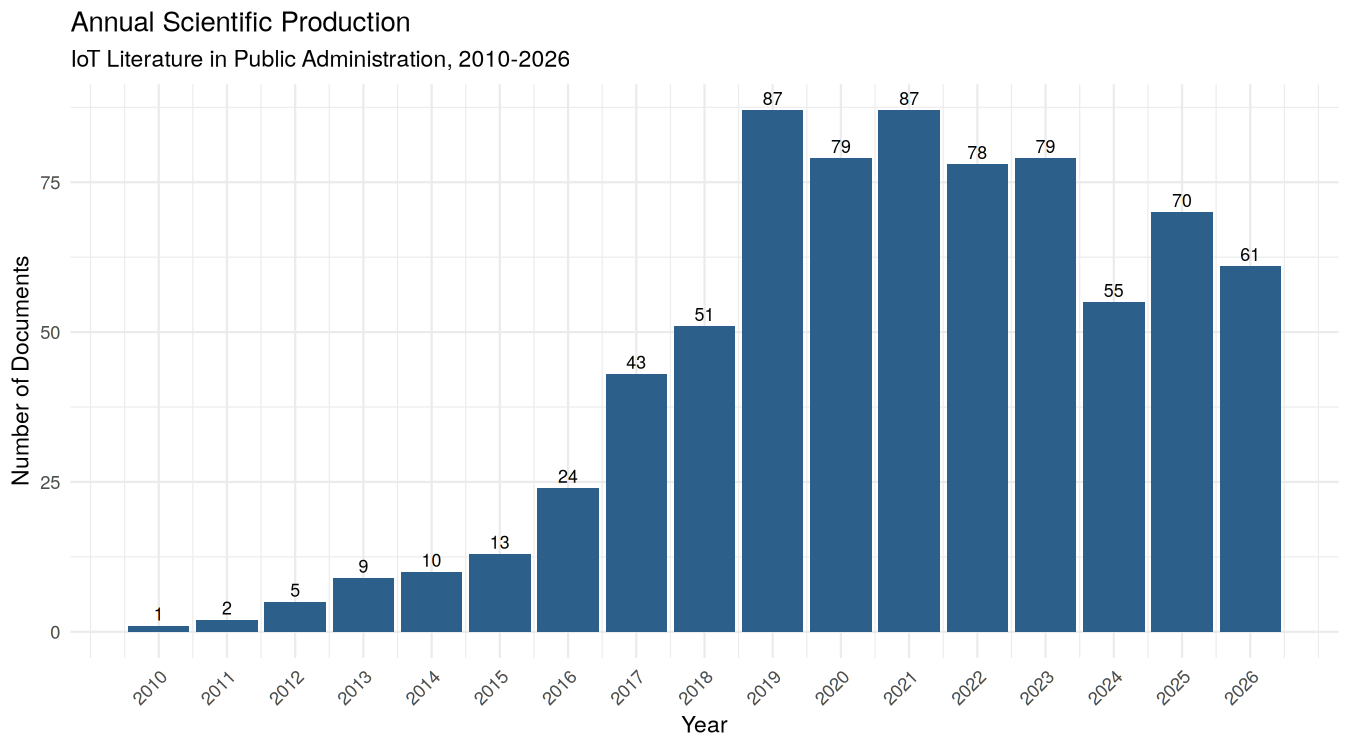
As shown in Figure 1, the annual publication output demonstrates a general upward trend throughout the study period. Beginning in 2010, the number of publications increased progressively and reached its highest levels in 2019 and 2021, with 87 publications recorded in each of these years. Following these two peaks, the annual publication output declined to 55 documents in 2024 before increasing again to 70 publications in 2025 and 61 publications in 2026. It should be noted that the reported figure for 2026 is provisional because the WoS search was conducted on September 2, 2026, and therefore does not represent the complete publication output for that calendar year.
Table 1 presents the principal descriptive characteristics of the dataset, including its timespan, number of sources and documents, annual growth rate, citation indicators, authorship characteristics, and level of international collaboration.
| Description | Result |
|---|---|
| Timespan | 2010:2026 |
| Sources (Journals, Books, etc.) | 567 |
| Documents | 754 |
| Annual Growth Rate % | 29.3 |
| Document Average Age | 5.01 |
| Average Citations per Document | 17.61 |
| References | 36331 |
| Keywords Plus (ID) | 754 |
| Author’s Keywords (DE) | 2368 |
| Authors | 2529 |
| Author Appearances in Single-authored Docs | 81 |
| Single-authored Documents | 82 |
| Co-Authors per Document | 3.63 |
| International Co-authorship % | 27.45 |
As reported in Table 1, the dataset comprises 754 documents published across 567 sources during the period from 2010 to 2026. An examination of the document types indicates that journal articles constitute the largest category, with 400 records, followed by conference proceedings papers, with 258 records. Together, these two document types account for a substantial majority of all the publications included in the dataset and demonstrate the importance of both journals and conference proceedings in the dissemination of research in this field.
A further examination of the document types reveals that ten records are classified in the Web of Science database as “Article; Retracted Publication,” while one additional record is identified as an “Expression of Concern.” These records warrant particular attention when interpreting the citation patterns and research impact represented in the dataset. Their presence is also consistent with the broader increase in retractions reported in recent years across research areas associated with artificial intelligence and the Internet of Things. Accordingly, researchers using the dataset obtained for subsequent investigations may consider examining these eleven records separately, particularly when conducting citation-based, impact-based, and longitudinal analyses. Such separate examination would help prevent retracted or questioned publications from disproportionately influencing interpretations of the intellectual development and citation structure of the field.
B. Findings on Authors, Sources, and Countries
Table 2 presents the most productive authors based on their respective numbers of publications, whereas Table 3 identifies the authors whose publications received the highest total numbers of citations within the dataset obtained.
| Author | Documents |
|---|---|
| Janssen, M | 5 |
| Bouvry, P | 4 |
| Chohan, SR | 4 |
| Fiandrino, C | 4 |
| Kliazovich, D | 4 |
| Zhang, Y | 4 |
| Alexopoulos, C | 3 |
| Charalabidis, Y | 3 |
| Das, S | 3 |
| González, V | 3 |
As shown in Table 2, Janssen, M is the most productive author in the dataset, with five documents. Several authors follow with four publications, while the remaining authors included in the table contributed three documents each. This relatively narrow difference among the most productive authors suggests that publication activity is distributed across multiple contributors rather than being dominated by a single highly productive scholar.
| Author | Documents | Total Citations |
|---|---|---|
| Tsiftsis, TA | 2 | 421 |
| Kshetri, N | 1 | 405 |
| Biswas, K | 1 | 312 |
| Muthukkumarasamy, V | 1 | 312 |
| Dang, LM | 1 | 270 |
| Ding, GR | 1 | 270 |
| Han, D | 1 | 270 |
| Lin, Y | 1 | 270 |
| Min, K | 1 | 270 |
| Moon, H | 1 | 270 |
The citation analysis presented in Table 3 indicates that no single author clearly dominates the field in terms of citation impact. Tsiftsis, T. A. ranks first, with 421 citations across two publications, followed closely by several authors whose citation impact is largely attributable to a single highly cited publication. This distribution suggests that citation influence within the field remains concentrated among a relatively small number of highly cited individual publications rather than being consistently associated with authors who have produced a sustained body of research over time. Consequently, the high citation counts reported for these authors may reflect the exceptional influence of specific publications rather than the cumulative scholarly impact of their wider research output.
The distribution of author productivity in the dataset was further examined in relation to Lotka’s Law, as illustrated in Figure 2.
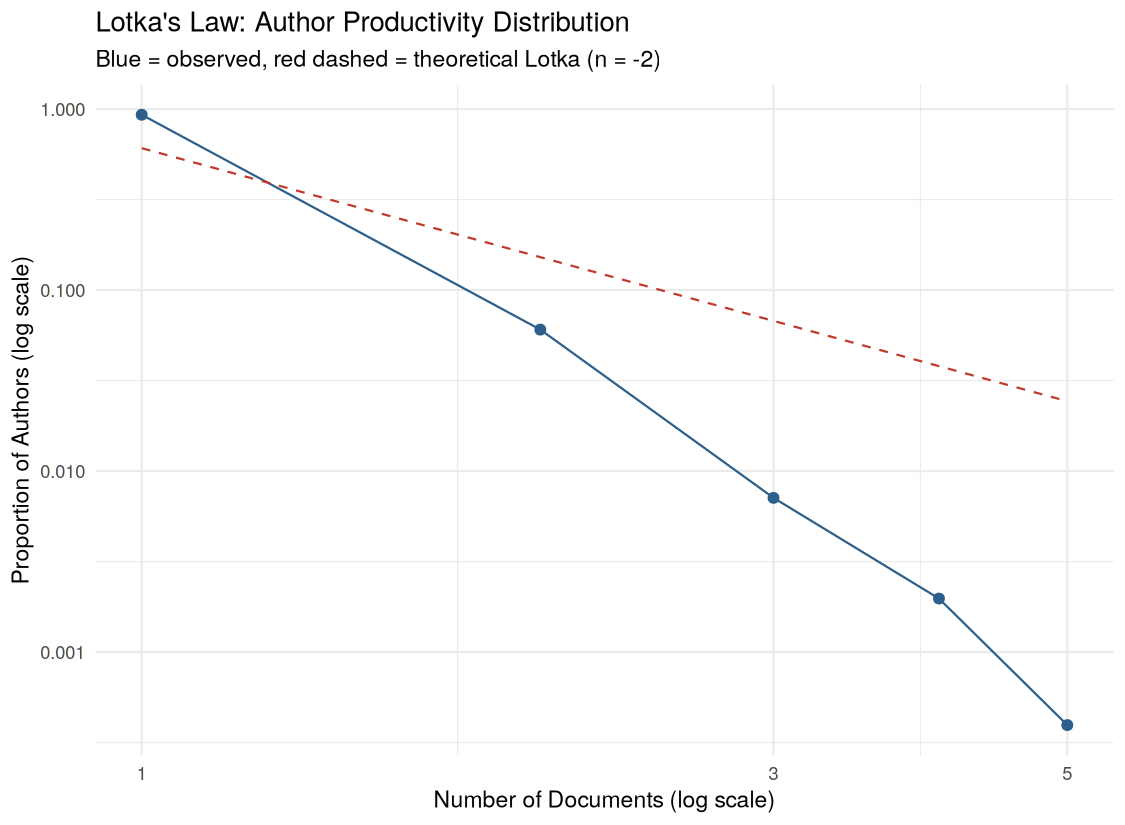
As shown in Figure 2, the results indicate a substantially greater concentration of single-document authors than would be expected under the classical Lotka distribution. Of the 2,530 distinct authors identified in the dataset obtained, 93.0% contributed exactly one publication to the literature, whereas the theoretical Lotka distribution with an exponent of 2 predicts a corresponding proportion of 60.8%.
This finding indicates a highly asymmetric distribution of author productivity, characterized by a large proportion of authors with limited publication activity and a relatively small core of more productive contributors. Such a pattern may suggest that the research field continues to attract a considerable number of new or occasional contributors, while sustained research activity remains concentrated among a comparatively small group of authors. The observed distribution therefore points to a field that is still developing its core scholarly community rather than one already dominated by a well-established, highly productive, and stable group of specialists.
Table 4 lists the ten most-cited documents in the dataset, together with their first authors, publication years, and total citation counts.
| First Author | Title | Year | Citations |
|---|---|---|---|
| Kshetrid [43] | Blockchain’s roles in strengthening cybersecurity and protecting privacy | 2017 | 405 |
| Biswas and Muthukkumarasamy [44] | Securing Smart Cities Using Blockchain Technology | 2016 | 312 |
| Ding et al. [45] | An Amateur Drone Surveillance System Based on the Cognitive Internet of Things | 2018 | 270 |
| Dang et al. [46] | A Survey on Internet of Things and Cloud Computing for Healthcare | 2019 | 270 |
| Or-Meir et al. [47] | Dynamic Malware Analysis in the Modern Era-A State of the Art Survey | 2019 | 248 |
| Kim et al. [48] | A study on the adoption of IoT smart home service: using Value-based Adoption Model | 2017 | 218 |
| Kankanhalli et al. [49] | IoT and AI for Smart Government: A Research Agenda | 2019 | 190 |
| Sánchez-Corcuera et al. [50] | Smart cities survey: Technologies, application domains and challenges for the cities of the future | 2019 | 181 |
| Li et al. [51] | A Comprehensive Survey on Machine Learning-Based Big Data Analytics for IoT-Enabled Smart Healthcare System | 2021 | 178 |
| Ghosh et al. [52] | Patterns and trends in Internet of Things (IoT) research: future applications in the construction industry | 2021 | 176 |
As indicated in Table 4, the most-cited document is the publication authored by Kshetri, N, which received 405 citations. It is followed by the publication authored by Biswas, K, with 312 citations, and two publications authored by Ding, G. R. and Dang, L. M., each of which received 270 citations. The titles represented in the table also demonstrate that highly cited research extends across cybersecurity, blockchain technology, smart cities, drone surveillance, healthcare, smart government, and other IoT-enabled application areas.
Table 5 presents the most productive publication sources according to the number of documents represented in the dataset.
| Source | Documents |
|---|---|
| IEEE Access | 22 |
| Sustainability | 22 |
| Sensors | 14 |
| Government Information Quarterly | 8 |
| Smart Cities | 8 |
| IEEE Internet of Things Journal | 7 |
| Journal of Science and Technology Policy Management | 6 |
| CMC-Computers Materials & Continua | 5 |
| Heliyon | 5 |
| Microprocessors and Microsystems | 5 |
As reported in Table 5, IEEE Access and Sustainability are the most productive sources, with 22 documents each, followed by Sensors, with 14 documents. Government Information Quarterly and Smart Cities each contributed eight documents, while the remaining sources included in the table published between five and seven documents. These findings indicate that the literature is distributed across technological, interdisciplinary, governmental, and urban-studies publication outlets.
The concentration of these publication sources was additionally evaluated by applying Bradford’s Law, and the resulting distribution is presented in Figure 3.
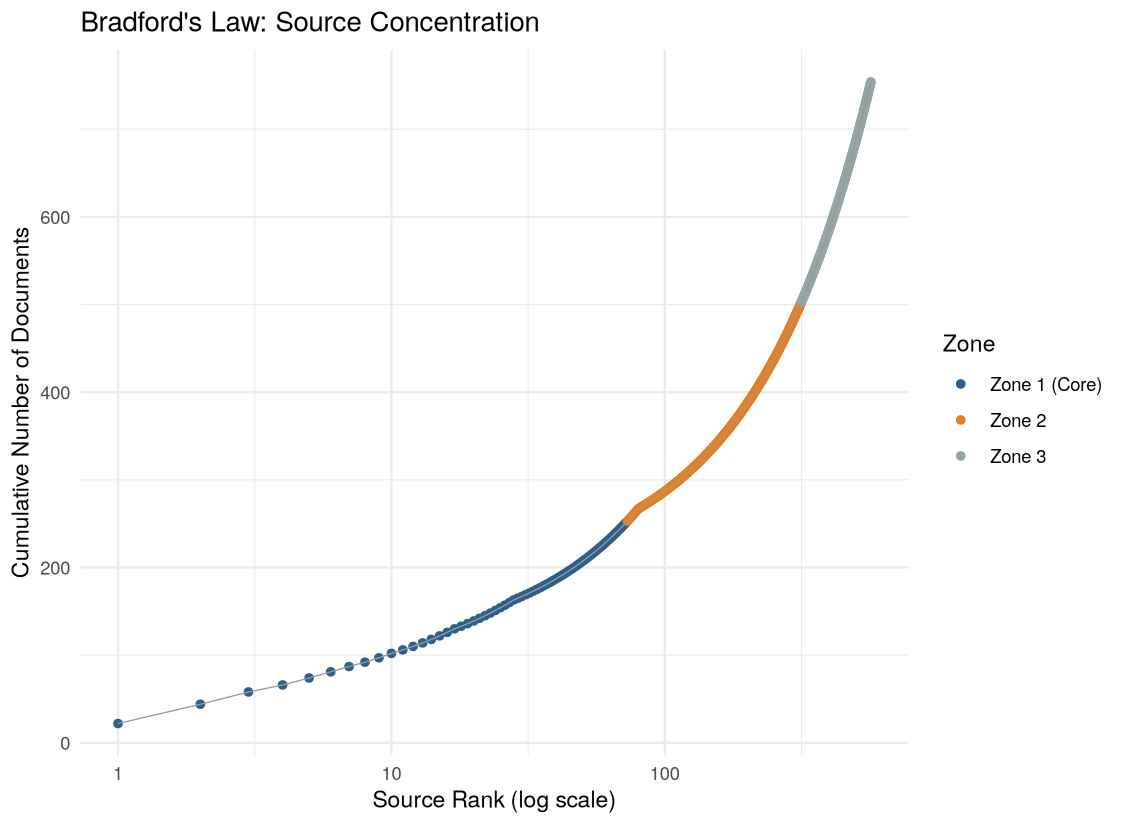
As illustrated in Figure 3, applying Bradford’s Law to the 567 sources represented in the dataset reveals a moderately concentrated yet broadly dispersed publication structure. The core zone comprises 72 sources, led by IEEE Access and Sustainability, with 22 documents each, followed by Sensors, with 14 documents. Collectively, these 72 core sources account for approximately one-third of the total publication output, comprising 251 of the 754 documents. The second zone consists of 243 sources and accounts for the subsequent third of the publications, while the remaining 252 sources constitute the third zone and contribute the final third. Sources within the latter zone contribute, on average, approximately one document each.
The resulting Bradford multiplier, calculated as the ratio of the number of sources required to account for successive thirds of the publication output, is approximately 3.4 between the first and second zones. This finding indicates a moderately concentrated source structure while simultaneously demonstrating considerable dispersion across publication outlets. The observed distribution suggests that research concerning IoT applications in public administration is not confined to a small group of specialized journals. Instead, it is disseminated across a relatively broad and diverse range of scholarly publication sources.
The geographical distribution of publication productivity is presented in Table 6, while the corresponding ranking based on total citation impact is provided in Table 7.
| Country | Documents |
|---|---|
| China | 143 |
| USA | 83 |
| India | 69 |
| United Kingdom | 46 |
| Italy | 39 |
| Saudi Arabia | 36 |
| Australia | 35 |
| Spain | 34 |
| Pakistan | 28 |
| South Korea | 27 |
At the country level, Table 6 shows that China emerges as the most productive country, with 143 publications, followed by the United States with 83 publications, India with 69 publications, and the United Kingdom with 46 publications. Italy, Saudi Arabia, Australia, Spain, Pakistan, and South Korea also make notable contributions to the publication output represented in the dataset.
| Country | Documents | Total Citations |
|---|---|---|
| USA | 83 | 2828 |
| China | 143 | 2640 |
| United Kingdom | 46 | 1673 |
| Australia | 35 | 1247 |
| India | 69 | 1087 |
| Canada | 23 | 986 |
| Spain | 34 | 955 |
| South Korea | 27 | 838 |
| Italy | 39 | 828 |
| Pakistan | 28 | 745 |
As shown in Table 7, the United States ranks first in terms of total citation impact, with 2,828 citations, followed by China with 2,640 citations and the United Kingdom with 1,673 citations. Australia and India also demonstrate substantial citation impact, with 1,247 and 1,087 citations, respectively. Thus, although China has the highest publication output, the United States demonstrates the highest overall citation impact within the analyzed dataset.
The difference between publication productivity and citation impact indicates that a higher volume of publications does not necessarily correspond to a proportionally higher level of citation influence. This pattern is consistent with the findings observed at the author level and highlights the importance of considering both productivity indicators and citation-based indicators when assessing the contributions of individual countries to the development of the research field. The strong publication and citation performance of China and the United States further suggests that these countries have become major contributors to the international research landscape concerning IoT applications in public administration.
Finally, Table 8 presents the academic and research institutions contributing the largest numbers of documents to the dataset.
| Institution | Documents |
|---|---|
| Delft Univ Technol | 9 |
| Univ Aegean | 7 |
| Univ Johannesburg | 7 |
| Jazan Univ | 6 |
| Univ Cantabria | 6 |
| Brunel Univ London | 5 |
| Southeast Univ | 5 |
| Thapar Inst Engn & Technol | 5 |
| Univ Luxembourg | 5 |
| Univ Minho | 5 |
As reported in Table 8, Delft University of Technology is the most productive institution, with nine documents. The University of the Aegean and the University of Johannesburg follow with seven documents each, while Jazan University and the University of Cantabria contributed six documents each. The remaining institutions listed in the table contributed five documents each. The relatively limited differences among these institutions indicate that institutional productivity is broadly distributed and is not concentrated within a single university or research organization.
C. Findings on the Conceptual Structure of the Field
Chart 4 and Table 9 present complementary findings concerning the most frequently occurring author keywords in the dataset. Chart 4 shows the fifteen most frequent author keywords across the complete dataset, whereas Table 9 compares the leading author keywords recorded during the earliest and most recent periods of the analysis.
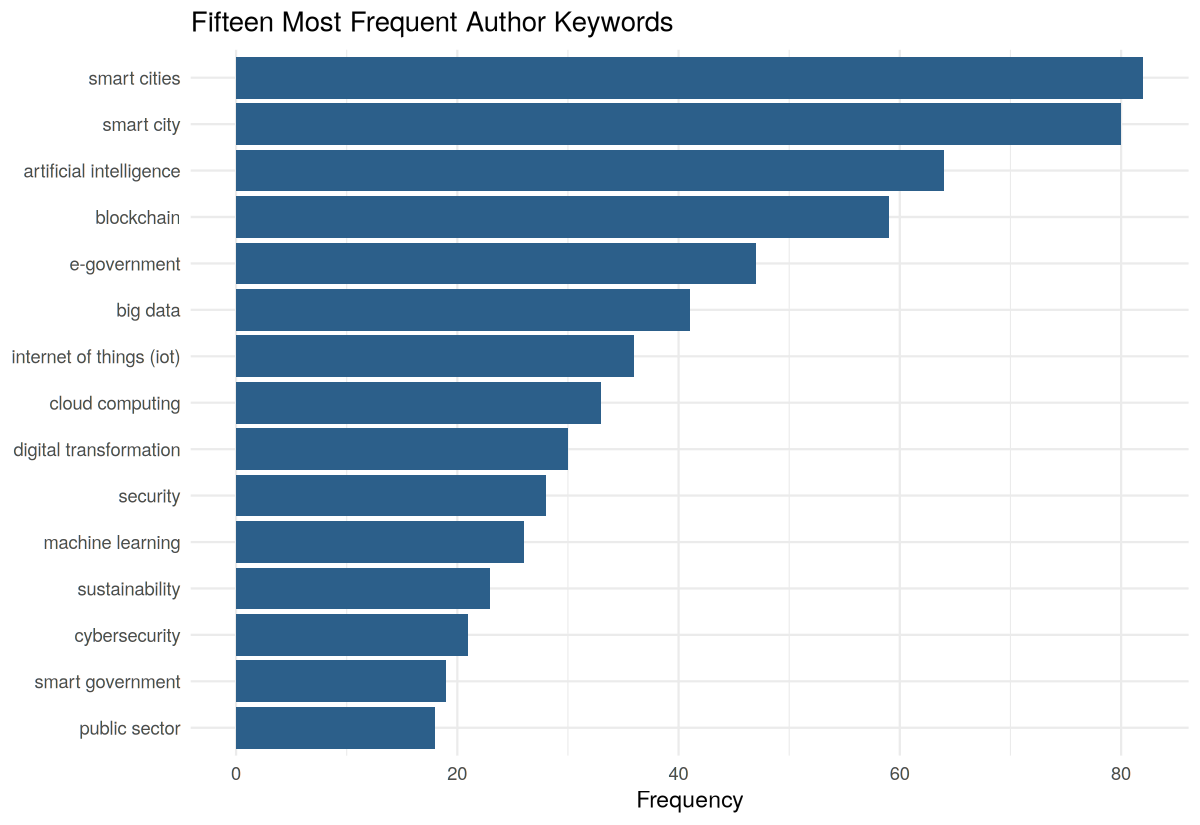
As illustrated in Chart 4, “smart city” and “smart cities” collectively constitute the most frequently used author keywords in the dataset, even though terms containing “smart” were deliberately excluded from the search query. This finding suggests that the smart-city perspective has emerged as a prominent conceptual framework through which researchers characterize and discuss IoT applications in public administration, rather than appearing as a direct consequence of the search strategy. “Artificial intelligence” and “blockchain” are the next most frequently occurring keywords, followed by fundamental public administration concepts such as “e-government.” The frequency distribution therefore reflects a combination of technological concepts and public administration perspectives within the intellectual development of the field.
| 2010–2019 | 2023–2026 |
|---|---|
| smart city (36) | artificial intelligence (39) |
| smart cities (27) | blockchain (33) |
| e-government (18) | smart cities (25) |
| big data (16) | smart city (23) |
| internet of things (IoT) (14) | digital transformation (20) |
| cloud computing (12) | internet of things (IoT) (15) |
| security (12) | e-government (12) |
| privacy (8) | sustainability (12) |
A comparison of the earliest and most recent periods in Table 9 reveals a notable thematic evolution within the research field. During the 2010–2019 period, smart-city- and e-government-related concepts were particularly prominent, alongside themes such as big data, cloud computing, security, and privacy. In contrast, during the 2023–2026 period, “artificial intelligence” and “blockchain” occupy more prominent positions in the keyword ranking, while smart-city-related terms continue to maintain a strong and visible presence. “Digital transformation” also emerges as a prominent theme during the most recent period, whereas the relative prominence of “e-government” decreases despite its continued presence in the literature.
Overall, the keyword patterns presented in Chart 4 and Table 9 indicate a gradual transformation in the conceptual orientation of the field. Earlier research appears to have focused primarily on foundational concerns involving digital government and technological infrastructure, whereas more recent studies have increasingly examined the integration of IoT with emerging technologies, particularly artificial intelligence and blockchain. At the same time, the persistent prominence of smart-city-related terminology across both periods indicates that the smart-city framework remains a central and enduring context for understanding and applying IoT technologies within public administration.
A more detailed temporal analysis of author keywords was conducted by examining the median year of keyword occurrence rather than relying exclusively on a division of the literature into two broad periods. The results indicate that “public policy” and “e-government” are among the earliest temporally centered keywords, with median years of occurrence of approximately 2019 and 2020, respectively. In contrast, “digital transformation” and “digital government” are positioned toward the more recent end of the temporal distribution, with median years of occurrence in 2024 and later.
The analysis also identifies “COVID-19” as a distinctive and temporally concentrated keyword, with a median year of occurrence of 2022. Its relatively narrow temporal concentration suggests that the pandemic constituted a specific and time-bounded thematic episode within the broader evolution of IoT-related research in public administration. By comparison, “artificial intelligence” and “blockchain” combine relatively high frequencies with comparatively recent temporal positions, with both terms having a median year of occurrence of 2023. Their simultaneous prominence in terms of both frequency and recency further supports their emergence as important and rapidly developing themes within this research field.
Overall, the temporal distribution of the keywords suggests a gradual shift from traditional public administration and digital-government concerns toward emerging technological and transformational themes. At the same time, the continued presence of established concepts alongside newer technologies indicates that the thematic development of the field has been evolutionary rather than being characterized by the complete replacement of earlier research priorities. In this respect, newer technological themes appear to have expanded the field’s conceptual structure while continuing to interact with its established public administration foundations.
A keyword co-occurrence network was constructed using the 40 most frequently occurring author keywords in the dataset. The network was clustered using the Walktrap community-detection algorithm, resulting in five distinct thematic clusters. The largest cluster, comprising 17 keywords, is primarily centered on “smart cities,” “artificial intelligence,” “blockchain,” and “big data.” This cluster reflects the strong association among IoT applications, smart-city development, data-intensive practices, and emerging digital technologies within the literature.
The second cluster, consisting of seven keywords, brings together “e-government,” “digital transformation,” and “public administration,” representing the fundamental public administration and digital-government dimensions of the research field. A third, smaller cluster is primarily associated with “cloud computing” and “Industry 4.0,” highlighting the technological and infrastructural dimensions of IoT research. The fourth cluster groups “security,” “privacy,” and “public policy,” indicating a thematic intersection among technological risks, data protection, regulatory concerns, and policy-related considerations. The fifth cluster represents a comparatively smaller thematic grouping within the wider keyword network.
Overall, the co-occurrence structure indicates that research on IoT applications in public administration is organized around several interconnected technological, administrative, governance-related, and policy-oriented themes. The prominence of smart cities, artificial intelligence, blockchain, and big data in the largest cluster further reinforces the increasing integration of IoT with emerging digital technologies. Meanwhile, the presence of e-government, digital transformation, and public administration in a separate cluster highlights the continuing relevance of public-sector and governance perspectives within the broader research field.
It should be emphasized that this clustering constitutes a network-based approximation of the thematic structure of the literature. The analysis does not reproduce the complete centrality–density strategic diagram or the full range of thematic-mapping procedures available in the bibliometrix package. Accordingly, the identified clusters should be interpreted as empirically derived communities within the keyword co-occurrence network rather than as fixed or definitive thematic categories of the entire field. Nevertheless, the network provides a useful representation of the principal relationships among the most frequently used author keywords.
D. Findings on the Collaborative Structure of the Field
Figure 5 presents the international collaboration network among the most frequent country pairs, including country pairs associated with three or more co-authored documents. Table 10 complements the network visualization by reporting the ten strongest international collaboration pairs and their corresponding numbers of co-authored documents.
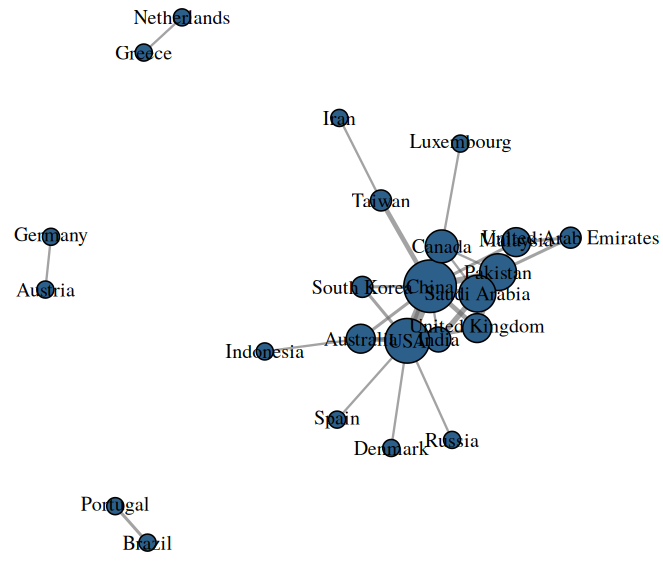
As shown in Figure 5, the international collaboration structure consists of several interconnected national research communities. The network demonstrates that some countries occupy comparatively central positions because they collaborate with multiple international partners, whereas other countries participate through a more limited number of bilateral research relationships.
| Country 1 | Country 2 | Co-authored Documents |
|---|---|---|
| China | USA | 15 |
| China | Pakistan | 8 |
| Pakistan | Saudi Arabia | 8 |
| India | Saudi Arabia | 7 |
| Australia | USA | 6 |
| China | Taiwan | 6 |
| China | United Kingdom | 6 |
| Canada | China | 5 |
| Canada | USA | 5 |
| Pakistan | United Kingdom | 5 |
As reported in Table 10, the strongest collaboration relationship is observed between China and the United States, with 15 co-authored documents. This relationship is followed by the collaborations between China and Pakistan and between Pakistan and Saudi Arabia, with eight co-authored documents recorded for each pair. India and Saudi Arabia also demonstrate a notable collaboration relationship, with seven co-authored documents. Australia and the United States, China and Taiwan, and China and the United Kingdom each produced six co-authored documents. The remaining country pairs presented in Table 10 produced five co-authored documents each.
International co-authorship accounts for 27.45% of all documents in the dataset, indicating a substantial degree of cross-border collaboration within the research field. The collaboration network in Figure 5 further demonstrates that international research activity is concentrated among a relatively limited number of country pairs, with China occupying a particularly central position through its collaboration with several countries. Overall, the findings presented in Figure 5 and Table 10 highlight the increasingly international and interconnected nature of research on IoT applications in public administration, while also indicating that the intensity and geographical distribution of collaboration vary considerably across countries.
E. Extended Findings on the Intellectual Structure of the Field
The three analyses presented below extend the conceptual and social structure findings discussed above by examining the thematic organization of the field, the intellectual relationships among cited references, and the direct citation relationships within the selected literature. These analyses include a strategic thematic assessment of the keyword clusters, a reference co-citation network, and a within-corpus direct-citation network presented as a historiograph. All three analyses were implemented in R using the igraph package and were specifically developed for the present study. Accordingly, the resulting findings should be regarded as methodological approximations of the corresponding analytical outputs available through the bibliometrix package rather than as exact replications of those procedures.
Figure 6 presents the keyword co-occurrence network and the thematic clusters used to assess the conceptual organization of the research field.
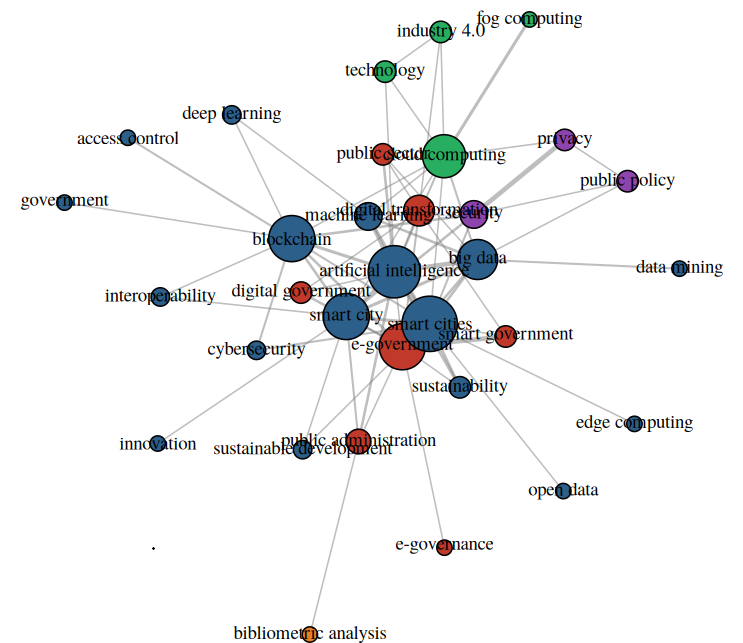
The positioning of the four multi-keyword clusters identified in Figure 6, according to their centrality, represented by external network links on the x-axis, and their density, representing internal cohesion on the y-axis, provides further insight into the thematic structure of the field. The “smart cities” cluster emerges as the most prominent motor theme, demonstrating both a high degree of centrality within the broader network and a high level of internal cohesion. This positioning indicates that smart cities constitute a well-developed thematic area that is also strongly connected to other research themes within the field.
The “e-government” cluster is positioned close to the median level of centrality and exhibits comparatively lower density. This pattern suggests that e-government functions primarily as a transversal or connecting theme, linking different areas of research rather than forming a highly self-contained thematic domain. In contrast, the “security” and “cloud computing” clusters occupy the lower-centrality region, indicating that these themes are comparatively specialized and have fewer connections with the broader thematic structure of the literature.
Because only four clusters met the minimum requirement of containing at least two keywords, the strategic interpretation of Figure 6 should be treated as an indicative representation of the thematic structure rather than as an exhaustive mapping of the entire research field. Nevertheless, the findings provide useful evidence concerning the relative maturity, internal cohesion, and interconnectedness of the principal thematic areas identified within the keyword network.
Table 11 presents the references most frequently cited by documents within the analyzed corpus and reports the number of within-corpus citations received by each reference.
| Reference | Times Cited Within Corpus |
|---|---|
| Zanella et al. [28] | 43 |
| Gubbi et al. [22] | 38 |
| Atzori et al. [9] | 37 |
| Albino et al. [53] | 26 |
| Caragliu et al. [54] | 24 |
| Jin et al. [55] | 24 |
| Chatfield and Reddick [56] | 23 |
| Kankanhalli et al. [49] | 22 |
| Silva et al. [57] | 18 |
| Chourabi et al. [58] | 18 |
| Meijer [59] | 18 |
| Venkatesh et al. [60] | 18 |
As shown in Table 11, the most frequently cited reference within the corpus is Zanella et al. [28], with 43 within-corpus citations, followed by Gubbi et al. [22], with 38 citations, and Atzori et al. [9], with 37 citations. The remaining references received between 18 and 26 citations within the corpus. This distribution demonstrates the continuing influence of foundational IoT studies, while also revealing the importance of research concerning smart cities, digital governance, technology adoption, and public-sector innovation.
The co-citation network resolves into three distinct and relatively well-separated clusters, indicating that the literature draws upon three principal intellectual traditions. The first cluster comprises foundational studies addressing the engineering and technological development of the Internet of Things, including Zanella et al. [28], Gubbi et al. [22], Atzori et al. [9], and Miorandi et al. [20], all of which rank among the most frequently cited references in the dataset. This cluster represents the principal technological foundations upon which subsequent research concerning IoT applications has developed.
The second cluster encompasses literature on smart cities and urban governance, including Caragliu et al. [54], Albino et al. [53], Chourabi et al. [58], Nam and Pardo [61], Hollands [62], and Meijer A [59]. The presence of these works highlights the importance of urban development, smart-city governance, and digitally enabled public services in shaping the intellectual foundations of IoT research within public administration. This cluster therefore links the technological potential of IoT with broader questions concerning urban management, governance, service provision, and institutional transformation.
The third and comparatively smaller cluster consists primarily of studies addressing technology adoption and e-government, including Venkatesh et al. [60], Wirtz [63], Kankanhalli et al. [49], and El-Haddadeh [64]. These works contribute theoretical and empirical perspectives concerning technology acceptance, digital-government development, public-sector innovation, and the organizational adoption of emerging technologies.
Taken together, the three clusters and the citation frequencies presented in Table 11 indicate that research concerning IoT applications in public administration is situated at the intersection of several established scholarly traditions, particularly engineering and technology studies, smart-city and urban-governance research, and information-systems and e-government scholarship. Rather than constituting a fully independent citation tradition, the field appears to draw substantially upon these interconnected intellectual foundations. This interdisciplinary dependence reflects the technological and administrative complexity of applying IoT systems within public-sector environments.
Figure 7 presents the historiograph generated from the direct citation relationships identified among the documents included within the analyzed corpus.
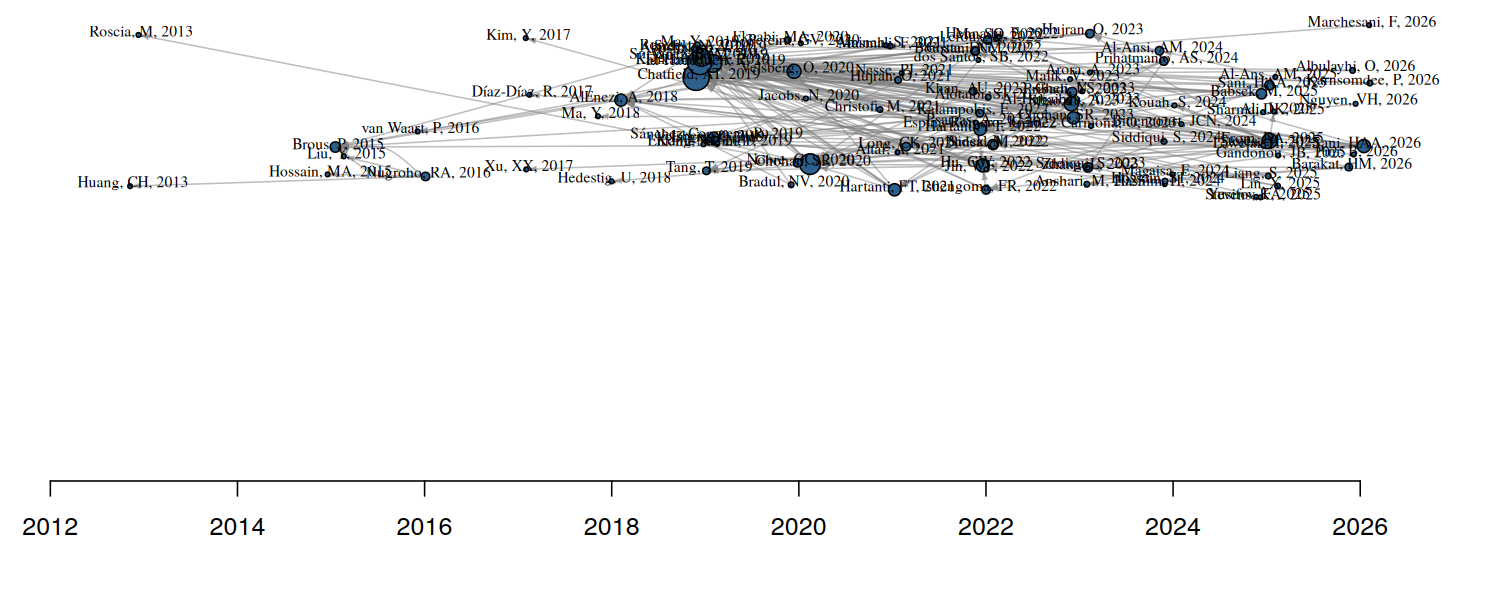
A direct citation analysis was conducted by matching the DOIs of cited references with the DOIs of the 754 documents contained in the dataset. This procedure identified 272 direct citation links involving 200 documents, indicating the existence of a moderately interconnected and self-referencing body of literature. At the same time, the fact that a substantial proportion of the documents are not connected through direct citation relationships suggests that the field remains relatively heterogeneous and continues to draw upon diverse and partially separate research traditions.
As illustrated in Figure 7, the chronological historiograph positions citing publications to the right of the publications that they reference, thereby showing the temporal development of direct citation relationships within the corpus. The documents receiving the highest numbers of citations from other publications within the corpus are Chatfield and Reddick [56], with 23 direct citations, followed by Kankanhalli et al. [49], with 22 citations, and El-Haddadeh [64] and Wirtz [63], with 15 citations each.
These highly connected publications primarily address e-government, digital governance, and IoT-related frameworks and appear to have provided important conceptual and theoretical foundations for subsequent research within the field. Their comparatively high levels of within-corpus citation suggest that these studies have played a significant role in connecting earlier technological perspectives with emerging research concerning public administration and digital government. Accordingly, Figure 7 demonstrates both the chronological development of the field and the central positions occupied by several influential publications within its internal citation structure.
IV. Discussion
Viewed through the lens of public administration and administrative science, rather than interpreted merely as a purely technical mapping exercise, the findings of this study indicate that research on IoT applications in public administration remains in the process of consolidating its disciplinary identity. The results reveal four closely interrelated patterns that provide important insights into the current intellectual, conceptual, collaborative, and thematic development of the field.
A. From E-Government Infrastructure to Algorithmic Governance
The thematic shift identified in Table 9 and Figure 8, from a vocabulary centered on e-government and big data during the 2019–2021 period toward artificial intelligence and blockchain during the more recent period, reflects a broader reorientation that is also evident within the public administration literature. Recent scholarship has increasingly moved beyond questions concerning whether public organizations adopt digital infrastructures and has begun examining how algorithmic systems influence administrative discretion, accountability, transparency, institutional legitimacy, and the exercise of public authority [65], [66]. This shift reflects a broader transformation in the conceptualization of digital technologies within public administration, moving from instruments that support administrative modernization toward technologies that can potentially reshape the nature of administrative decision-making itself.
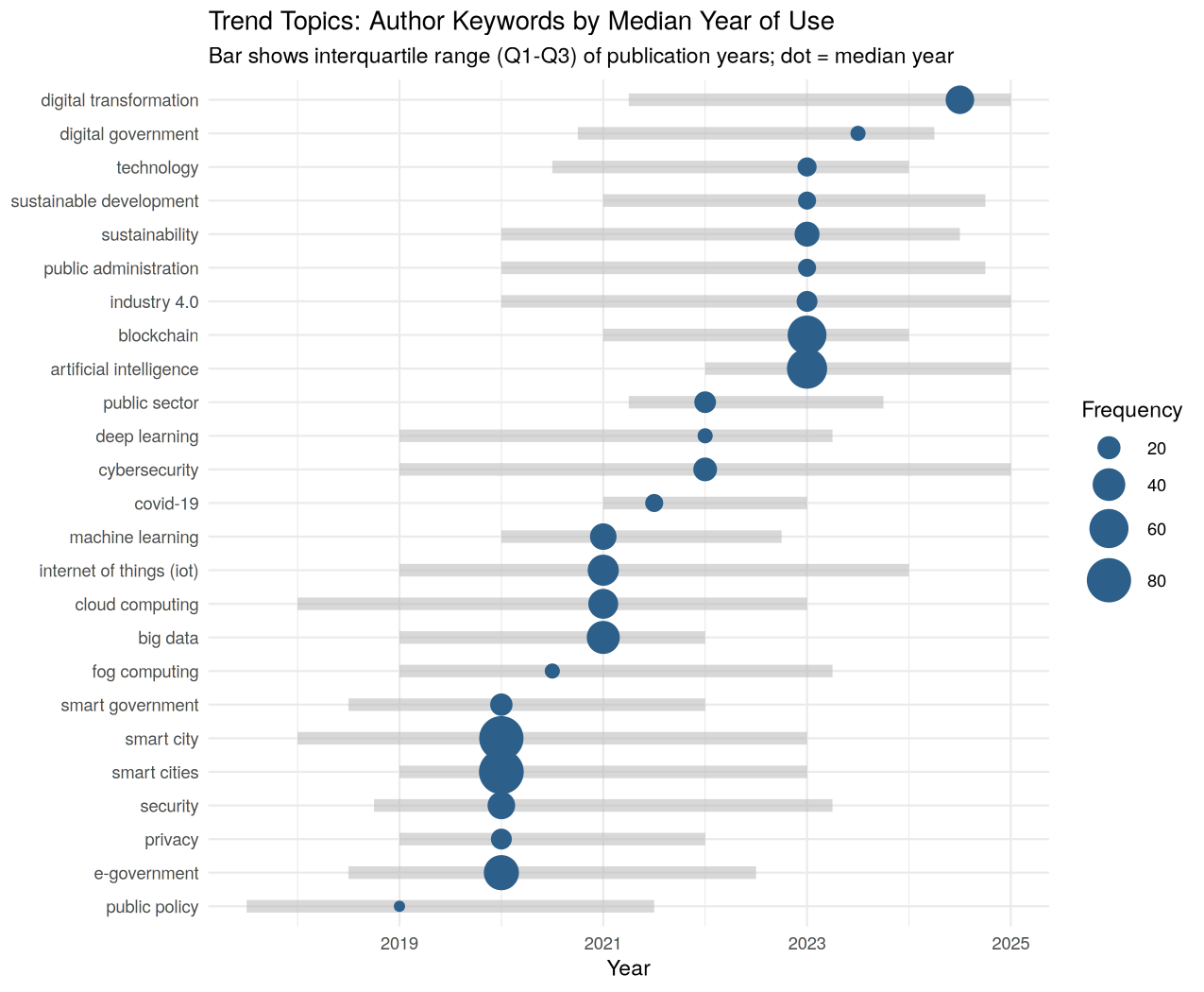
As illustrated in Figure 8, topics associated with artificial intelligence, blockchain, and digital transformation occupy comparatively recent temporal positions, whereas e-government and related public-sector concepts emerged earlier in the literature. Selten and Klievink [67] describe this development as a tension between treating artificial intelligence adoption as a separate and specialized function within public organizations and integrating AI into their core administrative processes. The findings of the present study provide empirical indications of this transition. Although “artificial intelligence” and “blockchain” have become more prominent than “e-government” within the recent keyword structure, the continued presence of e-government indicates that emerging technological concerns are being incorporated into, rather than replacing, the established digital-government agenda. The field therefore appears to be experiencing a process of thematic layering in which concerns related to algorithmic governance are developing alongside established digital-government perspectives.
From a public administration perspective, this development suggests that IoT can no longer be conceptualized solely as a matter of technological infrastructure or public-service delivery. As IoT systems increasingly interact with artificial intelligence, blockchain, big data, and other emerging technologies, their implications extend to fundamental administrative questions concerning decision-making, accountability, data governance, privacy, transparency, institutional responsibility, and public legitimacy. Consequently, IoT research is becoming increasingly connected to the broader debate concerning algorithmic accountability in government and the administrative implications of digitally mediated decision-making. This development also creates a need for public administration researchers to examine not only the operational advantages of these technologies but also their institutional, ethical, organizational, and democratic consequences.
B. Smart-City Framing and the Unresolved Question of Data Sovereignty
The continued prominence of “smart city” and “smart cities” as the two most frequently occurring author keywords, as shown in Chart 4 and Table 9, is particularly noteworthy because these expressions were deliberately excluded from the search query. Their prominence should not be interpreted merely as a neutral technological preference. Rather, it indicates the importance of a particular administrative and institutional model in which the smart city functions as a principal context for IoT deployment. Recent scholarship concerning urban governance has increasingly treated this model as contested rather than institutionally settled or politically neutral.
Comparative research on smart-city governance models distinguishes between state-led and centrally integrated approaches and more citizen-oriented or data-sovereignty-oriented models. One frequently discussed example is the approach associated with Barcelona, where urban data are increasingly conceptualized as a public asset rather than primarily as a corporate resource [68], [69]. These alternative approaches raise fundamental questions concerning who controls urban data, how data-related decisions are legitimized, how citizens participate in these processes, and which mechanisms of public oversight should govern the collection and use of data generated through IoT systems.
The co-citation clustering presented in Figure 9 provides further support for this interpretation. The separation of the smart-city and urban-governance tradition from the IoT engineering literature, together with its distinction from the e-government and technology-adoption tradition, suggests that research on IoT in public administration continues to draw substantially upon established perspectives from urban planning and geography. At the same time, the field appears to have developed comparatively limited theoretical integration concerning the administrative dimensions of smart-city data governance. In particular, questions regarding who has authority over smart-city data, under which institutional arrangements that authority is exercised, and through which mechanisms public accountability is maintained remain insufficiently integrated into the IoT and public administration literature.
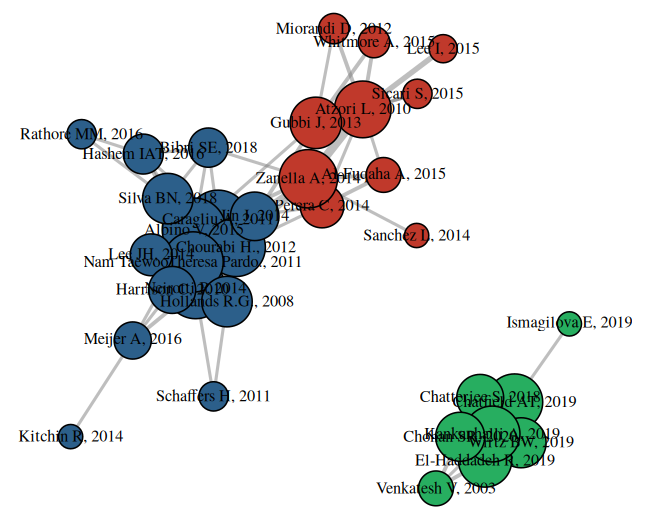
As illustrated in Figure 9, the intellectual structure of the field includes a distinguishable cluster of studies concerned with smart cities and urban governance. This issue is particularly important in light of recent discussions concerning data sovereignty, digital rights, and surveillance within urban governance. From this perspective, the central governance challenge associated with smart-city IoT may not lie exclusively in the technological capabilities of IoT systems. Instead, it increasingly involves unresolved questions concerning data ownership, institutional authority, civic participation, democratic legitimacy, privacy protection, and public oversight. This represents an important area in which public administration scholarship can contribute to the development of a more institutionally grounded and publicly accountable understanding of smart-city technologies.
C. Security and Privacy as a Persistent but Peripheral Cluster
The position of the “security” cluster in the strategic diagram presented in Figure 10 provides another important finding. The cluster is relatively small, is characterized by low centrality, and is only weakly connected to the dominant smart-city and artificial-intelligence themes. This finding is noteworthy because the security of IoT-connected public infrastructure has become an increasingly important policy, institutional, and administrative concern during the period covered by this study.
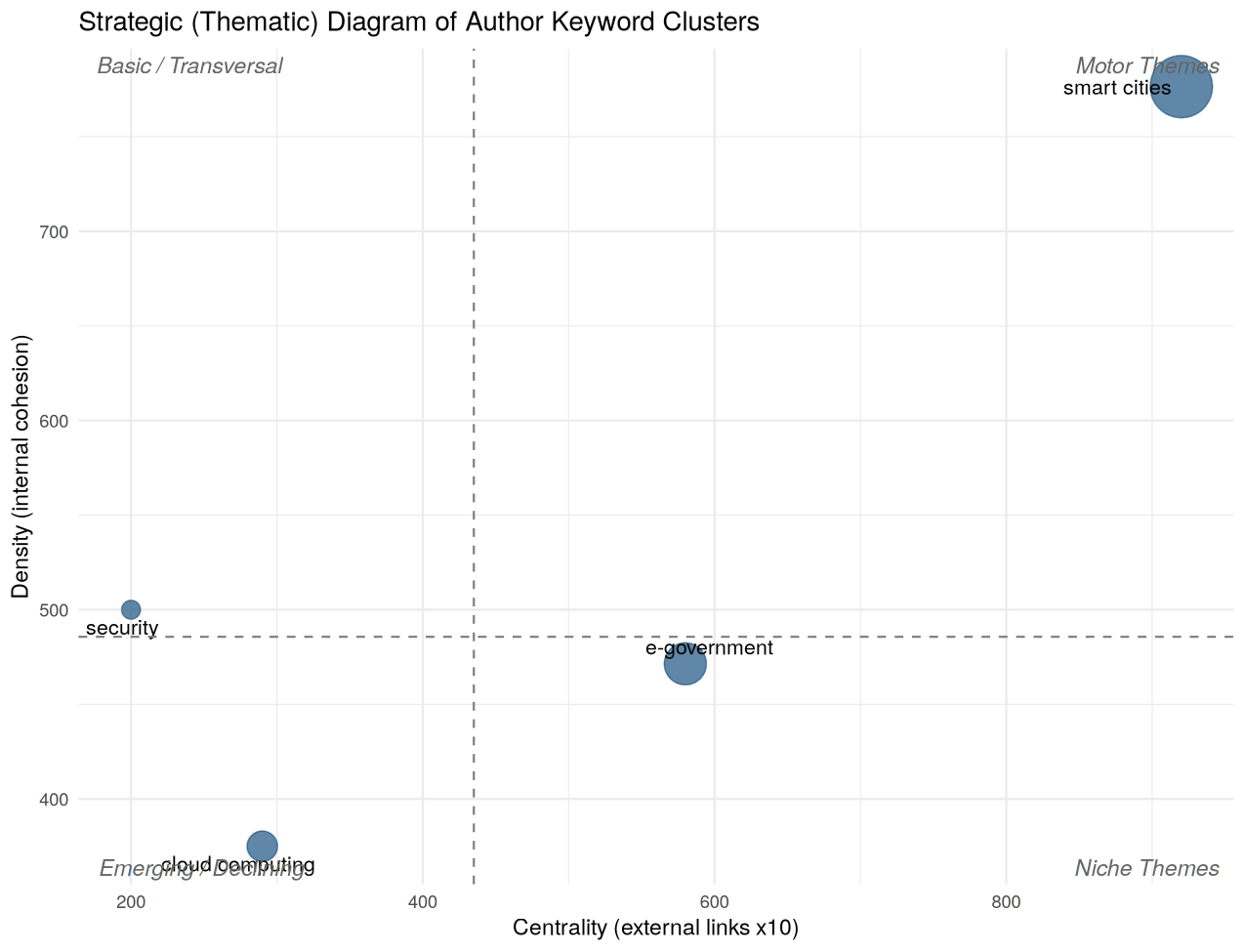
As shown in Figure 10, the relatively peripheral position of the security cluster indicates that security- and privacy-related concerns have not become strongly integrated with the central themes of the field. Governments have increasingly moved from voluntary guidance toward more formal and binding approaches to IoT security. This development reflects growing concerns regarding the security vulnerabilities associated with internet-connected devices, particularly when such technologies are deployed within critical infrastructure, government facilities, and public-service environments. The increasing exposure of public organizations to cyber threats, including ransomware attacks and vulnerabilities associated with connected devices, further underscores the administrative significance of IoT security.
Against this background, the relatively peripheral position of security and privacy within the thematic structure identified in this study suggests a potential discrepancy between the research priorities reflected in the literature and the practical governance challenges associated with IoT deployment. Although cybersecurity and privacy have become increasingly significant concerns for policymakers, administrators, and public-sector practitioners, they do not appear to occupy a correspondingly central position within the thematic structure of IoT research in public administration. This thematic position may indicate that technical and operational discussions have developed more rapidly than research examining the corresponding governance and accountability requirements.
This discrepancy represents a concrete research opportunity for public administration scholars. Questions concerning procurement standards, inter-agency coordination, the allocation of responsibility, regulatory compliance, data protection, risk management, and administrative liability in cases of IoT-related security failures extend beyond narrowly technical cybersecurity considerations. They are fundamentally questions of governance, institutional responsibility, administrative capacity, and public accountability. Greater integration of these dimensions into future IoT research could therefore strengthen the contribution of public administration scholarship to the broader debate concerning secure, trustworthy, and responsible digital public-service delivery.
D. A Field Still Recruiting Rather Than Institutionalizing
The findings concerning Lotka’s Law, Bradford’s Law, and the historiograph, presented in Figures 2, 3, and 7, respectively, collectively indicate that the research field remains relatively fragmented and has not yet consolidated around a stable core of specialized scholars, highly concentrated publication outlets, or a densely interconnected internal citation structure. Specifically, the finding that 93.0% of the field’s 2,530 authors have published only one document, as illustrated in Figure 2, together with the moderately dispersed source structure identified through Bradford’s Law in Figure 3, suggests that research activity continues to involve a broad and diverse population of contributors rather than being dominated by a relatively small group of established specialists or flagship journals.
Similarly, the historiograph presented in Figure 7 identifies a moderately self-referential citation structure, with 272 citation links connecting 200 of the 754 documents. This finding indicates that, although a degree of intellectual continuity exists within the literature, the field has not yet developed a highly dense internal citation network. A substantial proportion of the publications remain outside the principal direct-citation relationships, thereby indicating that the field continues to incorporate studies originating from diverse disciplinary, theoretical, and methodological backgrounds.
This pattern is consistent with Yildiz’s longstanding observation [70] that research related to e-government tends to attract scholars from neighboring disciplinary areas without necessarily developing a strong and coherent internal theoretical tradition. It also corresponds with the more recent argument advanced by Schmeling et al. [71], who call for a more dedicated research agenda addressing data-related governance questions within the broader field of digital-government scholarship. Taken together, these findings suggest that IoT research in public administration remains an interdisciplinary and developing research domain in which contributions from different intellectual traditions have not yet been fully integrated into a coherent theoretical framework.
The co-citation analysis shown in Figure 9 provides further support for this interpretation by demonstrating that the field draws upon three distinct intellectual traditions rather than being structured around a single dominant theoretical foundation. These traditions encompass the engineering and technological foundations of IoT, smart-city and urban-governance research, and technology-adoption and e-government scholarship. The coexistence of these intellectual traditions reflects the interdisciplinary character of IoT research in public administration, but it may also contribute to conceptual fragmentation, terminological variation, and limited theoretical integration.
In this context, the findings of the present study suggest that IoT research in public administration would benefit from an explicit integrative theoretical framework capable of connecting technological developments with administrative, organizational, institutional, ethical, and governance perspectives. Such an approach would be consistent with the type of integrative framework proposed for artificial-intelligence research in public administration by Criado, Sandoval-Almazán, and Gil-Garcia [65]. Developing a comparable framework for IoT could help move the field beyond a loose aggregation of contributions from engineering, urban studies, information systems, and related disciplines toward a more coherent research agenda grounded in the theoretical and empirical concerns of public administration. Such a framework could also clarify the relationships among technological capabilities, organizational adoption, regulatory oversight, administrative values, and public accountability.
V. Conclusion
This study situates the bibliometric landscape of IoT research in public administration approximately one year further into a period of rapid technological and conceptual change. The findings indicate continuity in the overall structure of the field, alongside notable changes in its thematic content. Research on IoT in public administration continues to expand and maintains a relatively stable level of international collaboration, with slightly more than one in four publications involving international co authorship. The smart city also remains the predominant administrative context around which the field is organized. However, the findings suggest a shift in the conceptual center of the research domain. Artificial intelligence and blockchain have emerged as increasingly prominent themes without displacing the e government terminology that characterized much of the field during its first decade. At the same time, security and privacy remain comparatively underdeveloped within the thematic structure of the field. This finding is particularly noteworthy given the increasing policy relevance of IoT related cybersecurity, regulatory developments, and security incidents involving connected technologies.
For public administration and administrative science, the findings of this study suggest three important implications. First, research on IoT in government would benefit from a more explicit theoretical connection between the literature on algorithmic accountability, which has been gaining increasing prominence within public administration, and the smart city and IoT literatures from which much of the existing research draws. Rather than conceptualizing technology as a self evident background condition for administrative processes, future research should examine how IoT technologies interact with administrative institutions, decision making processes, accountability mechanisms, and public values. Such an approach would contribute to positioning IoT research more firmly within the theoretical foundations of public administration.
Second, the relatively persistent yet low centrality of security and privacy within the thematic structure identified in this study represents an important research gap with direct implications for public governance. The governance of IoT enabled public infrastructure involves questions of procurement, legal responsibility, data protection, institutional accountability, and the allocation of risks across governmental agencies and other stakeholders. These issues cannot be addressed solely from a technical perspective, as they also constitute significant administrative, organizational, and legal challenges. Consequently, future research should give greater attention to the institutional and governance dimensions of IoT security and privacy.
Third, the author and citation structures identified in this research suggest that the field has not yet become strongly institutionalized around a stable group of specialized scholars or publication outlets. Rather than indicating that IoT research in public administration has reached a mature and settled stage elsewhere, this pattern may represent an opportunity for public administration scholars and journals to contribute more actively to the theoretical and empirical development of the field. Greater engagement by scholars in administrative science could help establish a stronger disciplinary foundation for IoT research and encourage research agendas that address the institutional, organizational, and governance consequences of emerging technologies.
The present study also has several limitations. First, the analysis relies exclusively on the Web of Science database and therefore does not capture publications indexed in other major bibliographic databases. Second, the findings reflect a single search strategy and may consequently be influenced by the selection of search terms and retrieval criteria. Third, the analytical framework employs a customized R based workflow rather than the complete set of analytical functions available through the bibliometrix and Biblioshiny environments. As discussed previously, the strategic diagram, co-citation network, and historiograph generated in this research should therefore be interpreted as indicative approximations of the corresponding bibliometric analyses rather than as exact reproductions of the algorithms implemented in bibliometrix.
Future research could extend the scope of this study by incorporating bibliographic data from databases such as Scopus and Dimensions, thereby enabling a broader representation of the international literature. Further research could also employ topic modeling and other advanced text mining approaches capable of identifying emerging concepts that have not yet become established within conventional bibliometric terminology, including the rapidly developing role of generative artificial intelligence in government. In addition, longitudinal research could examine whether the security and privacy theme identified in this study gradually moves toward the thematic core of the field as regulatory frameworks for IoT cybersecurity become more comprehensive and stringent. Such research would provide valuable evidence regarding the extent to which technological developments, regulatory pressures, and changing governance priorities reshape the intellectual structure of IoT research in public administration.
Data and Code Availability
The R scripts used for data extraction, processing, statistical analysis, and visualization are available from the corresponding author upon reasonable request and may be made publicly available through an open code repository. The raw bibliographic data were retrieved from the Web of Science Core Collection on September 2, 2026, using the search strategy described in the Methods section. The data can be independently reproduced by rerunning the same search query through an institutional subscription to the Web of Science Core Collection.
Declaration of Generative AI Use
During the preparation of this study, the author used Claude (Anthropic), an artificial intelligence based language model, to assist with the development and refinement of R code. All AI generated outputs were critically reviewed, edited, and, where necessary, rewritten by the author. The author independently verified all statistical analyses and figures against the underlying R output and takes full responsibility for the content, accuracy, interpretation, and conclusions presented in this publication.
Conflict of Interest
The authors declare no conflict of interest.
Funding
No funding.