
Digital environments now constitute an important part of the social settings in which adolescents and young adults learn how to describe themselves, interact with peers, interpret social norms, and negotiate visibility. Gender socialization historically occurred through family, school, community, religious or cultural institutions, and mass media. Contemporary identity development also takes place through social networks, messaging platforms, streaming services, recommendation systems, games, avatars, and online communities. These environments do not merely transmit information; they shape who can be seen, which forms of self-presentation are rewarded, and how social responses are distributed.
The influence of digital technology on gender identity cannot be described adequately as either positive or negative. Systematic and empirical research shows that online spaces can support identity exploration, social connection, self-acceptance, and access to affirming information for LGBTQ+ youth [1] [2] [3]. At the same time, social-media self-presentation occurs in front of multiple and sometimes conflicting audiences. Chen and Mares show that identity exploration, supportive feedback, and context collapse all affect how LGBTQ+ youth present themselves online [4]. Digital participation is therefore best understood as conditional: the same platform can function as a supportive environment for one user and as a risky or restrictive environment for another.
This conditionality becomes especially important when gender identity is considered as a socio-technical rather than purely individual phenomenon. Platform interfaces determine privacy settings and identity categories; recommendation systems influence which content is repeatedly encountered; moderation determines whether harassment is removed or normalized; and commercial profiling systems may infer gender without explicit user consent. Consequently, the digital environment participates in the social organization of recognition, visibility, and misrecognition.
Gaming and avatar-based environments introduce additional possibilities because they allow users to alter appearance, embodiment, naming, and social presentation. Studies of avatar customization indicate that virtual characters can provide opportunities for experimenting with gender expression beyond offline constraints [5] [6] [7] [8] [9] [10]. At the same time, representation within commercial gaming remains limited. GLAAD reports that 17% of active gamers identify as LGBTQ+, whereas less than 2% of available major-console and PC games include LGBTQ+ characters or storylines [11]. This contrast illustrates how user diversity can exceed the representational assumptions built into digital products.
Visual platforms create a different form of gendered pressure. Research on Instagram, TikTok, and related image-centered platforms links appearance-focused use with body-image concerns, comparison, and gendered norms [12] [13] [14]. Digital masculinity research similarly shows how influencers, repeated recommendations, and peer communication can normalize restrictive scripts concerning strength, emotional control, dominance, money, and appearance [15] [16] [17]. These effects are not produced by content alone; they also depend on platform amplification and repeated exposure.
Online hostility represents another layer. Cyberhomophobia, targeted harassment, and cyberbullying can coexist with supportive peer networks in the same digital environment [18] [19] [20]. This duality is especially relevant for gender-diverse adolescents because online spaces may provide access to support that is unavailable locally while also increasing exposure to discrimination.
Algorithmic gender inference extends the issue beyond interpersonal interaction. Automated systems may infer gender from profile, behavioral, linguistic, or visual data and may reproduce binary assumptions or misclassify users [21] [22]. Recent cross-sectional evidence shows that social-media gender-classification systems can produce systematic misclassification and disproportionately affect marginalized users [23]. International policy work similarly emphasizes that inclusion, transparency, and safety should be part of digital-system design rather than treated solely as individual user responsibilities [24] [25] [26].
The present article therefore examines digital technology as an infrastructure within which gender identity is explored, affirmed, constrained, and classified. The goal is to synthesize current evidence across social media, online communities, gaming and avatar environments, visual platforms, algorithmic systems, and digital-safety policy. The central hypothesis is that the influence of digital technologies is predominantly ambivalent and depends not only on individual user strategies but also on platform architecture, moderation, recommendation systems, audience composition, and access to supportive communities.
The first major strand of research concerns the supportive potential of digital environments. Berger et al.’s systematic review finds that social-media use among LGBTQ+ youth can facilitate social connection, identity expression, and access to community while also exposing users to negative interactions [1]. Escobar-Viera et al. similarly show that rural LGBTQ youth use digital technologies to reduce social isolation and obtain forms of connection that may be difficult to access in local physical environments [2]. Suto, Turban, and Belfort describe social media as an increasingly significant context for adolescent sexual and gender identity development [3].
Self-presentation research adds an important qualification. Chen and Mares show that LGBTQ+ self-presentation is related to identity exploration, the heterogeneity of online audiences, and supportive feedback [4]. Context collapse can make the same post visible to family, peers, classmates, and other audiences whose expectations differ. Avenant’s analysis of nonbinary identity likewise emphasizes that social media can participate in the development of new vocabularies and practices of identity rather than merely displaying identities formed elsewhere [5]. Herrmann et al. further report that transgender and gender-diverse adolescents use social media for information and affirmation in ways that differ from cisgender peers [6].
Gaming and avatar customization create conditions for experimenting with embodiment without reproducing every offline constraint. Whitehouse et al. examine how avatars can support gender alignment among transgender and gender-diverse players [7]. Han and Ho report that players use avatar customization to conform to, subvert, symbolize, and explore gender identities [8]. A systematic review by Lolansen et al. similarly identifies recreational gaming as a mechanism for gender exploration and affirmation [9]. Maletska’s review places such practices within a wider literature on queer identity and videogame culture [10].
Industry-level evidence confirms both the relevance and the representational gap. GLAAD reports that 17% of active gamers identify as LGBTQ+, while less than 2% of games on major console and PC storefronts are identified as containing LGBTQ+ characters or storylines [11]. The discrepancy does not establish a direct psychological effect, but it shows that the diversity of players is not matched proportionally by visible representation.
A second cluster of studies concerns visual and behavioral normativity. Maes and Vandenbosch report longitudinal relationships between adolescent girls’ Instagram and TikTok use and body-image-related constructs [12]. Dahlgren et al. find associations among social-media use, eating-disorder pathology, appearance ideals, and perceived pressure in Norwegian adolescents [13]. Aran-Ramspott et al. analyze young social-media users from a gender perspective and show that digital participation is experienced through gendered expectations [14].
Research on boys and masculinity highlights a related mechanism. Roberts and Wescott discuss the role of social-media “manfluencers” in sexist behavior among boys in school settings [15]. Koester and Marcus synthesize evidence concerning social media and adolescent boys’ gender norms, emphasizing that effects depend on repeated exposure, group affiliation, and platform dynamics rather than simple one-directional causality [16]. Common Sense Media’s 2025 report shows that adolescent boys regularly encounter masculinity-related online content and that high exposure can be associated with loneliness and restrictive expectations concerning vulnerability [17].
The supportive potential of digital spaces coexists with meaningful risks. Gámez-Guadix and Incera link online homophobic victimization with poorer mental-health outcomes among queer adolescents [18]. Nagata et al. report elevated cyberbullying victimization among transgender and gender-questioning early adolescents [19]. Fisher, Tao, and Ford describe social media as a “double-edged sword” in which connection and support coexist with exposure to discrimination [20].
This literature has shifted the research question away from asking whether the internet is inherently safe or dangerous. A more useful question is which platform conditions, communities, moderation practices, and user circumstances increase support or risk. Such conditionality becomes central to the interpretation developed in the Results and Discussion sections.
Algorithmic systems increasingly classify users for personalization, advertising, recommendation, or analytics. Fosch-Villaronga et al. show that gender inference from social-media data raises privacy, epistemological, and discrimination concerns [21]. Their related work on gendering algorithms emphasizes that automated systems can reproduce normative assumptions about gender categories [22]. More recent empirical research reports misclassification in social-media gender-classification systems and shows that LGBTIQ+ users are especially vulnerable to such errors [23].
The policy implications extend beyond social networks. The OECD’s digital-education outlook emphasizes the role of digital ecosystems, governance, data, and system design in shaping educational opportunities [24]. UNESCO’s 2024 gender report examines technology in relation to gender equality and education [25], while its 2025 work on reclaiming digital space addresses gender equality in the context of newer technologies [26]. Together, these sources support an institutional approach in which digital inclusion depends on platform and policy decisions as well as user skill.
Three additional studies in the bibliography address digitization, migration, public administration, economic security, education, and human capital [27] [28] [29]. These studies are not part of the 32-source thematic digital-gender corpus coded in this review. They are retained as contextual background showing that digital transformation affects public administration, mobility, human-capital policy, and social inclusion more broadly. Their evidential role is therefore contextual rather than direct: they do not establish effects on gender identity.
The study uses a secondary qualitative evidence-synthesis design. The primary thematic corpus contains 32 sources focused directly on gender identity, sexuality, gender norms, digital communities, gaming, social media, cyberbullying, algorithmic classification, or gender-oriented digital policy. Because the bibliography includes relevant 2026 publications that were available by the time of this revision, the thematic corpus spans 2021–2026 rather than ending in 2025.
The three public-administration and migration publications cited in the preceding contextual subsection are not included in the 32-source thematic coding corpus. This distinction reconciles the 32-source review design with the 35 total bibliography entries.
Sources were eligible for thematic coding when they met at least one of the following conditions: they examined social media, algorithms, gaming or avatar environments, online communities, digital safety, or digital policy in relation to gender or sexuality; they reported empirical findings or systematic-review evidence; or they focused on adolescents, young adults, gender-diverse users, or normative digital practices relevant to identity formation. The corpus includes peer-reviewed articles, systematic reviews, analytical reports, and institutional policy documents.
The unit of analysis was the principal empirical or analytical finding reported in the selected source. Sources were first grouped by digital domain: social media; online communities; gaming and avatar spaces; visual platforms; algorithmic systems; and moderation or digital-safety policy.
A second coding stage identified seven themes: (1) gender-identity exploration and affirmation; (2) community support and belonging; (3) stereotyping and appearance pressure; (4) cyberbullying, hostility, and discrimination; (5) algorithmic misgendering and classification bias; (6) privacy risk, context collapse, and identity disclosure; and (7) inclusive institutional, educational, or policy responses.
The direction of influence was then coded descriptively as predominantly supportive, predominantly risky, or ambivalent. These categories summarize the dominant interpretation of each source and should not be understood as effect-size estimates.
Table 1 summarizes the analytical matrix used to connect digital domains, mechanisms, effects, and representative sources.
| Digital domain | Dominant mechanism | Effect on gender identity | Direction | Representative sources |
|---|---|---|---|---|
| Social media | Curated self-presentation, audience control, feedback | Support identity exploration but increase the risk of context collapse | Ambivalent | Chen & Mares [4]; Avenant [5]; Berger et al. [1] |
| Online communities | Search for communities, linguistic frameworks, and role models | Strengthen belonging, affirmation, and social legitimization | Predominantly supportive | Escobar-Viera et al. [2]; Suto et al. [3]; The Trevor Project [30]; Hopelab & Born This Way Foundation [31] |
| Gaming and avatar environments | Avatar customization and distancing from offline sanctions | Facilitate gender exploration, euphoria, and the testing of alternative embodiment scripts | Predominantly supportive | Whitehouse et al. [7]; Han & Ho [8]; Lolansen et al. [9] |
| Visual platforms | Appearance comparison, visibility metrics, platform pressure | Intensify body reflexivity, stereotypes, and appearance norms | Predominantly risky | Maes & Vandenbosch [12]; Dahlgren et al. [13]; Aran-Ramspott et al. [14] |
| Algorithmic systems | Gender profiling, classification, targeted delivery | Reproduce misgendering, binary assumptions, and discriminatory patterns | Predominantly risky | Fosch-Villaronga et al. [21] [22]; OECD [24]; UNESCO [25] [26] |
| Moderation and safety policies | Rules of visibility, protection from hate, complaints | Determine the level of safety and the possibility of public self-expression | Ambivalent | GLAAD [32]; UNESCO [26]; Common Sense Media [17] |
Source: compiled by the author on the basis of the reviewed corpus listed in References.
The representative-source column in Table 1 now provides a direct citation immediately after each named author or organization. These citations identify the exact studies used to support each digital domain and prevent the table from relying on uncited author names.
The review is qualitative, but several institutional reports contain quantitative indicators that illustrate the scale of particular phenomena. These values were not simulated or estimated by the authors. They were reproduced from the cited reports and are presented separately from the thematic coding.
Table 2 lists selected indicators concerning survey scale, online identity disclosure, LGBTQ+ participation in gaming, game representation, masculinity-related content, and platform safety.
| Source | Indicator | Value | Analytical implication |
|---|---|---|---|
| The Trevor Project [30] | Sample size | 18 000+ | Confirms the high representativeness of a national survey of LGBTQ+ youth. |
| Hopelab & Born This Way Foundation [31] | Online disclosure of gender identity | 2x | Transgender and nonbinary youth are substantially more likely to disclose identity online than offline. |
| GLAAD [11] | Share of active gamers who identify as LGBTQ+ | 17% | The gaming environment is significant for gender- and sexually diverse youth. |
| GLAAD [11] | Share of available console games with LGBTQ+ characters or storylines | <2% | Representation in games substantially lags behind the real presence of LGBTQ+ gamers. |
| Common Sense Media [17] | Adolescent boys who regularly see problematic content about masculinity | 69% | Algorithms disseminate narrow and often toxic models of masculinity. |
| GLAAD [32] | Safety score of platform X in the Social Media Safety Index | 30/100 | Major platforms remain insufficiently safe for LGBTQ+ users. |
Source: compiled by the author from The Trevor Project [30], Hopelab and Born This Way Foundation [31], GLAAD [11] [32], and Common Sense Media [17].
The quantitative report indicators are used illustratively and should not be treated as a pooled meta-analytic dataset because the underlying populations, sampling methods, outcome definitions, and reporting periods differ.
The 32-source thematic corpus indicates that digital technologies influence gender identity through several interconnected mechanisms: exploration and self-presentation; community support; visual and behavioral norms; privacy and context collapse; algorithmic classification; and safety or moderation. Figure 1 presents the frequency distribution of the thematic codes assigned in the review.
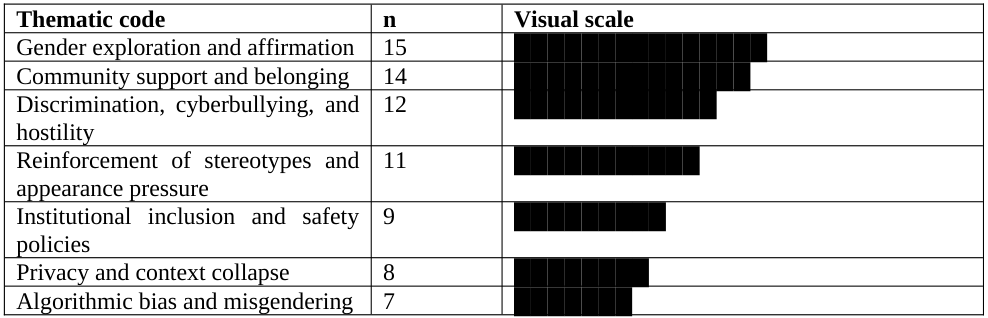
Source: author’s thematic coding of 32 sources listed in References.
The code frequencies indicate which issues recur most often in the reviewed literature, but they should not be interpreted as prevalence estimates for the general population. A source can also contribute to more than one theme because supportive and risky effects frequently coexist.
Figure 2 shows the distribution of sources according to their dominant logic of influence: supportive, harmful, or ambivalent.

Source: author’s classification of the reviewed corpus by dominant effect logic.
The distribution supports the study’s central interpretation that digital environments are predominantly conditional and ambivalent rather than uniformly beneficial or harmful.
The first major result concerns opportunities for experimentation and affirmation. Social media and online communities can provide vocabularies, role models, informational resources, and supportive feedback that are unavailable in some offline environments [1] [2] [3] [4] [5] [6]. Digital self-presentation may allow users to calibrate disclosure according to audience, platform, and perceived risk.
Gaming environments offer a related but distinct mechanism. Avatar customization allows users to experiment with appearance, names, bodies, and gendered presentation while maintaining greater distance from some offline consequences [7] [8] [9] [10]. These practices can support gender exploration and, for some users, experiences of alignment or gender euphoria.
The industry-level context reinforces the importance of gaming. GLAAD reports that 17% of active gamers identify as LGBTQ+, despite LGBTQ+ characters or storylines appearing in less than 2% of available major-console and PC games [11]. The representational gap indicates that identity exploration occurs within an industry whose content does not necessarily reflect the diversity of its users.
Digital communities also provide relational support. Rural LGBTQ youth report using online spaces to reduce isolation and gain access to peers [2]. Transgender and gender-diverse adolescents similarly use social media to seek information and affirming interaction [6]. The 2025 Hopelab and Born This Way Foundation report indicates that transgender and nonbinary youth in its sample disclosed their gender identity online approximately twice as often as in person [31]. The Trevor Project’s national survey provides additional large-scale evidence on the digital and social environments experienced by LGBTQ+ young people [30].
These results do not mean that online disclosure is universally safer. Disclosure can increase exposure to harassment, unwanted audience crossover, or persistent digital records. The relevant mechanism is therefore control: the ability to choose audiences, accounts, pseudonyms, privacy settings, and interaction spaces.
The second major result concerns normative pressure. Image-centered platforms increase the visibility of bodies and create quantifiable feedback through likes, views, comments, and recommendation systems. Appearance-oriented social-media use has been associated with body-image concerns and appearance pressure [12] [13]. Young users also describe these pressures as gendered [14].
Manago, Walsh, and Barsigian show that gender identification and gender ideologies are related to different purposes of adolescent social-media use [33]. Research on social-media “manfluencers” and digital masculinity further indicates that repeated exposure can normalize scripts emphasizing strength, dominance, financial status, emotional restriction, or hostility toward gender equality [15] [16]. Common Sense Media’s 2025 report similarly documents widespread exposure among boys to masculinity-related material and to problematic gender-role messages [17].
The important point is that normative influence is not produced only by explicit ideological content. Platform metrics and recommendation systems can make particular body types, lifestyles, or gender performances appear unusually common or socially rewarded.
The third cluster concerns hostility and safety. Cyberhomophobia and online sexual victimization are associated with poorer psychological well-being among queer adolescents [18]. Transgender and gender-questioning early adolescents experience elevated cyberbullying victimization [19]. Fisher et al. emphasize that social media can simultaneously provide connection and expose LGBTQ+ youth to discrimination [20].
GLAAD’s Social Media Safety Index provides an institutional assessment of platform policies and safety performance [32]. These findings support the interpretation that online safety cannot be reduced to individual resilience. Platform rules, reporting systems, recommendation systems, and enforcement practices affect the duration and visibility of harmful interactions.
The fourth major result concerns automated classification. Gender-inference systems can assign categories from behavioral or profile data even when users have not explicitly supplied gender information [21] [22]. Such systems raise two distinct issues: whether the inference is accurate and whether the inference should be made at all.
Recent cross-sectional evidence on algorithmic gender classification shows that misclassification is not distributed uniformly and can disproportionately affect LGBTIQ+ users [23]. This provides empirical support for concerns that binary or reductionist classification systems can fail when gender expression does not correspond to the categories assumed by the model.
Policy reports from the OECD and UNESCO reinforce the need for transparency, inclusion, privacy, and non-discrimination in digital systems [24] [25] [26]. From the perspective of gender identity, algorithmic design therefore becomes part of the social environment through which people are recognized or misrecognized.
Digital exposure also differs across groups. Nagata et al. report associations between sexual orientation and screen use in early adolescence [34], while related work examines screen use among transgender and gender-questioning adolescents [35]. Higher use should not automatically be interpreted as evidence that screens are inherently harmful. For users seeking information, peers, or identity affirmation that is difficult to access offline, greater digital participation may reflect the social importance of online spaces.
At the same time, more frequent use can increase cumulative exposure to algorithmic recommendations, visual comparison, harassment, misinformation, and privacy risk. The relevant research question is therefore not simply duration of use but the interaction among duration, content, platform affordances, user vulnerability, and available support.
The results support a socio-technical interpretation of gender identity in digital environments. Digital platforms do not create identity in isolation, but they influence the conditions under which identity can be named, displayed, affirmed, concealed, or classified. This shifts part of the analytical focus from individual media use toward system design.
First, visibility is conditional. A user may experience affirmation within a niche community while facing risk when the same content reaches family, school, work, or hostile audiences. Chen and Mares’ findings on context collapse demonstrate why audience structure matters alongside self-acceptance [4]. Privacy tools are therefore not merely technical conveniences; they influence the practical conditions for identity disclosure.
Second, virtual embodiment can expand experimentation. Avatar systems can make gender presentation more flexible than some offline environments [7] [8] [9]. Inclusive design should therefore avoid unnecessary binary restrictions in avatar creation and profile systems. At the same time, customization alone is insufficient when community harassment or moderation failures make participation unsafe.
Third, repeated visibility can normalize restrictive gender scripts. Visual platforms and masculinity-oriented influencer cultures demonstrate that platform influence occurs through repetition and recommendation as well as direct persuasion [12] [13] [15] [16] [17]. Digital literacy should therefore include an understanding of why particular content appears repeatedly and how popularity metrics can create misleading impressions of social consensus.
Fourth, algorithmic classification can transform social assumptions into infrastructure. When a system infers gender for advertising, recommendation, identity verification, or analytics, it may force users into categories they did not choose [21] [22] [23]. Platform developers should minimize unnecessary sensitive-attribute inference, provide user control where classification is needed, and evaluate error patterns across diverse populations.
Fifth, safety policies must address targeted forms of abuse. Misgendering, deadnaming, coordinated harassment, misogynistic campaigns, and anti-LGBTQ+ hate may require more specific moderation approaches than generic toxicity detection. Reporting systems should allow users to describe identity-targeted abuse accurately, and enforcement should consider repeated or coordinated patterns rather than isolated messages only.
The broader public-administration and human-capital studies retained in the bibliography [27] [28] [29] reinforce a general point about digital transformation: inclusion depends on institutional governance as well as technological access. These sources are not evidence about gender identity directly, but they support the wider policy context in which digital participation, education, migration, and human capital are governed.
For platform designers, the findings support greater control over audience boundaries, reduced reliance on binary gender classification, transparent explanations of sensitive-attribute inference, and stronger tools for blocking, reporting, and appeal. Avatar and profile systems should allow flexible self-description without requiring users to select unnecessary gender categories.
For educators and families, digital literacy should extend beyond identifying “dangerous content.” Young people benefit from understanding recommendation systems, advertising, engagement metrics, data profiling, and the persistence of digital disclosure. Such literacy can help users recognize that repeated exposure does not necessarily reflect majority opinion.
For researchers, cross-platform designs are especially important. Adolescents may move among TikTok, Instagram, games, messaging applications, private communities, and educational platforms within the same day. Studying each platform in isolation can obscure how support found in one environment compensates for risk in another.
This study is a secondary qualitative review rather than a primary empirical study or statistical meta-analysis. The reviewed publications differ in population, country, platform, method, and outcome definition. The thematic frequencies in Figure 1 and the dominant-effect categories in Figure 2 summarize the authors’ coding of the selected corpus and do not estimate population-level prevalence.
The review is also time-sensitive. Platform policies, recommendation systems, and identity features change rapidly. The inclusion of sources through 2026 improves recency but means that results describe a moving technological environment.
A further limitation is geographic concentration. Several empirical studies and reports focus on the United States or other high-income settings. Gender norms, platform use, legal protections, and digital access differ across countries, limiting straightforward generalization.
Finally, the review does not independently audit proprietary recommendation or gender-classification algorithms. Claims about platform mechanisms are based on the evidence and analyses reported in the cited literature.
Digital technologies have a systemic and predominantly ambivalent relationship with gender identity. They can create spaces for gender exploration, community support, avatar-based experimentation, affirming feedback, and controlled self-disclosure. These opportunities are particularly important for transgender, nonbinary, queer, and other users who may lack comparable support in local offline environments.
The same digital infrastructures can reproduce restrictive gender norms, intensify appearance pressure, normalize toxic masculinity scripts, increase exposure to cyberbullying, and misclassify users through automated gender inference. These risks are shaped not only by interpersonal behavior but also by platform architecture, recommendation systems, audience structures, privacy controls, and moderation practices.
The central conclusion is therefore that the social consequences of digital technology depend on design and governance as well as individual use. Safer digital environments require gender-sensitive platform design, transparent algorithmic systems, effective moderation, meaningful privacy controls, and digital literacy that includes understanding algorithmic amplification.
Future research should examine cross-platform identity trajectories, compare experiences across cultural and legal contexts, evaluate generative-AI systems that infer or represent gender, and study how online and offline environments interact over time in the development of gender identity among adolescents and young adults.
L.S., A.F., M.Z., U.M., and R.L. contributed equally to the conceptualization, methodology, literature review, thematic analysis, interpretation, visualization, manuscript preparation, and review and editing. All authors have read and approved the final manuscript.
This research received no specific external funding.
No new primary dataset was generated. The study is based on published literature and publicly available analytical reports cited in the manuscript. The authors’ thematic coding matrix and source-classification materials are available from the authors upon reasonable request.
Ethical approval and informed consent were not required because the study is based exclusively on published literature and aggregated public reports and did not involve recruitment of human participants, collection of identifiable personal data, or experimental intervention.
Not applicable.
The authors declare no conflicts of interest.