
I. Introduction
WSNs have become critical in a variety of fields, including health monitoring, infrastructure defense, and surveillance of military and high-risk regions [1]. These networks are made up of many small sensor nodes that have limited energy, computation, storage, and communication bandwidth [2]. These restrictions have an impact on quality-of-service indicators such as packet delivery ratio, end-to-end delay, bandwidth utilization, and node average energy consumption [3]. Traffic congestion happens when the volume of data processed by all sensors in a region exceeds the buffer size, resulting in an unanticipated surge of data traffic and blocked network pathways [4]. This reduces the quality of service (QoS) due to congested routes. Network congestion causes decreased performance, packet losses, higher latency, and energy loss in SNs [5], [6]. Congestion occurs mostly around the sink node, reducing WSN performance and potentially resulting in energy waste, increased latency, packet loss, and other difficulties [7]. Unfair resource allocation at the node or connection level is one driver of congestion [8]. The bulk of sensor nodes suffering congestion are located near the washbasin [9].
Node-level congestion in Wireless Sensor Networks (WSNs) increases power consumption and packet loss, reducing network lifespan and availability [10]. Bit error, collision, and competition all contribute to link-level congestion, which reduces packet delivery rates at the sink node [11]. To improve throughput and packet delivery, medium access control-based congestion management techniques should be used [12]. Congestion detection involves detecting congestion in sensor nodes and notifying upstream nodes. During the rate modification or congestion mitigation phase, congestion should be decreased and a suitable data rate selected [13]. Congestion control consists of three stages: detection, notification, and mitigation [14]. Congestion detection methods for WSNs include dual buffer thresholds, weighted buffer difference, and occupied queue length, packet service time, packet interval and service time, packet drop at the sink node, queue length, and channel status [15]. Two node-level sources of congestion are mismanagement of traffic arrival and departure rates and insufficient buffer use [16].
Channel utilization identifies congestion at the link level, and congestion control approaches are critical for increasing the lifespan of Wireless Sensor Networks (WSNs) [17]. Load shedding, hop-by-hop choke packets, token bucket algorithms, leaky bucket algorithms, the choke packet approach, flow control versus congestion control, and sluggish start are all examples of congestion control algorithms [18]. Congestion in WSNs necessitates a distinct traffic-focusing path from standard end-to-end schemes, particularly in single-sink WSNs [19]. Congestion can be determined by verifying the appropriate transmission rates [20]. Energy consumption is a significant barrier to WSNs, and many solutions are proposed to address it [21]. Traditional technologies such as duty cycling, load balancing, and data aggregation have been used, but they face various challenges due to the rapid increase in sensor nodes [22]. Current approaches for residual energy consumption include mobile sinks, trajectory-based data forwarding, and node-based energy supply [23]. These approaches simplify transmission but lack balanced energy between nodes. The system’s key effects are user mobility and transmission rate distribution, therefore congestion is a major concern [24].
The Key contribution of the work is enumerated as
The study presents a Deep Learning-Based Clustering Model (DL-CM) that enhances wireless sensor network (WSN) energy efficiency by utilizing recurrent neural networks (RNNs).
This model performs better in terms of energy consumption and network operational lifespan than conventional techniques such as LEACH, TCEER, TASRP, CARA, and SACC.
To demonstrate the benefits of deep learning-based approaches, the paper also performs an extensive comparative analysis against well-known clustering techniques.
To increase data transmission efficiency, the study emphasizes the possibility of combining deep learning techniques with clustering strategies.
The rest of the article is structured as follows section 2 reviews the existing work, section 3 discusses the analysis of congestion control, section 4 provides the evaluation of the congestion, and section 5 concludes the article.
II. Related Works
Kavitha et.al [25] The paper offers a new DDNN-PSO based on particle swarm optimization, which optimizes weight parameters for improved performance. DNN-GA and DNN approaches are used to do performance analysis, which includes calculating delivery ratio, packet delay, throughput, overhead, and energy usage. However, the approach cannot be improved for better results. There has been no testing of the suggested congestion control technique in practical WSN-based Internet of Things applications.
Srivastava et.al [26] The study provides a unique congestion control technique for energy-efficient transmissions, which reduces energy consumption across the network using a rate-based algorithm based on cluster routing. This approach lowers end-to-end latency, extending the network’s lifespan over the simulation period. The algorithm employs hybrid K-means and Greedy best-first search algorithms, firefly optimization for high packet delivery ratios, and Ant Colony Optimisation for maximum throughput. However, this strategy may incur delays, raise processing burdens, and complicate dynamic network situations.
Yadav et.al [27] study suggests a strategy for avoiding congestion and improving network performance (ECA-HA) and the Huffman coding algorithm. This technique focuses on resources and traffic, discovering alternate routes that are free of congestion. The forward step generates congestion-free paths from the source to the sink node, whereas the reverse step ensures successful paths from the sink to the source node. Huffman coding takes into account the packet loss rate on alternative pathways. This approach works well in tiny search spaces and can even be utilized in quickly growing networks.
Praveen et.al [28] The study suggests hybrid optimization strategies for an ECRR for IoT networks. It combines data clustering and a metaheuristic algorithm to assign large-scale IoT devices and gateways while minimizing congestion. A queue-based swarm optimization technique improves route discovery by selecting the best routes based on numerous restrictions. However, combining data clustering with metaheuristic techniques may increase computing complexity.
Majeed et.al [29] proposed the distributed congestion control protocol (DCCP), an energy-efficient method of reducing congestion and enhancing end-to-end latency. Initially, two congestion indicators are used to identify congestion. Secondly, every node compiles the data it has received and creates a map of traffic congestion. The optimal route is determined by utilizing the traffic congestion map. In the final analysis, the purpose of a rate controller is to avoid network congestion by informing a source node about the existence of congestion. Upon receiving a notification of congestion, the source node promptly modifies its transmission rate. However, the simplicity of the current topologies may limit performance, and more complex topologies could introduce additional computational overhead.
As a result, the study highlights the lack of testing in practical WSN-based IoT. The technique, which works well in small search spaces, may introduce delays, increase computational overhead, and cause complexity. However, it may also suffer from computational complexity due to data clustering and metaheuristic algorithms, and the simplicity of current topologies may limit performance. Therefore, a novel framework is necessary to avoid the congestion in the WSN.
III. Analysis of the Congestion control network
In WSNs, congestion control is crucial for maintaining efficient data transmission and prolonging network lifespan, given the limited energy resources of sensor nodes. Effective congestion management ensures optimal network performance by minimizing packet loss and reducing retransmission-related energy consumption.
A. Congestion management scheme
To improve data processing efficiency in sensor networks, the raw data from sensor nodes should be processed using a service computing technique. This process consists of three steps: sensing, processing, and service. Sensor nodes collect data from the environment or item being observed, which is then analyzed by the cluster head node. The information is provided to end users, who subsequently access the produced data over the internet. A geographic routing-based congestion control strategy is used to reduce power dissipation while preserving the optimal path distance between nodes.
The following presumptions are taken into account when developing the WSN network model. Both the source and the serial numbers will display a static feature. The CH provides data through a single sink. Because SNs are heterogeneous, they can be divided into three categories: regular nodes, advanced nodes, and intermediate nodes. For the sink node to perform as a super node, it must keep track of all subordinate sensor nodes’ most recent information. A central sink node is assigned to gather data from different SNs and then send it to another node for additional analysis. The method being considered uses inter-data communication to make data transmission via CH easier. Nonfunctional nodes are those that have run out of battery life.
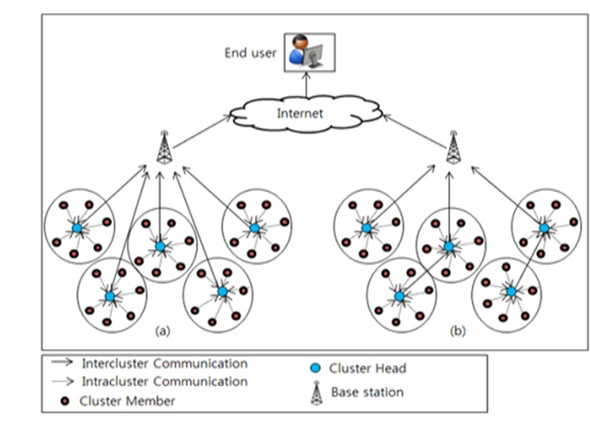
The research focuses on optimizing path routing for a 5G wireless communication network for the Internet of Things applications by utilizing deep learning, notably deep neural networks. The clustering mechanism is critical for energy-efficient delivery, network longevity, and energy savings. The clustering model is based on the RL method, which assigns sensor nodes to certain clusters via the Base Station (BS) or sink node. An algorithm is utilized to determine the appropriate cluster head, taking into account aspects such as traffic volume, separation, power, delay, and other limitations. The Multi-Objective technique is utilized to select the optimal cluster head, particularly when dealing with asymmetric, shifting, dynamically untrustworthy, and changeable channel characteristics. To achieve effective data transmission, a routing strategy based on DNN is developed that takes into account residual power, distance from the CH, number of neighboring nodes, and link distance.
B. Recurrent network
This work introduces the RNN-LSTM model, which divides n layers into k pieces to calculate the number of compute units required for each segment at the appropriate hierarchy level in a WSN. The use of RNN-LSTM will be explored in detail in the following sections.
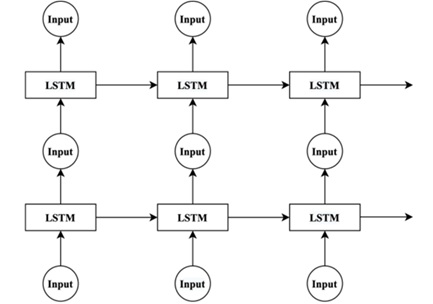
The RNN-LSTM model is a mechanism for transforming empirical data into computational units at a specified level. It solves the vanishing gradients problem with RNN by replacing each ancestral node with a memory cell and adding a self-connected recurrent edge. The LSTM approach distinguishes memory cells from ordinary nodes and gives useful references. Adjusting weight parameters allows primary recurrent neural networks to learn and recall new information over long periods. Short-term memory is used to transfer temporary functionality between nodes. The LSTM cell’s units are denoted by the symbols s and x, and the Clustering Model makes indexing a single memory cell easier. During training, the material is eventually encoded to represent generic knowledge.
The LSTM model is distinguished by its input gates, which are activated by the current data point (d_x) and the layer buried in the previous time step of the Clustering Model. The input gate v_x value rises in proportion to the input node’s value. A cell’s internal state, which includes linear activation, is a self-connected, continuous edge with a set unit weight. In the absence of an explosion in the Clustering Model, errors propagate over future time phases with similar weights at their edges. The vector function’s internal state update equation is s_x=g_x v_x+s_(x-1), where the symbol represents the point-wise multiplication operation. A function f_x represented by gates has been constructed, providing a method for learning about the delicate contextual features of a person’s internal state, which is especially useful in networks that regularly use the Clustering Model. Eq. (1) explains how to estimate the internal state during a forward pass using forget gates.
\[ s_x=g_xv_x+f_xs_{x-1} .\tag{1} \]
The study makes use of the EKM technique, which is an improved clustering algorithm that takes into account covariances and fluctuations across variables. By prioritizing the first centroid, this method makes the clustering process more flexible and helps to avoid clustering difficulties. For example, if 100 nodes are chosen, only 10 are generated, and the rest are assigned to h clusters using the Inverted Covariance Matrix, assuring exact clustering and minimizing errors.
IV. Energy optimization technique
The communication methods utilized by WSN sensors create changes in EC rates. Data is sent from the source node to the base station, which is in charge of data exchange throughout the network. Packet loss and reduced data transfer efficiency occur when the source node has less residual energy. To address this issue, a cluster of trustworthy social nodes, each known as a grouped node, is proposed.
The study uses the EKM approach, an improved clustering algorithm that calculates distance using the inverse covariance matrix. This strategy makes the clustering process more flexible by taking into account covariances and fluctuations across variables. The cluster is formed by using the usual technique that prioritizes the first centroid, which can result in clustering problems. For example, if there are 100 nodes in the WSN context, only 10 are selected to form a cluster. The remaining clustering model nodes are then assigned to h clusters using the Inverted Covariance Matrix. This approach ensures precise clustering while minimizing errors in the process. \[ {\overline{C}}_{d(x,y)}=\sqrt{({v_n-v_x)}^T{C_M}^{-1}{(v}_n-v_x)} .\tag{2} \]
The distance metric based on the inverse covariance matrix is indicated by the notation \({\overline{C}}_{d(x,y)}\). \(v_n\) represents the set of SNs, and \(v_x\) stands for the set of group centroids. \({C_M}^{-1}\) is the characteristic of the inverted covariance matrix. The SNs are assigned to the group centroid that is the closest to the centroids of every other cluster after the distance calculation. Iteratively repeating the above procedure results in the assignment of each data point, also referred to as an “SN,” to its cluster centroid. The resulting clustering is represented by Eq. (3); \[ C_{set}=\left\{C_1,C_2,\dots ,C_k\right\} .\tag{3} \]
The inscription \(C_k\) stands for the kth background cluster, and \(C_{set}\) indicates the set of groups. The DL-Cluster technique is then used to choose the CH for each group after the clusters have formed. The WSN employs the EKM technique for cluster formation, which uses the inverse covariance matrix to calculate Euclidean distances. This specific approach takes into account the interdependencies and variability of variables, which allows for greater flexibility in the clustering process.
The clustering technique groups sensor nodes into clusters using a specified number of centroids. Proper placement is critical to avoiding grouping issues. The Euclidean distance between SNs is calculated using the reversed covariance matrix, SN sets, and grouping centroids. Data points are assigned to their respective group centroids by iteratively selecting the cluster centroid that is closest to the centroids of each other group. These clusters are often known as SNs. The previously constructed groups are referred to as Set.
The study focuses on assigning CHs from the node group using logical concepts and male attraction in female reproduction. In the bowerbird attraction phase, the DL-clustering method is applied, which is based on bird stick structures. The conventional new optimization approach employs the normal distribution, which is unsuitable for large populations. Instead, the t-distribution is utilized, which is more effective over a large range of values. The DL-clustering approach addresses ethical considerations related to the bird’s existence in a series of steps.
Step 1: The first stage is to generate a random population to form a Bower Set. This population corresponds to each place in the set and is based on an optimized n-dimensional vector of parameters. \[\begin{aligned} {CN}_{set}=&\{({v_1,v_2,\dots ,v_k)}_{c_1},({v_1,v_2,\dots ,v_k)}_{c_2}\dots, \notag \\& ({v_1,v_2,\dots ,v_k)}_{c_k}\} , \end{aligned}\tag{4} \] where \({CN}_{set}\) denotes the Bowers group.
Step 2: Male bird success in attracting mates is mostly determined by producing an appealing bowler’s likelihood, whereas female bower birds select a bower based on the clustering Model’s likelihood. \[ p=\frac{{fn}_{CH}(k)}{\sum\limits^{N-1}_{k=0}{{fn}_{CH}(k)}} .\tag{5} \]
Eq. (6) expresses the maximum residual energy, which is considered the fitness of each solution. \[ {fn}_{CH}\left(k\right)=\left\{\mathrm{max}\mathrm{}{(E_f(R)}_M)\right\} .\tag{6} \]
The fitness function that was used to choose CH is indicated by the notation \({fn}_{CH}\left(k\right)\), and the remaining energy of the N remedies is represented by the symbol \({E_f(R)}_M\).
Step 3: The Bower Location algorithm updates each solution depending on its fitness value, with the best-fitting solution being considered elite. Eq. (7) shows how the program records the alteration of each bird’s nest every time it is utilized. \[ v_n\left(x+1\right)=v_n\left(x\right)+t_n\left(\frac{v_{sN}-v_{EN}}{2}\right)-v_n\left(x\right) ,\tag{7} \] \[ t_n=\frac{w}{1+p} .\tag{8} \]
The maximum step size (\(w\)) at which the likelihood (\(p\)) of the target location drops to zero is indicated by the symbol. When the step size is half the width and the probability of the target location equals 1, the minimum step size occurs.
Step 4: The Bower Location algorithm revises answers based on fitness value, with the best-fitting solution designated elite. Eq. (7) shows how the application records nest changes each time it is invoked.
\[ v_{NM}\left(x+1\right)=T\left(v_{NM}\left(x\right),{\alpha }^2\right) ,\tag{9} \] \[ T\left(v_{NM}\left(x\right),{\alpha }^2\right)=\frac{v_{NM}\left(x\right)-P}{\alpha /\sqrt{M}} ,\tag{10} \] \[ \alpha =\beta (B_{max}-B_{min}) .\tag{11} \]
The maximum limit is indicated by the notation \(B_{max}\), and the minimum limit is indicated by \(B_{min}\).
Step 5: In this phase, each cycle’s current population levels are examined both before and after the modifications. New individuals are created by gathering and classifying the two aforementioned populations according to their degree of fitness. This method’s steps 3 and 4 are carried out repeatedly until the termination requirements are satisfied.
The following are the procedures for choosing a CH:
Step 1: A portion of the bower set is reflected in a random population. An n-dimensional vector of variables that need to be optimized is connected to each position.
Step 2: Using each member of the population’s fitness values, the probability (p) of each is determined.
Step 3: After each iteration, a mutation process takes place in which random modifications are applied with a predefined probability. The fitness function and the target distribution for mutation are indicated by Eqs. (9) and (10), respectively.
The DL-clustering process selects CHs to collect data from SNs and transmit it to BS. The CH with the maximum residual energy is known as the “cluster node.” Following the selection procedure, SNs transfer data packets to their targeted locations via CH nodes. Maintenance of the CH is critical for energy-efficient information transfer since CHs are prone to energy loss across several data transfer cycles. The energy efficiency period of nodes is taken into account while picking a new cluster head. When the CH’s energy level falls below a predefined threshold, a new CH is selected, allowing the CH to continue transmitting data packets. This practice is sometimes referred to as CH maintenance.
V. Performance Evaluation
This paper compares a new strategy for wireless sensor network clustering to established methods such as LEACH [30], TCEER [31], TASRP [32], CARA [33], and SACC-AHP [31]. LEACH is a pioneering method, however it overlooks security. SACC selects cluster heads using the AHP approach, whereas TCEER isolates hostile nodes and ensures safe transmission with a trust model. TASRP implements both security and clustering while avoiding congestion conditions. CARA is utilized for performance evaluation. The DL-clustering approach exhibits higher energy efficiency throughout the duration, suggesting an increased capability for energy optimization. This study demonstrates the efficacy of advanced deep-learning approaches and intelligent grouping strategies in increasing energy efficiency in wireless sensor networks during data transmission.
A. Assumptions
Outlines several presumptions and the network model’s construction to justify and explain the suggested protocol. These are necessary because WSNs are limited in terms of power supply, computing power, and buffer storage.
\(\clubsuit\) Each node has a unique ID and location.
\(\clubsuit\) The propagation channel is symmetric. Sensor nodes are energy-constrained due to battery operation. Sensor nodes include both source and intermediary nodes, excluding sink nodes.
\(\clubsuit\) Each node is vulnerable to assaults in the same way.
\(\clubsuit\) The base station is stationary and far away from the sensor node.
\(\clubsuit\) The base station has no resource limits.
\(\clubsuit\) Nodes within the r-meter of the base station can communicate directly with it.
\(\clubsuit\) CHs track each Cluster member’s ID, location, and remaining energy. The most important SNs inside a cluster are known as CHs. The CHs send their combined data to the BS.
B. Configuration of the network
MATLAB software version 2020a has been used for simulation. 100 randomly distributed nodes with mobility features have been placed in a 200 \(\mathrm{\times}\) 200 mt\({}^{\ 2}\) network for simulation purposes. The mobility speeds at which the experiments were carried out ranged from 5 to 20 m/s. Additionally, Table ?? displays all required parameters along with their values for the simulation. It simulated with about 2000 rounds. The results are also displayed in the figure. The suggested method’s performance has been assessed by contrasting it with the LEACH [30], TCEER [31], TASRP [32], CARA [33], and SACC-AHP [31]. The energy efficiency, packet delivery rate, throughput, network lifetime, and other factors of these algorithms have been compared.
C. Results
A thorough evaluation of the suggested method’s performance was conducted, encompassing all of the critical network metrics such as throughput, energy consumption, and network lifetime.
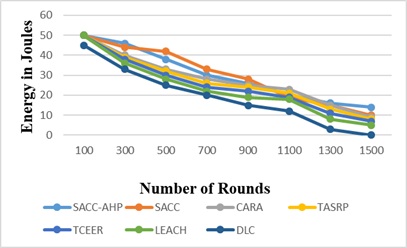
The graph highlights that the DLC algorithm demonstrates superior energy efficiency compared to other techniques, including SACC-AHP, SACC, CARA, TASRP, TCEER, and LEACH as shown in Figure 3. Over the rounds, DLC consistently shows lower energy consumption, indicating more effective management of energy resources during communication processes. This improved efficiency is attributed to DLC’s optimized approach in selecting cluster heads and managing node communication, which minimizes energy wastage. DLC’s energy consumption remains lower due to its strategic mechanisms for minimizing unnecessary energy expenditure, such as efficient cluster head selection and effective data transmission protocols. Although SACC-AHP also exhibits strong performance in energy efficiency, DLC closely follows with a notable reduction in energy consumption, demonstrating its capability to optimize resource utilization and prolong the lifespan of sensor nodes.
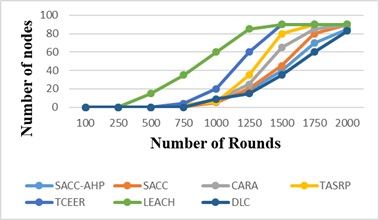
The graph demonstrates that the DLC algorithm provides a notable improvement in network lifetime for WSNs compared to other techniques as shown in Figure 4. Initially, all algorithms maintain a steady number of operational nodes, indicating similar energy efficiency. However, from around 750 rounds, LEACH and TCEER begin to exhibit a rapid decline in operational nodes, reflecting their lower energy efficiency. In contrast, the DLC algorithm maintains a higher number of operational nodes throughout the middle phase, showing superior energy management. By the later phase, DLC performs exceptionally well, closely following the SACC-AHP algorithm but with slightly fewer operational nodes. This indicates that while SACC-AHP leads, DLC also significantly extends the network lifetime and demonstrates effective energy conservation. LEACH and TCEER show the shortest network lifetimes, with LEACH nearing zero operational nodes by 1750 rounds. This analysis underscores that the DLC algorithm not only enhances network lifetime but also offers a more efficient energy management solution compared to other existing techniques.
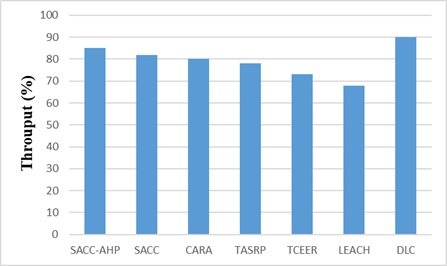
The throughput analysis presented in Figure 5 illustrates that the DLC algorithm achieves a notable throughput, outperforming other techniques, including SACC-AHP, TCEER, TASRP, CARA, and LEACH. DLC’s ability to maintain high throughput is attributed to its robust mechanism for identifying and mitigating the impact of malicious nodes, ensuring they do not adversely affect data transmission efficiency. In contrast, SACC-AHP, while effective, does not achieve the same level of throughput as DLC. Additionally, techniques like TCEER, TASRP, CARA, and LEACH exhibit lower throughput and packet delivery ratios (PDR), likely due to their inadequate consideration of WSN scenarios. This analysis underscores the DLC algorithm’s superior performance in sustaining high throughput and effective data transmission across the network.
DLC demonstrates lower energy consumption and superior energy management, attributed to its optimized cluster head selection and effective communication protocols, which extend the network’s operational lifetime. It maintains a higher number of operational nodes throughout the rounds, indicating better energy conservation and network longevity compared to other methods, especially LEACH and TCEER, which exhibit a rapid decline in node functionality. Additionally, DLC achieves notable throughput by effectively mitigating the impact of malicious nodes and selecting relay nodes based on key criteria, thus enhancing data transmission efficiency. This contrasts with other techniques that show lower throughput and less effective energy management. Overall, DLC’s ability to optimize both energy use and data transmission highlights its superior performance and efficiency in WSNs.
VI. Conclusion
The article describes a DLC model for optimizing energy utilization in WSNs by improving cluster formation, CH selection, and CH maintenance. This model dramatically improves energy efficiency and increases the network’s operating life. It routinely beats established approaches such as LEACH, TCEER, TASRP, CARA, and SACC in terms of energy efficiency and throughput. DLC’s strategic procedures, including effective CH selection and resilient data transmission protocols, lead to lower energy usage and increased throughput. This optimized approach ensures that sensor nodes last longer and transmit data more efficiently. Future work will concentrate on improving the DLC algorithm, incorporating new deep-learning models, investigating adaptive mechanisms, and broadening its ability to handle a variety of WSN settings. The promising results demonstrate the potential of sophisticated deep-learning approaches for energy optimization in WSNs, paving the path for more efficient and resilient sensor networks.