Sodium/potassium-ion can be the prime chemistry replacement candidate for LIBs [1]–[6]. The potassium-ion has certain privileges over analogous lithium-ion like the cell design is plain, and both the material and the construction methods are cheaper. The major benefit is the high amount and low cost of potassium in evaluation with lithium, which makes potassium batteries an engaged replacement for large scale batteries like household energy-saving and electric devices. Another privilege of a potassium-ion battery over a lithium-ion battery is potentially charging in a short time [7]–[13].
Lately, “Si-, Ge- or Sn-carbide nanostructures” have been proposed as occupied “H-grabbing” compounds [14]–[16]. Whereas the polarizability of Si is more than C atom, it is assumed that “Si–C/Si nanosheet” might append to compositions more strongly in comparison to the pure C-nanostructures [17]–[19]. The previous investigations of energy-saving devices through H-adsorption have been tailored owing to “DFT calculations” with a semiconductor group of “Si/Ge/Sn/Pb nano-carbides” [20], “Mg-Al nanoalloy” [21] and “Al/C/ Si doping of BN nanocomposite” [22].
Nanomaterials with notable structures detect undertaking demands in the field of electrocatalysis, fuel cells, and energy-saving. Furthermore, “rubidium and cesium ions” are studied as electrolyte additives for “sodium-ion batteries”. It is shown that adding small amount of “Rb\({}^{+\ }\)and Cs\({}^{+}\)” into the electrolyte significantly modifies the chemical composition of solid electrolyte interphase on hard carbon surfaces, which results in a significant increase in the “ionic conductivity” and “stability” of the solid electrolyte interphase [23].
This investigation wants to delve into the feasibility of “LiRb (GeO–SiO), LiCs(GeO–SiO), NaRb(GeO–SiO), NaCs(GeO–SiO), KRb(GeO–SiO), KCs(GeO–SiO) ” nanoclusters for H-storage. Therefore, it was analyzed the physico-chemical properties of mentioned heteroclusters and hydrogenated nanoclusters of “LiRb(GeO–SiO)–2H\({}_{2}\), LiCs(GeO–SiO)–2H\({}_{2}\), NaRb(GeO–SiO)–2H\({}_{2}\), NaCs(GeO–SiO)–2H\({}_{2}\), KRb(GeO–SiO)–2H\({}_{2}\), KCs(GeO–SiO)–2H\({}_{2}\)”.
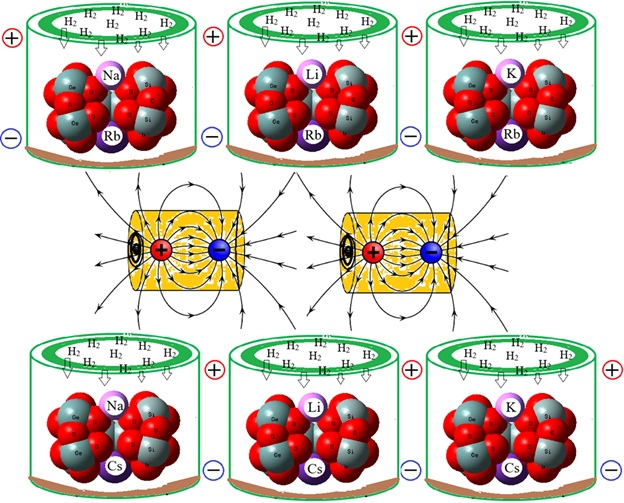
Figure 1 has shown alkali metals-based nanoclusters of “LiRb (GeO–SiO), LiCs(GeO–SiO), NaRb(GeO–SiO), NaCs(GeO–SiO), KRb(GeO–SiO), KCs(GeO–SiO) ” which can enhance the H-storage in cell batteries, transistors or other semiconductors. In our research, the calculations have been done by “CAM–B3LYP–D3 /EPR–3” level of theory. Figure1 shows the process of “hydrogen adsorption” by “LiRb (GeO–SiO), LiCs(GeO–SiO), NaRb(GeO–SiO), NaCs(GeO–SiO), KRb(GeO–SiO), KCs(GeO–SiO)” \({}_{\ }\)nanoclusters and hydrogen-adsorbed nanoclusters of “LiRb(GeO–SiO)–2H\({}_{2}\), LiCs(GeO–SiO)–2H\({}_{2}\), NaRb(GeO–SiO)–2H\({}_{2}\), NaCs(GeO–SiO)–2H\({}_{2}\), KRb(GeO–SiO)–2H\({}_{2}\), KCs(GeO–SiO)–2H\({}_{2}\)”.
The “Bader charge” analysis [24] was illustrated during H-atoms grabbing by “LiRb(GeO–SiO)–2H\({}_{2}\), LiCs(GeO–SiO)–2H\({}_{2}\), NaRb(GeO–SiO)–2H\({}_{2}\), NaCs(GeO–SiO)–2H\({}_{2}\), KRb(GeO–SiO)–2H\({}_{2}\), KCs(GeO–SiO)–2H\({}_{2}\)“ nanoclusters (Figure 1). The rigid potential energy surface using density functional theory [25]–[27] was performed due to “Gaussian 16 revision C.01” program package [28] and “GaussView 6.1” [29]. The coordination input for hydrogen grabbing by “LiRb (GeO–SiO), LiCs(GeO–SiO), NaRb(GeO–SiO), NaCs(GeO–SiO), KRb(GeO–SiO), KCs(GeO–SiO)” has been calculated using “LANL2DZ” and “6-311+G (d,p)” basis sets.
In “isolated system (such as molecule) “, the energy levels are discrete, the concept of “density of state (DOS)” is supposed to be completely valueless in this situation. Therefore, the “original total DOS (TDOS)” of isolated system can be written as [30]:
The normalized “Gaussian function” is defined as:
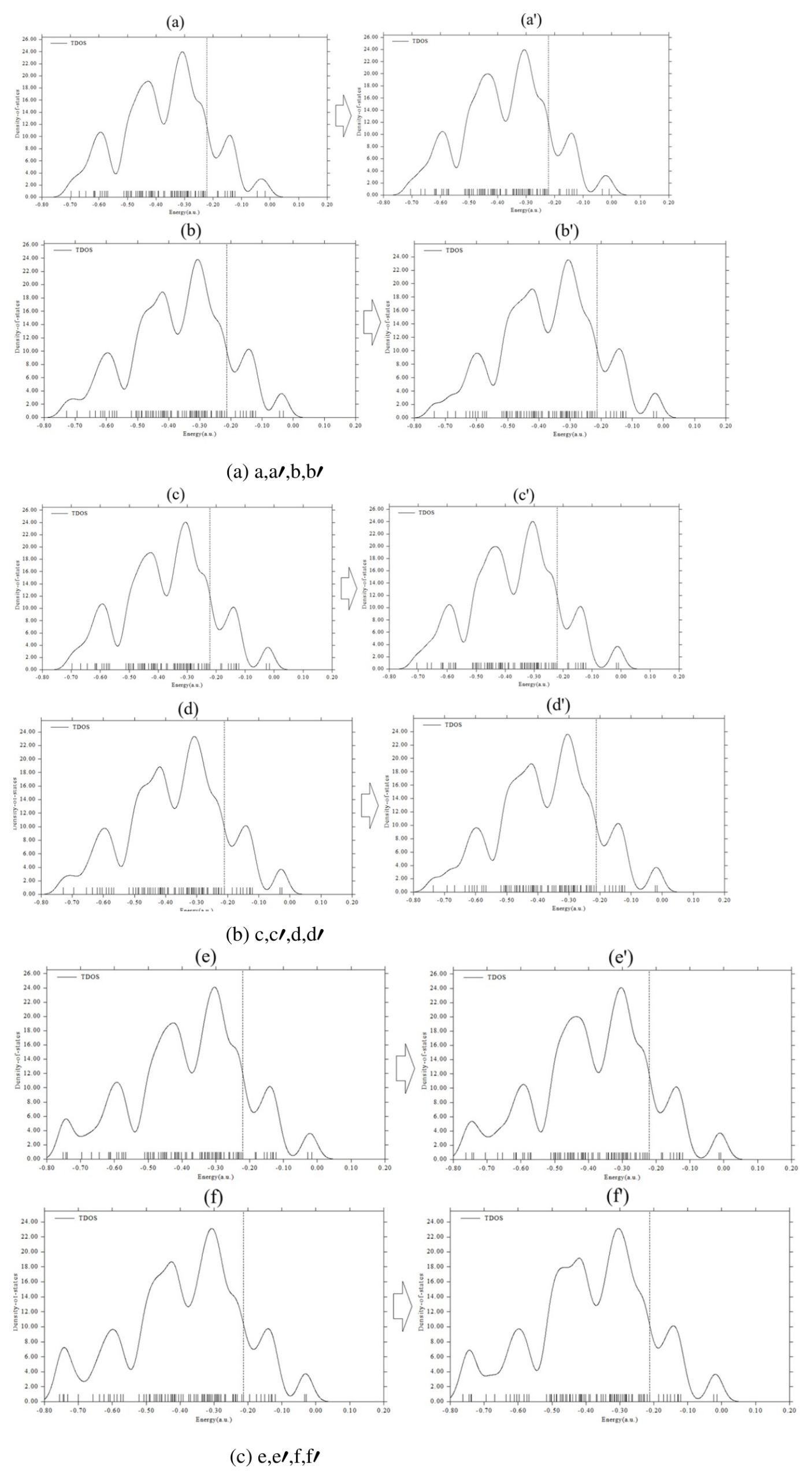
“FWHM (full width at half maximum)” is an adjustable parameter in “Multiwfn”. In the “TDOS map”, each discrete vertical line corresponds to a “molecular orbital (MO)”, the dashed line highlights the position of “HOMO”. The curve is the “TDOS” simulated based on the distribution of “MO” energy levels.
Regarding adsorption behavior of hydrogen by “LiRb(GeO–SiO), LiCs(GeO–SiO), NaRb(GeO–SiO), NaCs(GeO–SiO), KRb(GeO–SiO), KCs(GeO–SiO)” nanoclusters, “TDOS” has been measured. This parameter can indicate the existence of important chemical interactions often on the “convex side” (Figure 2 a,a\(\mathrm{\prime}\), b,b\(\mathrm{\prime}\), c,c\(\mathrm{\prime}\), d,d\(\mathrm{\prime}\), e,e\(\mathrm{\prime}\), f,f\(\mathrm{\prime}\)).
During formation of “LiRb (GeO–SiO), LiCs(GeO–SiO), NaRb(GeO–SiO), NaCs(GeO–SiO), KRb(GeO–SiO) ” (Figure 2 a,b,c,d,e) and hydrogenated nanoclusters containing “LiRb(GeO–SiO)–2H\({}_{2}\), LiCs(GeO–SiO)–2H\({}_{2}\), NaRb(GeO–SiO)–2H\({}_{2}\), NaCs(GeO–SiO)–2H\({}_{2}\)” (Fig.2a\(\mathrm{\prime}\),b\(\mathrm{\prime}\),c\(\mathrm{\prime}\),d\(\mathrm{\prime}\),e\(\mathrm{\prime}\)) have shown the steepest peaks around “–0.3, –0.45 and –0.60 a.u.” due to covalent bond between two atoms of “Li/Rb, Li/Cs, Na/Rb, Na/Cs” with (GeO–SiO) nanocluster.
However, the “TDOS” curve for KRb (GeO–SiO) and KRb (GeO–SiO)–2H\({}_{2}\) nanoclusters have shown four pointed peaks around “–0.3, –0.45, –0.60, –0.75 a.u.” due to covalent bond between atoms of K, Rb, Cs with (GeO–SiO) nanocluster through hydrogen storage with maximum density of state of \(\mathrm{\approx}\) 24 around –0.30 a.u. (Figure 2 f,f\(\mathrm{\prime}\)).
“Localized orbital locator (LOL)” has a similar expression compared to “electron localization function (ELF)” [31].
“Multiwfn” [32], [33] also supports the approximate version of “LOL” defined by “Tsirelson and Stash” [34], namely the actual kinetic energy term in “LOL” is replaced by “second-order gradient expansion like ELF” which may demonstrate a broad span of bonding samples. This “Tsirelson’s version of LOL” can be activated by setting “ELFLOL_type to 1. For special reason”, if “ELFLOL_type in settings.ini is changed from 0 to 2”, another formalism will be used:
If the parameter “ELFLOL_cut in settings.ini is set to x”, then “LOL will be zero where LOL is less than x“.
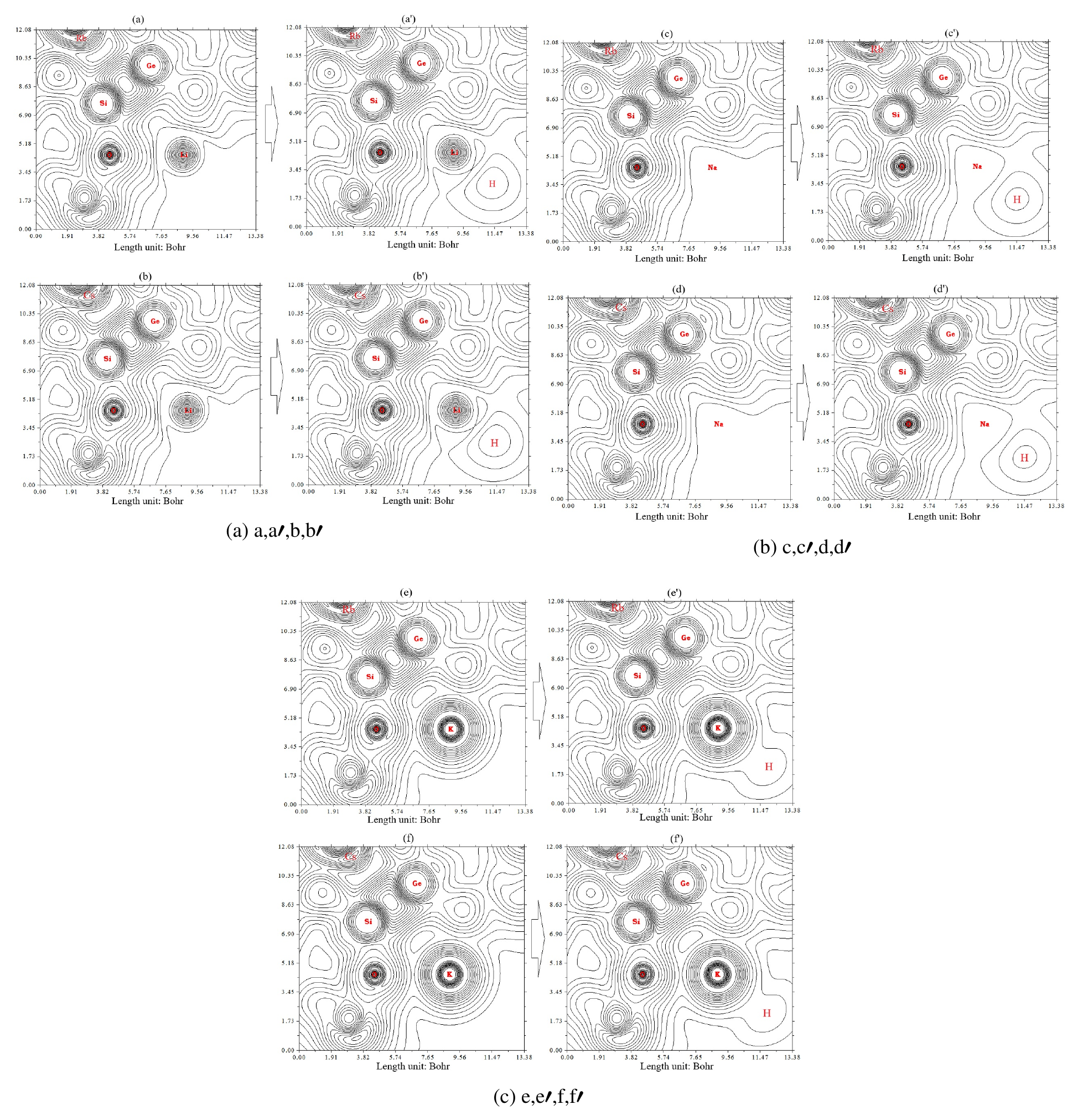
Trapping of hydrogens by “LiRb (GeO–SiO), LiCs(GeO–SiO), NaRb(GeO–SiO), NaCs(GeO–SiO), KRb(GeO–SiO), KCs(GeO–SiO)” (Figure 3 a,b,c,d,e,f).nanoclusters towards formation of “LiRb(GeO–SiO)–2H\({}_{2}\), LiCs(GeO–SiO)–2H\({}_{2}\), NaRb(GeO–SiO)–2H\({}_{2}\), NaCs(GeO–SiO)–2H\({}_{2}\), KRb(GeO–SiO)–2H\({}_{2}\), KCs(GeO–SiO)–2H\({}_{2}\)” might be described by “LOL graphs” due to achieving their “delocalization/localization” characterizations of electrons and chemical bonds (Figure 3 a\(\mathrm{\prime}\),b\(\mathrm{\prime}\),c\(\mathrm{\prime}\),d\(\mathrm{\prime}\),e\(\mathrm{\prime}\),f\(\mathrm{\prime}\)).
An isosurface map has shown the electron delocalization in “LiRb (GeO–SiO) (Figure 3 a), LiRb(GeO–SiO)–2H\({}_{2}\) (Figure 3 a\(\mathrm{\prime}\)), LiCs (GeO–SiO) (Figure 3 b), LiCs(GeO–SiO)–2H\({}_{2}\) (Figure 3 b\(\mathrm{\prime}\)), NaRb (GeO–SiO) (Figure 3 c), NaRb(GeO–SiO)–2H\({}_{2}\) (Figure 3 c\(\mathrm{\prime}\)), NaCs (GeO–SiO) (Figure 3 d), NaCs(GeO–SiO)–2H\({}_{2}\) (Figure 3 d\(\mathrm{\prime}\)), KRb (GeO–SiO) (Fig.4e), KRb(GeO–SiO)–2H\({}_{2}\) (Figure 3 e\(\mathrm{\prime}\)), KCs (GeO–SiO) (Figure 3 f),and KCs(GeO–SiO)–2H\({}_{2}\)” (Figure 3 f\(\mathrm{\prime}\)) through labeling atoms of “O10, O12, Si13, O24, O26, Ge28, X31(X=Li, Na or K), Y32 (Y=Rb or Cs) and H33, H34, H35, H36”. In fact, the “counter map of LOL” can confirm that LiRb (GeO–SiO), LiCs(GeO–SiO), NaRb(GeO–SiO), NaCs(GeO–SiO), KRb(GeO–SiO), KCs(GeO–SiO) nanoclusters may increase the efficiency during hydrogen adsorption towards formation of LiRb(GeO–SiO)–2H\({}_{2}\), LiCs(GeO–SiO)–2H\({}_{2}\), NaRb(GeO–SiO)–2H\({}_{2}\), NaCs(GeO–SiO)–2H\({}_{2}\), KRb(GeO–SiO)–2H\({}_{2}\), KCs(GeO–SiO)–2H\({}_{2}\).
Besides, “intermolecular orbital overlap integral” is important in discussions of intermolecular charge transfer which can calculate “HOMO-HOMO” and “LUMO-LUMO” overlap integrals between the H\({}_{2}\) molecules and heteroclusters of LiRb(GeO–SiO), LiRb(GeO–SiO)–2H\({}_{2}\), LiCs(GeO–SiO), LiCs(GeO–SiO)–2H\({}_{2}\), NaRb(GeO–SiO), NaRb(GeO–SiO) –2H\({}_{2}\), NaCs(GeO–SiO), NaCs(GeO–SiO)–2H\({}_{2}\), KRb(GeO–SiO), KRb(GeO–SiO)–2H\({}_{2}\), KCs(GeO–SiO), and KCs(GeO–SiO)–2H\({}_{2}\) nanoclusters. The applied wavefunction level is “CAM–B3LYP–D3/6–311+G (d, p)” that corresponds to “HOMO and LUMO” (Table1). The layered germanium-silicon oxide improved by alkali metal lithium doping have indicated the structural stability of lithium-, sodium- or potassium-ion batteries through the reported stability energy in Table1. A small portion of Rb or Cs entered the Ge–Si layer to replace the Li, Na or K sites might improve the structural stability of the electrode material at high multiplicity, thereby improving the capacity retention rate.
In summary, the addition of “Rb or Cs” ions into electrolyte greatly improves the cycling performance of the hard carbon anode in “lithium-, sodium-, or potassium-ion” batteries. This improvement is attributed to the participation of the “Rb or Cs” ions to form a highly conductive, which results in a lower cell reaction resistance. Therefore, the battery cells with “Rb or Cs” ions as the additive have not only higher specific capacity and smaller polarization, but also more stable.
H-capture by the nanoclusters of “LiRb (GeO–SiO), LiCs(GeO–SiO), NaRb(GeO–SiO), NaCs(GeO–SiO), KRb(GeO–SiO), KCs(GeO–SiO)” was investigated by “first-principles computations of DFT method”. The changes of charge density defined a notable charge transfer in “LiRb (GeO–SiO), LiCs(GeO–SiO), NaRb(GeO–SiO), NaCs(GeO–SiO), KRb(GeO–SiO), KCs(GeO–SiO)”. The fluctuation in charge density values describes that the electronic densities were in the boundary of “adsorbate/adsorbent” atoms during the adsorption status. Besides, thermodynamic parameters describing H-grabbing by alkali metals-based nanoclusters of “LiRb (GeO–SiO), LiCs(GeO–SiO), NaRb(GeO–SiO), NaCs(GeO–SiO), KRb(GeO–SiO), KCs(GeO–SiO)” have been studied consisting of internal process of the “adsorbent–adsorbate” system.
It is well established that the addition of Li, Na or K to cell batteries may increase the energy storage in cell batteries. In this work, we explore the effect of “Rb- or Cs-doped lithium-, sodium-or potassium-ion” batteries. Moreover, “hydrogen bond (H-bond)” accepting sites by “LiRb (GeO–SiO), LiCs(GeO–SiO), NaRb(GeO–SiO), NaCs(GeO–SiO), KRb(GeO–SiO), KCs(GeO–SiO) ” can alleviate “parasitic hydrogen evolution” in aqueous electrolytes in lithium, sodium, or potassium-ion batteries. The results of this work show that a addition in the form of “XY(GeO–SiO) (X = Li,Na,K/Y=Rb,Cs) ” can increase the capacity battery cell.
| Heteroclusters | E\({}_{s}\)\(\mathrm{\times}\)10\({}^{-3}\) (kcal/mol) | Dipole moment (debye) | E\({}_{HOMO}\) (eV) | E\({}_{LUMO}\) (eV) | \(\mathrm{\Delta}\)E=E\({}_{LUMO}\) –E\({}_{HOMO}\) (eV) |
|---|---|---|---|---|---|
| LiRb (GeO–SiO) | -986.6092 | 1.1509 | -6.0501 | -5.0314 | 1.0187 |
| LiRb(GeO–SiO)–2H\({}_{2}\) | -988.0376 | 1.7979 | -6.0318 | -5.0177 | 1.0140 |
| LiCs(GeO–SiO) | -983.9461 | 1.0986 | -5.8000 | -5.0456 | 0.7544 |
| LiCs(GeO–SiO)–2H\({}_{2}\) | -985.3503 | 1.3745 | -5.7932 | -5.0205 | 0.7727 |
| NaRb(GeO–SiO) | -982.0238 | 1.3744 | -6.0241 | -5.0119 | 1.0112 |
| NaRb(GeO–SiO)–2H\({}_{2}\) | -983.4472 | 1.8613 | -6.0161 | -5.0091 | 1.0069 |
| NaCs(GeO–SiO) | -979.3589 | 0.9598 | -5.7525 | -5.0603 | 0.6921 |
| NaCs(GeO–SiO)–2H\({}_{2}\) | -980.7597 | 1.3015 | -5.7777 | -5.0073 | 0.7703 |
| KRb(GeO–SiO) | -999.5136 | 1.5095 | -6.0063 | -5.0020 | 1.0044 |
| KRb( GeSiO )–2H\({}_{2}\) | -1000.9243 | 1.7183 | -6.0122 | -5.0133 | 1.0000 |
| KCs( GeSiO ) | -996.8456 | 0.5364 | -5.8088 | -5.3009 | 0.5080 |
| KCs(GeO–SiO)–2H\({}_{2}\) | -998.2354 | 0.9823 | -5.7579 | -5.0392 | 0.7187 |