Music education is experience a dramatic pedagogical shift. For example, traditional teaching methods based on notation, repetition, imitation, and group teaching still have their role, but are increasingly complemented by digital composition, collaborative online work, interactive platforms and immersive environments. However, this radical change brings with it an alteration in traditional classroom teaching that also enables new roles for – teachers, students, the shaping of creative activities, and the generation and sharing of music knowledge. Current research shows that these processes are highly variable. In digital composition platforms, experimentation, authorship, and learner-centred musical practice are promoted [1]. On line electroacoustic composition may equally enhance co-operation, reflection and the co-construction of musical ideas [2]. Nonetheless, projects via digitally converged media empower participants at great distances to write together and sustain creative interaction [3].
Mixed reality also deepens this field of practice as it provides visual instructions, real-time interaction and new formats of individual piano practice [4]. The fusion of digital and artistic-musical knowledge has also served as a qualification requisite for the training of the future music educator [5]. Yet the research does not typically seem to extend beyond a single technology or classroom context. Less attention has been paid to what extent established practices of traditional pedagogy, collaborative learning, digital composing, and immersive technologies can be integrated in teaching practice. This Gap matters because the value for learning of a novel technology is not simply to be inferred from the fact that it is new, but rather that technology fits with musical intent, student needs, and teacher’s capability for teaching.
The purpose of this paper is to describe innovative pedagogical approaches for music education and the transition of such models from traditional to computer-mediated instruction. The goals of this research were to document the pedagogical options available to students in contemporary music education via established pedagogies, to investigate the educative possibilities of digital composition, networked collaboration and mixed reality technologies, to describe the competencies required to optimise the use of technology and to identify circumstances where digital tools enhance creativity, student engagement and musical learning.
Studies on innovation in music education today are based on the ubiquitous assumption that digital technologies provide greater access, creativity, and participation. To be fair, this allegation is somewhat justified, but there is one persistent methodological limitation in the research; technology is very often conceptualized not as a resource, but as an aspect of education almost in itself whose value is affected by pedagogy, the teacher’s capacity, the circumstances of the institution and the requirements of the students. The digital turn is, they argue, “a structural transformation of musicking, learning, communicating, and participating in music” [6]. But it is still a big idea, including the sometimes unspoken divide between the adoption of new technical tools and genuinely transformative pedagogical change. A similar flaw of teacher education research is a failure to remain consistently focused on preparation. Calderón-Garrido et al. [7] concluded that digital practices within primary teacher training were influenced by teachers’ habits as well as their professional profiles. This suggests that simply having the technological means is not sufficient for advanced uses in the classroom. Merrick and Joseph [8], albeit in the context of Australia, reported comparable findings concerning confidence and preference with regards to ICT and music technology. Based on the TPACK framework, Soszyński [9] also stated that technological competence as a kind of wider learning ecology. However, research focusing on TPACK may result in better quantification of perceived competence than actual observed quality of instruction. Kong [10] made some strides in addressing this gap by linking pedagogical content knowledge to pedagogical reasoning, but the workshop model was context specific, and transferability is yet to be demonstrated.
Yet another problem has emerged in research on generalist teachers. Pre-service primary teachers were found to reveal the internalised belief that they were ‘not musical’ [11]. This is important because technological tools does not equal confidence in pedagogy or imagination in musical potential. Playful learning can also reduce these barriers, but the play-style methods risk becoming fragmented if not anchored to developed musical outcomes and progressions. Digital instruments appear to be most successful when used to support certain types of musical interaction. This research also demonstrated that music video games and mobile applications can increase engagement, feedback, and practice. Yet gamification may promote quantifiable speed, accuracy and repetition over interpretation, listening or emotional richness. Lam’s [12] review of the literature reveals that the use of technology may facilitate creativity within K–12 music education; however creativity was operationalized somewhat ambiguously in the review. The positive effect of digital tools in elementary music education was corroborated by Liu et al. [13]. Considerable heterogeneity was observed in the designs, duration, and outcome measurement of the included studies, thus any conclusive statements on efficiency should be taken with caution.
Yet, there is increasing attention in the literature to cultural participation and learner identity (e.g., in WTC). According to Kim [14], technology can support communities of practice and culturally sustaining pedagogy. This version, though, helps us think away from gadgets and towards representation, belonging and participation. By contrast, Morreale [15] argued that the teaching of music technology was too dependent on commercial software and traditional production paradigms. His argument highlights a bigger question: digital innovation can reproduce market logics and standardised workflows, but not necessarily facilitate experimentation.
This debate has been fuelled by generative (N)AI. Cheng [16] detected room for composing, commenting and differentiating as well as highlighting authorship, ethical implications and teacher replacement. He and Ren [17] affirm the importance of perceived usefulness, compatibility, and perceived risk in influencing the adoption of pre-service music teachers. But acceptance does not speak of pedagogical efficacy. The bibliometric study of Ma and Wang [18] corroborates that technology-based research continues to grow exponentially, although volume of publication could not be equated with conceptual maturity. On the whole the literature gives grounds for disillusionment. Digital technology can contribute to music education: but only when guided by pedagogical thinking, musical goals, cultural sensitivity, and teacher education. It’s not that we shouldn’t use technology in music, but that we should find ways to integrate the old, the playful, the collaborative and the digital within music education without turning music education into a vehicle for technical efficiency, platform-based activity.
One study was carried out in July 2026 as a structured integrative review with comparative thematic analysis. The material was comprised of 25 peer-reviewed English-language publications regarding traditional music teaching, digital composition, online collaboration, mobile and immersive technologies, artificial intelligence, teacher competence, informal learning, and post-digital pedagogy. The sources were selected from Scopus, Web of Science Core Collection, ERIC, and Google Scholar. The major publication period was 2020–2026. One study from 2016 was retained as a conceptual reference for comparing earlier and contemporary approaches to teaching digital composition. The sample itself was purposive and, hence, non-probability-based. Publications were selected when the primary context was music education and when they provided empirical findings, a structured review, or a clearly defined pedagogical model. Studies were excluded if they focused only on music production, described software without educational analysis, duplicated another record, or lacked sufficient methodological detail. Data were extracted for each publication regarding educational level, participant group, research design, pedagogical approach, technology used, learning outcomes, limitations, and practical implications. The studies can also be divided into five categories: traditional and teacher-centred practices; playful and learner-centred learning; digital composition and collaboration; mobile, immersive, and online technologies; and artificial intelligence and digital competence. The comparison emphasised creativity, motivation, participation, self-regulation, musical skill development, and teacher competence. Descriptive counts were made to summarise the distribution of studies by year, educational level, and technology type. Inferential statistics were not applied because the studies differed substantially in samples, methods, and outcome measures.
The final analytical corpus included 25 peer-reviewed papers published during the time period from 2016 to 2026. Most of the studies were recent. It reported 10 publications for 2025, five in 2024, three in 2022, two each for 2021 and 2023, as well as one for 2016, 2020, and 2026. Thus, 18 studies, representing 72.0% of the corpus, were published in 2023–2026. This distribution suggests that the digital transformation of music education has particularly manifested itself in recent literature, more particularly in relation to artificial intelligence, teacher digital competence, online collaboration, and learner-centred forms of musical activity. Educational contexts that came from among the published texts varied widely. Seven studies were based largely on pre-service or in-service teacher education, five on school music learning, two on online or technology-facilitated instrumental instruction, and 11 with cross-level, conceptual, review-, or bibliometric orientation. Teacher education was thereby positioned prominently in the work. The evidence reviewed generally focused on the extent to which the value of technology to practice was dependent upon teachers’ confidence, professional habits, subject knowledge, and ability to link digital tools with individual musical benefits [7]–[11]. The distribution of publications by analytical category is presented in Table 1.
| Analytical category | Number | Share, % |
|---|---|---|
| Traditional and teacher-centred practices | 2 | 8.0 |
| Playful, informal, and learner-centred learning | 3 | 12.0 |
| Digital composition and collaboration | 5 | 20.0 |
| Mobile, immersive, and online technologies | 4 | 16.0 |
| Artificial intelligence, digital competence, and post-digital pedagogy | 11 | 44.0 |
| Total | 25 | 100.0 |
| Note: Each publication was assigned to one dominant analytical category according to its principal research focus. Source: Compiled by the authors. | ||
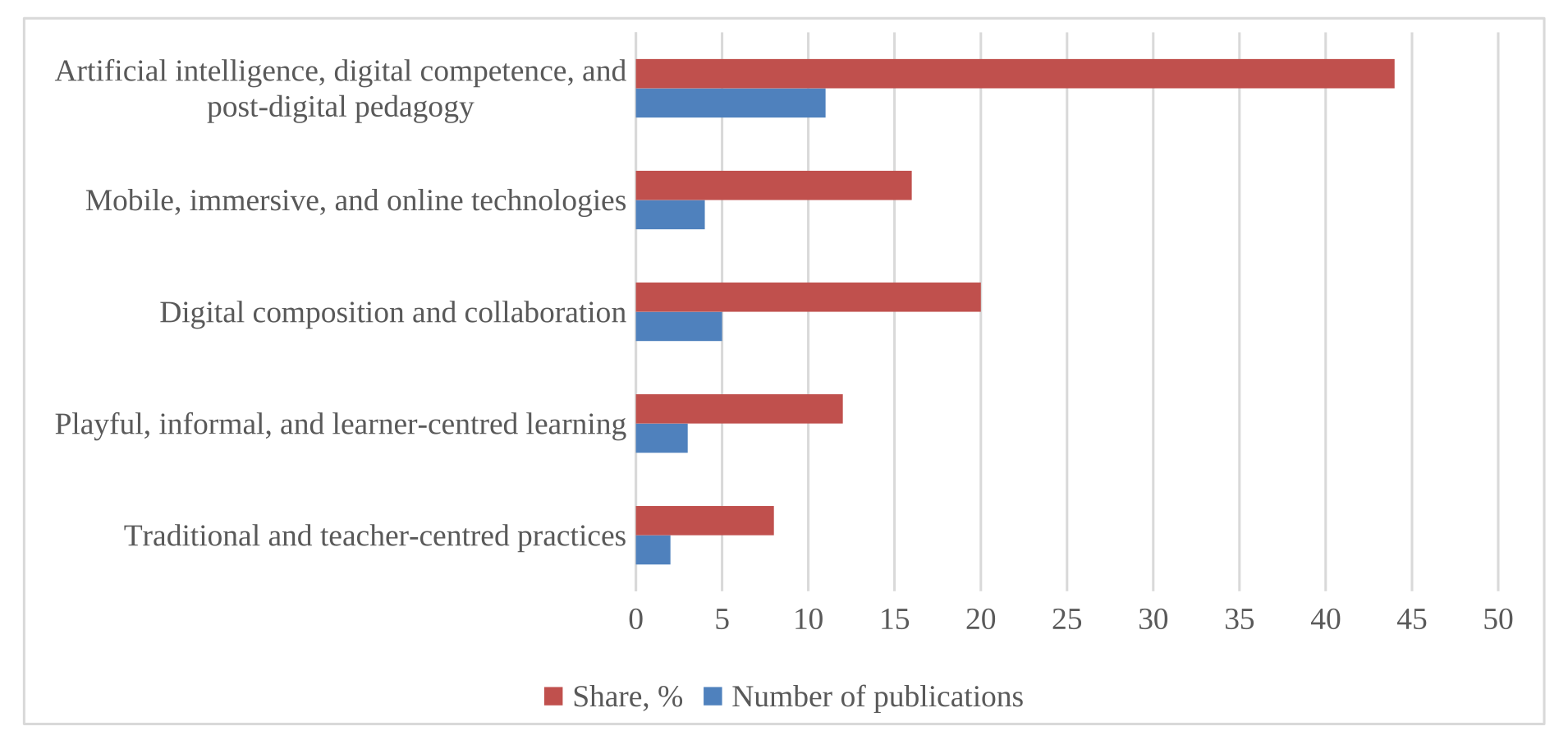
The largest theme was artificial intelligence, digital competence and post-digital pedagogy. In total, these articles accounted for 44.0 % of the corpus. They shared an understanding of digitalisation as transformation in the organisation of teaching, and not as simply the adoption of new software. Pre-eminence was given to Technological-Pedagogical Knowledge, professional preparedness, institutional support and the ability to retain musical judgement in digitally mediated learning [5], [6], [18], [19]. Generative artificial intelligence was researched for composition, personalised feedback, lesson preparation and differentiation. Nevertheless, they also revealed threats to authorship, validity of assessment, overreliance on generated content, and the incremental undermining of autonomous creative decision-making [16], [17]. The distribution of the reviewed publications by analytical category, %. source: created by the authors is presented in Figure 1.
Digital composition and collaboration were the second largest practice-based categories, representing 20.0% of the publications. Results indicated that digital contexts could promote experimentation, co-authorship, reflection and translocal (moving across geographical borders) participation [1]–[3], [20], [21]. However, the impact on learning was task structure-dependent. Technology enabled deeper engagement when students made their own choices about sounds, organization of musical material, revision of compositions, and discussion of creative decisions. When digital tools were employed merely to run exercises created in advance, the prevailing teacher-centered approach was not really challenged—its model was left intact, in other words.
Mobile apps, music video games, virtual reality, and online instrument platforms made up 16.0% of the corpus. These technology features were related to immediate feedback, performance visualisation, repetitive practice, motivation, and self-regulation [4], [13], [22], [23]. Mixed reality was particularly relevant for visual guidancein piano learning, but online instrumental teaching held learners more accountable for scheduling practice and sustaining motivation. Meanwhile, for longer-term effects there was less consistent support for the notion that interpretive development, expressive performance, and an independent musical judgement were enhanced through such involvement.
Playful, informal, and learner-centred methods accounted for 12.0% of the sample. These studies focused on exploration, personal musical interests, social participation, and reduced fear of making mistakes [14], [24], [25]. These strategies enhanced learner autonomy and democratized music education for participants who did not consider themselves musically capable. Their limitation was the potential for disjointed learning, if play, informal participation, or culturally familiar content was not linked to explicit musical development.
Throughout the corpus, creativity and participation were the most frequently reported outcomes. Motivation, self-regulation, musical skill development, and teacher competence were also the focus of several studies, albeit investigated using different instruments and methodologies. Hence, the synthesis certainly did not support a blanket statement to the effect that digital technologies inherently enhanced music education. Their added value was maximised when allied with teacher direction, learner autonomy, collaboration, culturally responsive content and well-articulated musical aims. They did, however, alter delivery formats, but infrequently did they alter pedagogical models.
It can be concluded that digital transformation in music education is most effective when it leads to a transformation of the learning architecture rather than just substituting old tools. This result is relevant since the dominant topics of the reviewed publications were underpinned by the themes of artificial intelligence, digital competence, and post-digital pedagogy, while teacher-centred practices represented a minor portion to the corpus. The shift thus seems to be a redistribution of agency: students are writing, experimenting, collaborating, and self-regulating at an ever increasing pace, while teachers craft meaningful musical scenarios.
The prevalence of digital creation and collaboration in these findings is consistent with that of Tejada et al. [20], who found that electroacoustic works can foster both creativity and the enhancement of digital skills in student teachers. Our synthesis adds that these benefits depend on learners taking real musical decisions. When software is used solely to play back predetermined exercises, the form is altered but the instructional model is traditional. This reading accords with Wise [21], who found that teacher approaches to digital composition varried markedly based on their beliefs about creativity, control, and the purpose of technology.
The resuls also support Treß’s [19] post-digital viewpoint. Technology proved most useful when embedded in participatory, maker-centric, and inquiry-based activities rather than isolated as an novel element. However, at the same time, the reviewed corpus suggests a limitation: participatory formats do not necessarily imply a systematic musical advancement. Learners need to be given autonomy but with a supportive scaffolding around it with feedback and explicit learning outcomes.
The connection between self-regulation and acknowledged importance is also consistent with the findings of Utermohl de Queiroz et al. [23], who related successful online instrumental learning with motivation, social interaction and environment management. Our findings suggest that online modalities can empower learner responsibility, but they can also impose excessive organizational demands on students. That’s especially critical in situations where learners are novices in designing practices, or in evaluating their own performance.
The value ascribed to playful, informal, and learner-centred strategies is also consonant with Weatherly et al. [25]. Informal learning has the potential to support engagement, perceptions of relevance and confidence, particularly when students engage with familiar musical forms and practices. Yet, the current narrative reveals that informal learning should not be equated with a lack of pedagogical organisation. In the absence of planned sequences, exploratory learning may likewiseremain stimulating, but give rise to uneven development in musical accomplishment.
In sum, the results illustrate that innovation in music education is not simply a matter of the uptake of digital platforms, artificial intelligence, or immersive environments. Its pedagogical impact is a function of interaction among musical objectives, teacher expertise, student autonomy, collaboration, and scaffolding. Future studies are required to contrast long-term learning performance among traditional, blended, and post-digital approaches, especially with respect to expressive performance, autonomous musical judgement, and long-term creative development.
The study turned out that the contemporary music education is being advanced with the fusion between traditional methodologies and digital, cooperative, pervasive and post-digital methods. A total of 25 peer-reviewed articles were reviewed that 72.0% of the corpus was published in the years of 2023-2026 which manifest a soaring research interest on technology-supported music learning. Artificial intelligence, digital competence and post-digital pedagogy grouped with 11 (44.0%) of the publications as the largest group. Digital composition and collaboration (20.0%) mobile, immersive and online technologies (16.0%) playful and learner-centred learning (12.0%) and traditional teacher-centred practices (8.0%).
The instrument was designed to measure that to what extent the value of technology education is driven by musical goals. Digital tools were particularly useful as the participants wrote, played with, collaborated on, revised and decided on the musical material independently. The most frequently cited outputs are creativity and participation. Of note were improvements in motivation, self-regulation, musical ability, and teacher proficiency, although these measures were assessed in diverse manners across the reviewed papers.
Traditional methods are still essential to forge the comprehensive playing technique, sight reading, acute listening, systematic training and self-disciplined practice. Still, their pedagogical potential is further enhanced when they are combined with improvisation, digital composition, interactive feedback, partnership projects, and learner-centred activities. The findings thus argue in tage of digital as an medium for replacement traditional teaching, rather than a full replacement of traditional teaching by digital (tools).
That is, music teacher education needs to include more than technical training, but should include pedagogical reflection, informed software use, responsible engagement with generative a I, and approaches to evaluating creative and musical work. The education departments should provide the technical assistance and sufficient time necessary for teachers to revamp learning assignments. Digital assignments, from left to right: they promote authorship and interpretation, cultural relevance and independent musical reasoning.
The study was constrained by the purposive sample of 25 English-language publications. Differences in study design, place of education, participants, and outcomes meant that statistical meta-analysis was not possible. In addition, attributing a dominant category to each article facilitated analyses-despite this, some articles could have been classified in more than one pedagogical strategy.
Further investigation should include larger multi-language samples, longitudinal designs, as well as comparisons between traditional, hybrid, and post-digital paradigms. Particular attention should be paid to long-term development as a musician, expressive performance, access, authorship, and implications for music education should these aspects be sustained through generative AI dependence.
Not applicable. The study analyzed previously published, publicly available literature and involved no human participants or animals.
Not applicable.
The authors declare no competing interests.
There is no specific funding to support this research.
This study analyzed publicly available peer-reviewed publications retrieved from Scopus, Web of Science Core Collection, ERIC, and Google Scholar. No original datasets were generated. The analyzed materials are available through the respective databases and publishers.