
Decisions about undergraduate research education are frequently supported by accounts of students who struggle to combine scholarly work with professional training. Such accounts matter because a curriculum is experienced through particular demands: an examination, a clinical placement, an unanswered request for supervision, or a paper that cannot be accessed. Yet an institutional decision usually concerns a different object, such as a timetable, an assessment rule, a supervisory allocation, or a library service. Moving between these objects requires interpretation. The fact that an experience has been reported does not by itself establish who should respond, how extensive the problem is, or whether a particular response will succeed.
Research instruction has been approached through dedicated teaching, supervised projects, and activities outside the formal curriculum. Guidance on developing medical students’ research skills emphasizes the educational design of these opportunities [1]. Reviews of scholarly participation describe considerable variation in the experiences offered and in the outcomes used to judge their value [2]. Extracurricular participation introduces an additional distinction between opportunities that exist institutionally and opportunities that a student can realistically use [3]. These contributions establish the relevance of research education while leaving local decision makers responsible for examining the evidence behind particular changes.
Students’ descriptions can identify matters that administrative records overlook. Confidence in performing research and perceived impediments to doing so need not coincide, as a mixed-methods investigation of medical students illustrates [4]. A qualitative investigation in Pakistan likewise examines difficulties and possible responses through participants’ accounts [5]. Recent work on medical students and residents further demonstrates the continuing relevance of training, support, and institutional conditions [6]. These studies provide contextual literature; their participants and numerical findings are not combined with the document examined here. Cross-study agreement would require a separate selection and synthesis procedure.
The quotation is a particularly influential device in this transfer from experience to institutional discussion. It allows readers to encounter a participant’s phrasing and can make an interpretation inspectable. Lingard explains how quotations contribute to an argument through their selection, placement, and surrounding interpretation [7]. More recent guidance examines selection and reporting practices directly, including the risk that illustrative material may be treated as more representative than its selection warrants [8]. A quotation can substantiate the presence of an account without indicating how often that account occurred. The distinction is especially consequential when multiple quotations carry identical demographic descriptions.
Documents are not transparent containers of everything that happened during an investigation. They are constructed for a purpose, an audience, and a constrained publication format. Document analysis therefore attends to what a text includes, how it organizes material, and what it leaves unavailable [9]. The READ approach makes the preparation, registration, analysis, and distillation of documentary material explicit [10]. Work on healthcare documents similarly stresses systematic decisions about document selection and interpretation [11]. Applied to a research article, this orientation shifts the question from whether unpublished experiences existed to what the publicly accessible report actually permits a reader to inspect.
This distinction also changes the role of numbers. Enumeration can clarify a qualitative report when the counted object and denominator are specified. Maxwell discusses the value of numerical information within qualitative reasoning [12], while Sandelowski identifies errors that arise when counts are used without attention to their meaning [13]. Counting displayed quotations is legitimate as a description of an article. Treating those quotations as independently sampled students is a different operation, requiring information that demographic labels alone cannot provide. A count can therefore increase transparency while remaining deliberately limited in its inferential role.
An educationally useful audit must also avoid equating reporting completeness with the quality of all research activity behind a report. Qualitative appraisal asks whether questions, methods, interpretations, and claims fit together [14]. Reporting standards help readers inspect those relationships, but they cannot reveal unreported procedures simply by listing expected items [15]. For interview studies, COREQ draws attention to participant description, analysis, and the use of supporting quotations [16]. The purpose here is not to award a checklist score. It is to specify the consequences of available and unavailable information for decisions about undergraduate research provision.
The distinction between a reported difficulty and an institutional responsibility is also a distinction between kinds of evidence. Students are well placed to describe the demands they encounter, the assistance they receive, and the consequences they perceive. They are not necessarily positioned to describe the full allocation of departmental resources or the reasons behind a service restriction. An institutional record can answer some of those latter questions but may say little about how access is experienced. The two perspectives can complement each other without being interchangeable. In the absence of the administrative record, the responsible interpretation is to retain the student’s account and delimit the administrative conclusion.
The purpose of a qualitative inquiry should determine the level of explanation it attempts. Introductory guidance for medical educators distinguishes questions about experience, meaning, and social processes from questions about frequencies or effects [17]. Finn and colleagues similarly emphasize alignment between the research aim and the selected methodology [18]. In this investigation, the question concerns the documentary support for institutional deliberation. It therefore calls for an account of attribution and interpretive movement, rather than a model of individual motivation or a claim about how all students progress through research activity.
The public visibility of a voice is not the same as the quality or completeness of that voice. A short quotation can make a highly consequential problem intelligible; a long quotation can remain ambiguous about the circumstances that produced it. The relevant issue is whether the interpretation has enough support for the particular claim being made. A statement that equipment was perceived as inadequate requires different support from a statement that equipment failed a technical inspection. The former can be documented through a displayed account. The latter requires a separate observation with appropriate technical criteria.
A further distinction concerns the role of conceptual language. Qualitative scholarship can move beyond description, but conceptual development needs a transparent relationship to the material under interpretation. Broom discusses this challenge in conceptualizing qualitative data [19]. The present audit uses institutional responsibility as an interpretive question rather than treating it as a property directly measured in interviews. The designation of a responsible service is an argument about where an issue could be examined. It remains separate from the participant’s statement and from any documented organizational mandate.
These distinctions have practical consequences for educational equity. If only selected voices are visible under a particular heading, allocating assistance to a demographic group on that basis would confuse reporting patterns with need. Conversely, excluding a concern because it appears in a single quotation would make frequency of display a condition for institutional attention. Neither inference is warranted. Deliberation can acknowledge an account, identify the service implicated, and seek the information needed to determine its extent. This sequence respects students’ experience while avoiding an unsupported comparison between groups whose complete accounts are unavailable.
The present study asks: which institutional decision areas are supported by the displayed student accounts, how broadly are those accounts attributable within the reported sample categories, and which conclusions remain unsupported when attribution and quotation dependence are examined? The contribution is an auditable connection between documentary visibility and the level of institutional claim that can reasonably follow. It does not estimate how common the barriers are, infer differences between medical and dental students, or evaluate an educational intervention. Its object is the evidential basis for institutional deliberation.
The qualitative investigation of undergraduate research engagement at Nishtar Medical University, Multan, Pakistan [20]. The article was selected because it was the specified material for this investigation, not through a systematic literature search. The unit of analysis was a displayed quotation block in the findings section. Eligibility required typographic presentation as participant speech within one of the four findings themes. Discussion passages repeating or paraphrasing earlier quotations were excluded to prevent counting the same documentary illustration again.
The distinction between preserving meaning and reproducing wording was handled through descriptive summaries. No quotation was lengthened, completed, or rewritten as if additional participant speech were available. The register’s summaries are analytic descriptions, not verbatim utterances. Systematic text condensation provides a useful methodological account of the relationship between meaning units and condensed descriptions [21]; the present procedure does not claim to reproduce its full phenomenological method. Its more limited purpose is to preserve the explicit concern and a stable route back to the displayed block.
The register does not silently repair the article’s attribution. The absence of a label on Q14 is preserved even though its position beneath other mentoring quotations might invite an assumption about its speaker. Positional proximity does not establish identity. Similarly, repeated MBBS female labels are not merged into one person or counted as separate people. These decisions protect the distinction between information visibly present and information a reader could plausibly imagine. They also ensure that a future correction to a label would be a transparent change to the register rather than an invisible assumption embedded in the calculation.
Three levels of attribution were distinguished: the quotation block, the programme–gender label, and the unique participant. The first is identifiable by page and position. The second is available for 13 blocks. The third is unavailable because the printed descriptors contain no individual pseudonym or unique code. Two blocks labelled MBBS female may therefore originate from one participant or from different participants. They remain two blocks in the register, but their relationship at the person level is unknown. No attempt was made to infer identity from wording, topic, or similarity of phrasing.
For descriptive comparison, the proportion of attributed blocks in each programme–gender group was placed alongside that group’s proportion in the participant table. The block denominator was 13; the participant denominator was 45. The two percentages describe different objects and were never treated as estimates of the same sampling quantity. Programme and gender were jointly retained because collapsing either dimension could conceal the limited coverage of a particular thematic section. Unspecified labels were excluded only from group-specific percentages and were otherwise retained in the corpus.
Coverage was defined as the number of theme–group combinations containing at least one explicitly attributed block. With four themes and four programme–gender groups, there were 16 possible combinations. The coverage proportion was calculated as
where \(n_{tg}\) counts displayed, attributed blocks in theme \(t\) and group \(g\). This proportion measures visibility in the findings pages. A cell without a displayed quotation does not indicate that no participant in that group experienced the concern. It indicates only that a reader cannot inspect a labelled quotation from that combination in the defined corpus.
An institutional referent was defined as the concrete object of a student’s concern that could be examined by an educational or research service. Seven referents were used: scheduling, assessment, recognition, practical training, equipment, literature access, and faculty availability. Coding remained close to explicit content. Methodological work on content analysis distinguishes descriptive categorization from deeper interpretation [22], [23]. Guidance on abstraction similarly emphasizes the need to keep the move from a meaning unit to a category visible [24]. Accordingly, the register preserves the location and concise rationale for each assignment rather than presenting the categories as self-evident discoveries.
Scheduling covered accounts organized around the allocation of time to coursework or clinical duties. Assessment covered the prioritization of grades, memorization, or examinations. Recognition concerned the expected reward for research effort, including a future allowance. Practical training concerned instruction in doing research. Equipment concerned laboratory technology or maintenance. Literature access concerned obtaining scholarly publications. Faculty availability concerned the time that teachers could devote to guidance alongside other duties. One primary referent was assigned to each block to make the enumeration interpretable; this choice did not assert that each account had only one meaning.
The categories are analytic assignments in a computer-assisted document audit. Registration, classification, and drafting used language-model assistance; inspection of rendered PDF pages and executable arithmetic made these outputs inspectable. There was no independent human coding exercise, participant validation, or calculated agreement coefficient. Intercoder agreement depends on an actual comparison between coders and cannot be inferred from consistent software output [25]. The relationship between descriptive and interpretive work was made explicit in the register, in keeping with content-analysis guidance for health professions education [26].
Three additional checks tested dependence on the registered material without introducing simulated students or interview responses. First, the unspecified programme–gender label of Q14 was assigned in turn to each of the four observed groups. This operation bounded the possible change in thematic coverage under the available categories. It did not impute an actual participant identity. The lower bound retained the observed coverage whenever the assigned group was already represented in the mentorship section; the upper bound allowed one additional combination when it was not.
Second, each quotation block was deleted once and the number of represented referents was recalculated. For a corpus \(Q\) and its set of represented referents \(R(Q)\), the retained count after removing block \(i\) was
This is an exhaustive finite perturbation of 14 displayed blocks. It is not a bootstrap, a sampling distribution, or a test of statistical significance. Its purpose is to distinguish a referent illustrated by multiple blocks from one whose direct quotation support depends on a single location in the document. Survival under deletion does not establish independent participant corroboration because unique speaker identities remain unknown.
Third, Q07 received an additional assessment assignment while retaining its primary practical-training assignment. The block explicitly connects practical preparedness with the emphasis on grades and memorization, making it a defensible location for testing a nonexclusive reading. The check asks whether permitting this one overlapping assignment changes the set of institutional concerns. It does not claim to exhaust every possible interpretation. All checks were performed by the accompanying script from the unchanged quotation register, and the full outputs are retained for inspection.
A second interpretive step linked each referent to an institutional question. This step identified a plausible unit capable of examining the concern, such as a curriculum committee, research office, departmental leadership, laboratory service, or library service. These units were proposed for deliberation; their actual responsibilities at the university were not documented. Assigning a question to a unit therefore does not establish fault, existing policy, or authority. The mapping asks what would need to be checked before an institutional response could be specified.
The analysis distinguished an observed documentary fact, an interpretation of a quotation’s content, and an untested institutional response. Documentary facts include the number and placement of blocks and their printed labels. Interpretations identify the concern expressed. Responses, such as reviewing timetable allocations or checking access arrangements, require further institutional evidence. This separation prevents a student account of limited opportunity from becoming an unsupported claim that a particular curriculum change will increase research participation. It also keeps educational recommendations proportionate to the narrow observational material available.
The work used publicly displayed article content without contacting students or accessing private interview material. It does not claim a new participant consent process or a new ethics approval. The document’s account of interview procedures is treated as reported context rather than as a procedure performed here. Participant protection requires particular care when descriptive labels are sufficiently detailed to invite identity inference [27]. The register therefore retains only the programme and gender categories and does not add names, inferred identities, or private information.
The audit is neither a reconstruction of complete interviews nor a qualitative evidence synthesis. Its reporting follows the principle that analytic claims should be linked to identifiable material and that unavailable information should remain explicitly unavailable. The distinction between primary qualitative analysis and other designs is reflected in journal reporting guidance [28]. The reproducible component is the transformation of an inspectable register into counts and plots. The interpretive component remains open to disagreement about category boundaries and institutional relevance. Those two forms of accountability are related, but neither substitutes for the other.
Fourteen eligible quotation blocks were identified. Three appeared under time constraints, four under motivation, knowledge, and ability, three under financial assistance and facilities, and four under mentorship and training. The distribution follows the organization of the findings pages. It should not be interpreted as a ranking of the four concerns because quotation selection and available publication space can influence how much material appears under a heading. The complete register preserves the individual blocks instead of treating a thematic heading as the unit counted.
Thirteen blocks had both programme and gender labels. Six were labelled MBBS female, three MBBS male, two BDS female, and two BDS male. One final training account was unlabelled. These descriptors establish which groups are visibly represented, but they do not establish whether the 13 attributed blocks correspond to 13 different students. The reported interview sample remains 45 people. The documentary corpus remains 14 displayed blocks. Neither quantity can be substituted for the other in a statement about participation or experience.
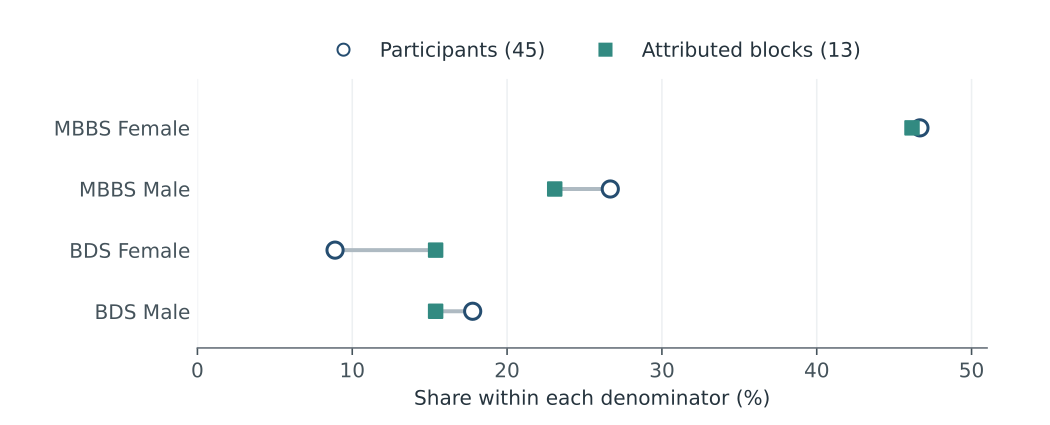
The comparison in Table 1 describes the composition of two documentary objects. Female BDS labels account for 15.4% of attributed blocks and 8.9% of the interview sample, a difference of 6.5 percentage points. This does not demonstrate preferential quotation selection, disproportionate participation in interviews, or a greater burden of research difficulties. The number of words spoken, the range of experiences described, and the editorial reasoning for selecting quotations are unavailable. The legitimate finding is a difference in visible composition, with its interpretation restricted accordingly.
| Printed group | Participants | Participant share | Blocks | Block share |
|---|---|---|---|---|
| MBBS female | 21 | 46.7% | 6 | 46.2% |
| MBBS male | 12 | 26.7% | 3 | 23.1% |
| BDS female | 4 | 8.9% | 2 | 15.4% |
| BDS male | 8 | 17.8% | 2 | 15.4% |
| Total | 45 | 100% | 13 | 100% |
| Participant counts are credited to Table 1, PDF p. 4, of the article identified in Materials and methods. Block counts are this audit’s enumeration of the findings on PDF pp. 5–7. Q14 is unspecified and excluded from the block-share denominator. Rounding may affect displayed totals. | ||||
The paired positions in Figure 1 distinguish the composition of the sample from the composition of its displayed illustrations. The near coincidence of the MBBS female points does not establish representative quotation selection, just as the separation of the BDS female points does not establish selection bias. Those interpretations would require a defined selection process and unique participant linkage. The graphical comparison instead makes the denominators explicit and allows readers to see why group presence alone is insufficient for a claim about whose experience was most common. Q14 remains outside the attributed-block denominator, preserving its unresolved status rather than assigning it to the group that would make the comparison appear more balanced.
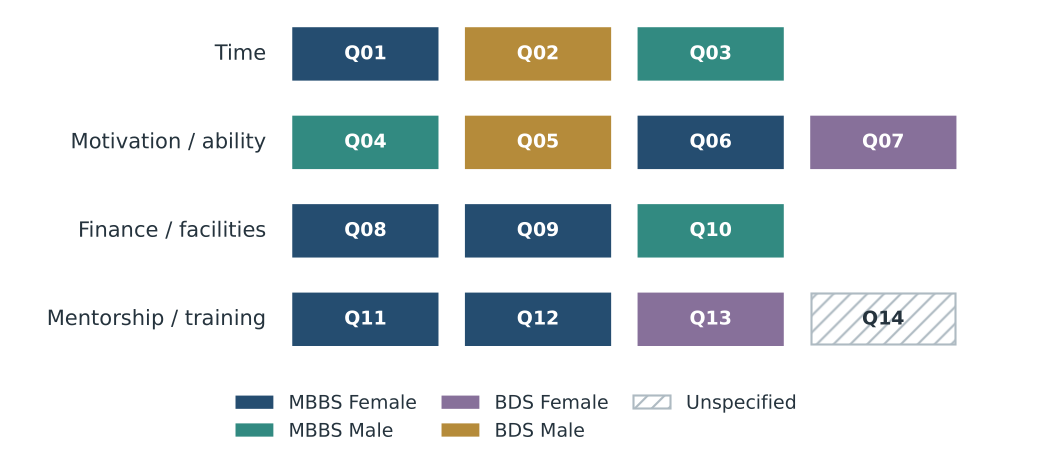
Eleven of the 16 possible programme–gender–theme combinations contained at least one attributed block, giving \(C=68.75\%\). The time section included MBBS female, MBBS male, and BDS male labels. The motivation, knowledge, and ability section included all four groups. The financial assistance and facilities section included MBBS female and MBBS male labels. The mentorship section included MBBS female and BDS female labels, together with the unspecified training account. Thus, broad representation across the article coexisted with unevenly distributed visibility within individual themes.
The financial and equipment discussion is particularly instructive. Its three displayed quotations contain two female MBBS labels and one male MBBS label. There is no labelled BDS quotation in that section. The document therefore supports the presence of those concerns in the displayed MBBS accounts, while the extent to which the same concerns were articulated by BDS interviewees cannot be inspected from those quotations. This distinction does not overturn the thematic interpretation. It specifies how far subgroup language can travel when the reader relies on the publicly visible evidence.
The mentorship section exhibits a different limitation. The three labelled blocks describe female students’ accounts, while Q14 is unlabelled. Male students may have discussed mentoring during their interviews, but the displayed material does not establish that contribution. The absence of a label is an attribution limitation, not evidence of a gender difference in access to supervisors. It would therefore be inappropriate to describe mentorship as a predominantly female difficulty or to infer that male students had adequate support. The theme is visible; its participant distribution is not recoverable.
The ordered strips in Figure 2 show how 14 quotation locations differ from 11 occupied theme–group combinations. Repeated colours within a strip identify repeated printed labels, not repeated speakers. The financial section, for example, contains three blocks but only two programme–gender groups. This distinction is lost if blocks are counted without their thematic location. The unfilled Q14 square also prevents the visually prominent training request from acquiring an identity by association with neighbouring quotations. The display consequently makes both the material available for interpretation and its attribution limits visible at the same scale.
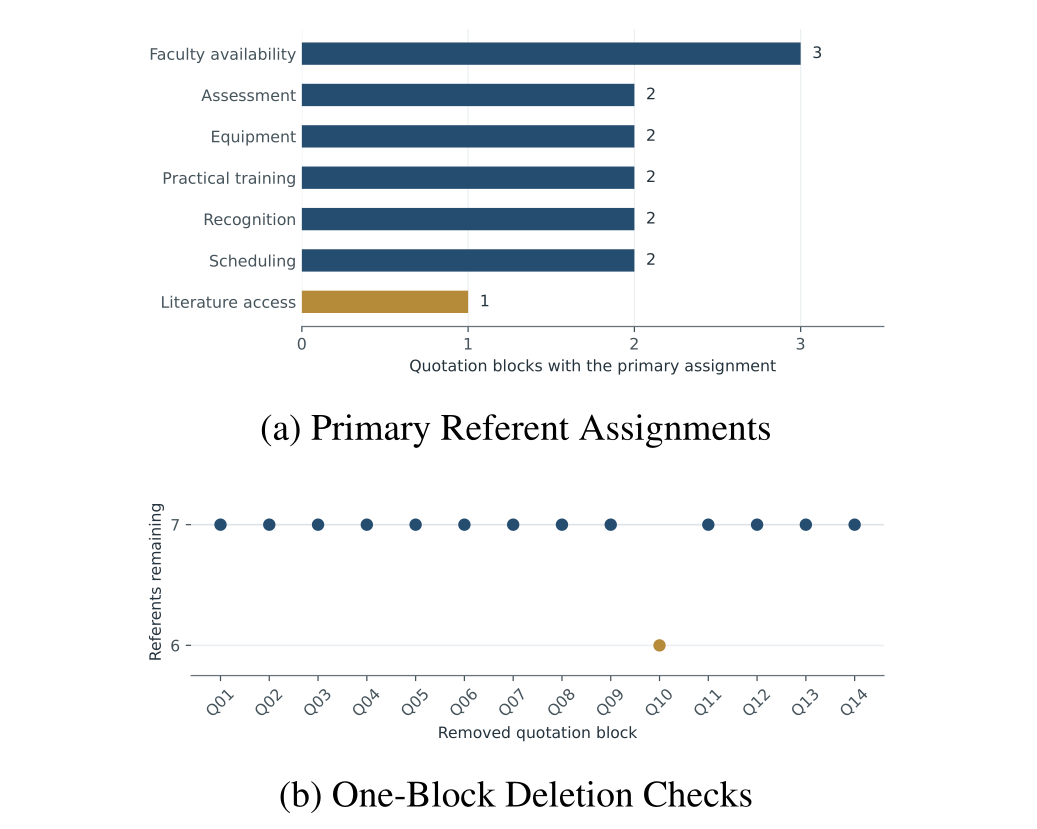
Primary coding identified seven referents. Faculty availability occurred in three blocks. Scheduling, assessment, recognition, practical training, and equipment each occurred in two. Literature access occurred in one. These counts describe the distribution of primary assignments and sum to 14. They do not measure the magnitude of a problem. A single detailed account can identify an administratively consequential issue, while several similar quotations may repeat a concern already established. The number of blocks is therefore used to show documentary concentration rather than to determine an order of institutional spending.
The scheduling accounts identify competition between research and scheduled educational duties. Their institutional relevance lies in whether expected research work has a defined place in the timetable. The assessment accounts identify the priority given to examinations and grades. Their relevance lies in what the assessment system makes consequential for progression. Recognition concerns ask whether effort receives an intelligible return within undergraduate study. These are separable questions even when the same student experiences them together. Timetable allocation, assessment design, and research recognition are different administrative decisions.
Practical training appears once in the motivation and ability section and once in the mentorship section. This cross-heading presence matters because the relevant institutional object is instruction rather than the name of the thematic category. Equipment accounts concern perceived limitations of laboratory technology and maintenance. The literature-access account identifies dependence on an overseas contact to obtain papers. Faculty-availability accounts concern the competing responsibilities that constrain guidance. Together, these referents shift deliberation toward identifiable educational services without implying that the services have already been audited.
The equipment and literature-access entries in Table 2 also distinguish two kinds of provision that the broad financial heading places together. Equipment is a project-specific requirement whose relevance depends on the research question and the condition of the available instrument. Literature access concerns the ability to examine existing knowledge before and during a project. Combining both under a general request for funding could obscure different remedies. The table therefore separates their administrative questions while preserving the fact that both arose within the same thematic section. This is an interpretive distinction about the object of inquiry, not a finding that one service is more deficient.
| Referent | Blocks | Question for institutional examination |
|---|---|---|
| Scheduling | Q01–02 | What research work is expected, and when can it be completed within scheduled duties? |
| Assessment | Q03, Q06 | How do assessment rules recognize research learning relative to examination performance? |
| Recognition | Q04–05 | What forms of recognition are available during undergraduate study, and who can access them? |
| Practical training | Q07, Q14 | Which supervised research tasks are taught and assessed in practice? |
| Equipment | Q08–09 | Which proposed projects require particular equipment, and is that equipment functional? |
| Literature access | Q10 | Can students obtain the publications needed for an approved project through institutional services? |
| Faculty availability | Q11–13 | What protected supervisory capacity exists, and how is it allocated? |
| The block locations are recorded in the quotation register; referents and institutional questions are this audit’s interpretations of the findings on PDF pp. 5–7, not additional interview responses. | ||
The questions in Table 2 specify an evidential next step for each referent. They do not prescribe a uniform programme. A laboratory-service check might establish that existing equipment is adequate for a feasible question, that maintenance is required, or that a different project design is educationally preferable. A library-service check might identify a genuine access restriction or a lack of awareness of available provision. Those possibilities cannot be distinguished from the quotations alone. Institutional investigation is needed before the interpretation becomes a resource decision.
The dominant primary referent was faculty availability, but its three blocks share an additional documentary feature: all are attributed to female students. Two carry MBBS labels and one a BDS label. This permits a limited statement that the displayed concern crosses programme labels within the female category. It does not permit a statement about comparative mentoring access by gender. The same numerical result can therefore support a cross-programme observation and fail to support a gender comparison. Maintaining the joint labels is what makes that distinction visible.
The training referent illustrates a different relationship between support and uncertainty. Q07 has a BDS female label, whereas Q14 has none. Removing Q14 leaves practical training represented, which explains its stability in the deletion check. Nevertheless, the missing attribution still limits the ability to compare who voiced the training concern. Referential survival and subgroup attribution answer different questions. A referent can be stable under a deletion check while remaining incompletely attributable. This is why a single summary of robustness would be inadequate for the present evidence.
The financial heading contains a contextual account of a USD 1,300 publication charge, but that amount does not occur in an eligible displayed quotation block. It is consequently excluded from the seven-referent frequency calculation. The decision preserves the stated unit of analysis rather than treating an arresting numerical detail as an additional interview observation. The amount is a contextual report, not a verified invoice or a current journal price. Neither the access classification nor the institutional questions depend on accepting the amount as representative of publication costs.
Allocating Q14 to either female group left thematic coverage at 11 combinations because both groups already appeared in the mentorship section. Allocating it to either male group increased coverage to 12 combinations. The resulting interval was 11–12 of 16, or 68.75–75.00%. No possible allocation within the four printed groups achieved complete coverage. The missing label therefore affects the exact extent of visibility, but resolving it would not remove the wider limitation on theme-specific attribution.
The deletion check retained all seven referents in 13 of the 14 removals. Removing Q10 reduced the represented set to six because literature access had no other primary quotation assignment. Removing any other block preserved the seven-referent set. This result identifies the location on which the direct quotation evidence for literature access depends. It does not imply that the concern is unreliable, uncommon, or less consequential. A limited documentary support base calls for careful specification and further inquiry, not automatic exclusion from institutional consideration.
The empty combinations in Figure 2 cannot be completed by proportionally distributing the unspecified block. Such a calculation would produce an appearance of demographic balance without adding observed attribution. The bounded allocation instead keeps all four possibilities visible and demonstrates that none resolves the absent BDS labels in the financial section. That concrete result identifies where additional contextual explanation would be needed if the manuscript were to discuss finance as a programme-specific experience. It also explains why retaining an unknown category is analytically preferable to silently making the record appear complete.
The nonexclusive reading of Q07 increased assessment assignments from two to three and total assignments from 14 to 15. The seven-referent set remained unchanged. Thus, the breadth of the institutional questions was stable under this particular boundary decision, while the count assigned to assessment was not. The distinction matters because a numerical ranking based on primary assignments could change with a reasonable interpretive choice even when the substantive agenda for institutional examination did not.
The contrast between Figure 3a and Figure 3b separates repetition from dependence. Faculty availability has the largest primary count, but its position does not establish priority for intervention. Literature access has the smallest count and is the only referent removed entirely by a single deletion. Its amber point identifies an evidential dependency that an institutional reader can check directly at Q10. It does not downgrade the student’s account. The combined reading supports a more precise statement than either chart alone: the seven-area agenda is mostly stable under removal of one displayed block, while one area has a uniquely identifiable and limited direct quotation basis.
The research question concerned the relationship between displayed experience, attribution, and institutional action. The findings support seven areas for institutional examination, but the strength of this contribution is specificity rather than breadth. The audit can identify a scheduling concern, an assessment concern, or an access concern and link each to a visible account. It cannot establish which concern affects the most students or which response would yield the largest educational improvement. Recognizing this boundary preserves the practical value of qualitative material while preventing claims that exceed the available observation.
The analysis also shows why complete demographic coverage at article level is insufficient for subgroup interpretation. All four programme–gender groups appear among the labelled quotations, yet only one of the four findings themes contains all four groups. Readers could therefore leave the article with an accurate impression that both programmes and both gender categories were included, while still being unable to inspect how a particular concern was articulated across those groups. The issue is thematic attribution, not a requirement that every qualitative report contain a balanced set of quotations.
A document can present a persuasive thematic account without providing the evidence needed for every secondary comparison. Content-analysis scholarship emphasizes that interpretation depends on the level of abstraction being attempted [23], [24]. Here, the required level is deliberately modest: a concrete concern is identified, its documentary location is preserved, and a question for institutional examination follows. Claims about mechanisms operating across a whole institution would require more contextual material. Claims about subgroup differences would additionally require a defensible comparison across participant accounts.
The value of the numerical component lies in making the publication’s composition inspectable. The denominators of 14 blocks, 13 attributed blocks, 16 possible thematic combinations, and 45 participants each answer a different question. Keeping them separate prevents an apparently precise percentage from disguising a change in unit. The percentage of attributed blocks carrying a female BDS label is a property of the selected material. It is not the percentage of female BDS participants who encountered a barrier, and it does not reveal the probability that their experience was selected for quotation.
Saturation cannot resolve this problem. Reviews of sample sufficiency show that adequacy depends on how an inquiry is designed and justified [29]. Empirical tests of saturation concern particular analytic procedures and bodies of interview material [30]. Conceptual work further distinguishes the different meanings attached to saturation [31]. A reported interview count or statement of theme repetition therefore cannot be transferred into a guarantee that the displayed quotations are sufficient for the new attribution questions posed here. The present corpus is complete as a set of eligible displayed blocks, not as a representation of everything participants said.
Counts also cannot establish coding reliability. A program can reproduce the same category totals perfectly while the categories themselves remain contestable. O’Connor and Joffe discuss the purposes and limits of agreement procedures [25]; the present work makes no claim to have performed one. Instead, the register permits inspection of a small number of explicit assignments. This is a practical form of transparency appropriate to a document audit, provided it is not inflated into a claim that the interpretation has been independently validated.
The institutional contribution is strongest when an account is converted into a question that can be answered administratively. A student description of examinations taking priority suggests inspecting assessment requirements and time allocation. It does not prove that examinations should carry less weight. A request for structured training suggests examining the sequence and content of supervised tasks. It does not establish that adding a workshop will improve competence. These distinctions separate a plausible response from an evaluated educational effect, and they make the evidence useful to committees without presenting an untested intervention as established practice.
Curriculum development can combine multiple kinds of evidence, including stakeholder accounts, educational objectives, and explicit prioritization procedures. A mixed-methods study of medical research curriculum development illustrates such a combination [32]. The present audit performs only the documentary part of that work. It provides a limited set of questions for curriculum leaders and research services. It does not reproduce stakeholder consultation, infer a consensus, or claim to have determined institutional priorities. Those additional activities would create evidence that the current register does not contain.
Access and equipment require particular restraint. A student’s belief that modern technology is necessary for publishable research is evidence of that belief and its perceived consequences. It is not an objective assessment of instrument performance or of the minimum technology required for a sound project. Likewise, dependence on a personal contact to obtain papers establishes a described access difficulty without establishing the institution’s actual subscription holdings. An effective administrative response would investigate the particular service or project requirement before generalizing from the account to a claim of institutional inadequacy.
A complete inventory of displayed blocks is not a complete qualitative account of the participants. It captures the selection boundary, while interpretation of full interviews could reveal contradictions, qualifications, and contexts that the article did not print. LaDonna and colleagues caution against assuming that short textual responses necessarily support a full qualitative analysis [33]. Although displayed interview quotations are not survey responses, the relevant caution is the same: limited text must be matched to a limited analytic purpose. The audit accordingly concerns documentary visibility and concrete referents rather than the reconstruction of lived experience.
Conceptual depth is also distinct from the number of categories. Nelson discusses the use of depth criteria in evaluating whether analysis can support further theoretical development [34]. Seven categories here should not be read as seven established mechanisms. The register identifies what students explicitly discuss and where an institutional inquiry could begin. The manuscript deliberately avoids theoretical claims that would require detailed accounts of timing, interaction, or changes in experience. Its contribution is to make the evidential threshold for those stronger claims visible.
The presence of numerical checks could otherwise encourage a mistaken impression of methodological certainty. Varpio and colleagues show why familiar qualitative terms require attention to their meanings and methodological origins [35]. The deletion calculation used here is therefore named for the exact operation performed. It demonstrates whether one displayed block is the sole registered support for a referent. It does not demonstrate triangulation, theme saturation, participant agreement, or explanatory validity. Those properties would require distinct procedures and material beyond the present corpus.
A request for protected supervision illustrates the difference between relevance and effectiveness. The faculty-availability accounts make supervisory time a relevant object of inquiry. They do not establish how many supervisors are required, how often meetings should occur, or which balance of individual and group instruction would be appropriate. An institution would need to examine staff commitments, expected project complexity, and student access before choosing an arrangement. An educational evaluation would then need to determine whether the arrangement accomplished its intended purpose. None of those quantities can be derived from three displayed quotations.
Practical instruction requires an equally specific interpretation. The two training accounts indicate a perceived need to learn how research is done. They do not identify which particular skills are absent across the curriculum. A committee could examine whether students practise question formulation, literature retrieval, ethical reasoning, analysis, and writing, but the present evidence does not establish deficiencies in every task. The distinction prevents a focused student request from becoming a claim that the entire methods curriculum is inadequate. It also creates an answerable question about the relationship between expected work and demonstrated instruction.
The assessment and recognition accounts warrant a similarly differentiated response. Assessment determines which performances affect academic progression; recognition may acknowledge contributions without changing progression rules. Q03 and Q06 concern the priority given to grades, whereas Q04 and Q05 concern the value attached to research effort. A committee could therefore alter recognition while leaving the competition for examination preparation unchanged. Conversely, adding assessed research could increase workload if supervision and practical instruction remain unspecified. These possibilities show why the seven referents should not be collapsed into a single motivational explanation, while remaining hypotheses for institutional examination rather than observed consequences.
Intervention development requires information about implementation conditions and the assumptions connecting an action to an intended effect. Medical Research Council guidance on complex interventions emphasizes these considerations [36]. Its relevance here is the boundary between identifying an issue and evaluating a response, not evidence that a particular package of research teaching will work. The documentary audit can help specify questions for that process. It cannot provide an effect estimate, a cost-effectiveness comparison, or evidence of feasibility for an institution whose operational arrangements were not examined.
The literature on scholarly participation provides context for these distinctions rather than a numerical validation of them. Chang and Ramnanan’s review concerns experiences, attitudes, and outcomes across research programmes [2]; the current comparison concerns the evidential presentation of one institutional account. Laidlaw and colleagues address how research-related skills may be taught and assessed [1]; the present register does not determine whether those teaching arrangements were delivered locally. Keeping the functions of these citations explicit avoids presenting general educational literature as confirmation of an unobserved institutional condition. The two bodies of work meet at the questions an educational committee should examine, not at a pooled estimate.
An institution might reasonably begin by checking access to required publications because the question is concrete and potentially answerable through existing services. That practical accessibility would not make literature access the most important barrier. Equally, faculty availability has the highest primary block count but may involve constraints that are difficult to address quickly. The choice of what to investigate first can depend on decision urgency, service remit, and the information already available. Those are deliberative considerations that should be stated openly instead of being hidden behind a ranking of quotation counts.
More detailed attribution can improve interpretability but can also increase disclosure risks. Demographic descriptions should therefore be selected for a clear analytic purpose rather than added mechanically. Kaiser emphasizes the difficulty of preserving confidentiality in qualitative reporting [27]. Discussion of qualitative data sharing likewise identifies tensions between openness, contextual interpretation, and participant protection [37]. A useful response is not necessarily to publish complete transcripts. An accountable register of already displayed material can improve documentary transparency while respecting the limits of public access.
Participant validation and transcript review are separate procedures that should not be implied by careful reporting. Member checking has its own purposes and methodological constraints [38]. Research on interviewee transcript review examines how that process can affect the resulting material [39]. Neither procedure was available in this audit, and neither can be retrospectively attributed to it. The appropriate statement is therefore precise: the public text and its labels were inspected, while their relationship to complete interviews and participants’ later interpretations remains outside the analysis.
Language is another aspect of attribution. The focal article describes interviews conducted in English, and the present audit examines only the printed English material. No translation was performed, and no conclusion about linguistic equivalence is warranted. Younas and colleagues address the importance of representing original-language material when qualitative work involves translation [40]. That discussion identifies a question a reader might appropriately ask of multilingual research; it does not establish that translation occurred in this case. The audit therefore retains the language description as reported and avoids adding a translation procedure that was not documented.
The investigation concerns one specified article from one institution. It is not a comparative audit of medical education and cannot establish how common the observed attribution patterns are. The findings reflect both the interviews described and the decisions that shaped their presentation. Quotations may have been shortened or selected for reasons unavailable to the reader. The absence of unique identifiers prevents person-level linkage, and the unspecified label prevents complete thematic attribution.
The primary referent coding simplifies accounts that can contain several concerns. Its utility is organizational clarity rather than exhaustive interpretation. The classifications were produced with language-model assistance; independent human scholarly validation has not occurred. The institutional mapping additionally depends on assumptions about which services could investigate each concern. Actual university policies, budgets, supervisory workload, laboratory records, and subscription arrangements were not examined. Consequently, the proposed questions should be understood as a bounded contribution to deliberation rather than a completed institutional diagnosis.
The displayed student accounts support seven specific areas for institutional examination: scheduling, assessment, recognition, practical training, equipment, literature access, and faculty availability. They support these areas as articulated concerns, not as ranked causes of limited participation. Attribution is narrower than the sample description might suggest: 13 labelled blocks cover 11 of 16 programme–gender–theme combinations, while unique participants cannot be identified. A useful institutional response is therefore to investigate the corresponding educational arrangements and service responsibilities before choosing an intervention. The paper’s question is answered by locating both the actionable objects in the accounts and the information that remains necessary to justify stronger decisions.
The robustness findings refine the conclusion without changing its evidential level. Six referents survive every single-block deletion, and allowing an additional assessment assignment leaves the seven-area set intact. Those properties show stability of the registered agenda under explicit documentary changes. They do not establish that the agenda is exhaustive or independently corroborated. The appropriate institutional use is to retain the seven questions, mark the particularly limited quotation basis for literature access, and seek the operational evidence needed to decide what action is warranted.
Accordingly, the finding that deserves institutional attention is the availability of a checkable concern, rather than its position in a frequency ranking. A committee can preserve that distinction by recording the cited account, the service question it raises, and the additional evidence required before any change to teaching, supervision, or expenditure is authorized.
This document involved no participant contact or access to private interview records. No new ethics approval or participant consent procedure is asserted.
The accompanying project contains the quotation register, participant-count file, calculation outputs, and executable scripts for every plot and numerical result. Complete interview transcripts and recordings are not included and were not accessed.
A language model assisted with document registration, descriptive coding, calculations, literature identification, and manuscript drafting. Reproducible scripts and page references expose the analytic decisions for scholarly inspection. No independent human coding or author approval is claimed by this document.
The authors declare no conflict of interests.