
Against the backdrop of a rapidly evolving global political communication landscape, public speeches delivered by political leaders have become crucial channels for expressing national strategic intentions, announcing policy directions, and mobilizing responses to crises [1]. Whether they take the form of annual government reports, diplomatic speeches, election campaign addresses, or public health crisis response statements, these texts not only convey policy information but also construct strategic narratives, establish agendas, and shape the public’s cognitive framework for understanding political and social realities [2]. However, traditional political discourse research typically relies on manual content analysis or keyword-based methods, making it difficult to systematically capture the long-term, cross-scenario, and cross-event deep semantic structures and patterns of narrative evolution within large-scale corpora. With breakthroughs in large language models (LLMs) and deep semantic representation technologies, political discourse research is undergoing a new methodological transformation: moving from static analysis that relies on manual coding toward dynamic semantic modeling based on machine learning techniques [3], [4].
Despite these developments, existing research still faces several significant challenges. First, the semantics of political speeches are highly complex and polysemous. The same policy objective may be communicated through different rhetorical devices, tones, and narrative strategies in different contexts, making it difficult for traditional topic models to consistently and accurately cluster these elements [5]. Second, the strategic narrative structure of political discourse often contains multilayered semantic elements, such as “Self—Other—Goals—Means,” which traditional natural language processing (NLP) methods struggle to extract accurately from cross-sentence and cross-paragraph contexts. Third, the framing of political texts is often implicit; for example, rhetorical structures such as metaphors, analogies, causal chains, and emotional mobilization frequently cannot be identified through simple word-frequency statistics and therefore require a combination of contextual reasoning and semantic understanding. Fourth, the temporal evolution of political discourse exhibits significant event-driven characteristics [6], [7]. For instance, financial crises, geopolitical conflicts, and pandemics can trigger abrupt changes in discourse themes and narrative structures, making it difficult for traditional methods to dynamically quantify multidimensional semantic indicators, such as Topic Drift, Embedding Shift, \(\Delta\)FSI, and changes in emotional polarity and modality. In summary, political discourse research urgently requires a comprehensive analytical framework that combines statistical thematic analysis, semantic narrative extraction, and event-driven dynamic modeling [8].
The existing literature has explored this field to a certain extent. In topic modeling, methods such as LDA, NMF, and BERTopic are widely used to identify issues in political texts, but most studies are limited to static topics and do not address the dynamic characterization of semantic drift or changes occurring before and after major events. In narrative research, some studies propose narrative frameworks based on transitional structures, such as crisis–response–recovery, but they lack systematic modeling and the automatic extraction of the four elements of Self–Other–Goals–Means and continue to rely heavily on manual annotation [9], [10]. In framing analysis, some studies focus on the influence of media framing on public attitudes, but the automated detection of micro-level framing devices within broader frames, such as metaphors, analogies, causal chains, and emotional mobilization, remains limited. In temporal evolution research, although some scholars have used time-series models to analyze changes in sentiment or shifts in keywords, few studies have integrated topic drift, semantic-space convergence, the Frame Strength Index (FSI), and modal changes within the same analytical framework. Moreover, there remains a lack of cross-period comparisons involving multiple major event cycles [11].
Based on the shortcomings discussed above, this study proposes a three-level, multidimensional, and interpretable framework for the large-scale analysis of political discourse. The proposed framework integrates topic modeling, strategic narrative extraction, framing analysis, and diachronic modeling. Its aim is to systematically reveal changes in the semantic structures and the dynamic mechanisms of narratives within political leaders’ speeches across different policy scenarios and major event cycles.
To scientifically analyze the evolution of strategic narrative structures and framing patterns in the speeches of political leaders, this study first constructed a corpus characterized by strong temporal continuity, broad contextual coverage, and highly reliable sources [12]. The primary principle of data collection was the integrity of the time series, ensuring that sufficient speech samples were available for each year within the selected time interval \(T=\left[t_{0},t_{n}\right]\), thereby making the analysis of narrative changes across different years statistically meaningful. Let \(S(t)\) represent the set of speeches delivered by political leaders at time \(t\); then, the overall corpus can be defined as:
where \(\delta\) represents the minimum number of speeches collected per year, a threshold that considers both thematic distribution and contextual heterogeneity. Furthermore, the data must cover five typical political scenarios: speeches delivered before legislative bodies, foreign policy statements, crisis response speeches, economic policy reports, and election or campaign speeches. Therefore, the annual corpus must satisfy the following requirements:
Regarding the data sources, this study strictly limited data collection to authoritative sources, such as official government websites, parliamentary gazettes, and verbatim transcripts published by official media organizations, thereby ensuring that the texts had not been edited by external news media or retransmitted through social media platforms. The corpus constructed in this study is characterized by strong traceability, a continuous timeline, and diverse political contexts, providing a rigorous data foundation for subsequent computational linguistics processing and model-based analysis.
After the corpus was constructed, systematic text preprocessing was required to ensure that the data could be effectively used for advanced tasks such as semantic analysis, narrative structure extraction, and event-chain recognition [13]. This study adopts a hybrid approach combining “classical NLP modules + a Large Language Model (LLM)” to achieve synergy between fine-grained structural parsing and high-level semantic induction.
This step is completed by combining regular expressions with word-frequency statistics to ensure the formalization of the linguistic structure while preserving the original semantic content.
To perform a fine-grained analysis of speech texts according to thematic, event-based, or temporal dimensions, this study employs a segmentation method based on semantic embeddings. First, a Transformer model is used to generate sentence vectors \(e_{i}\), after which the semantic distance between adjacent sentences is calculated as follows:
A semantic paragraph boundary is identified when the following condition is satisfied:
Here, \(\theta\) is adaptively determined using the “mean + standard deviation” of the distance distribution calculated across the entire text. This method can effectively capture thematic transition points while avoiding the subjective bias that may arise from manual text segmentation.
To capture the “Subject–Action–Object (SVO)” structure embedded in strategic narratives, this study employs dependency-parsing techniques. Let each word be represented as:
The following structural relationship is then extracted:
This step can reveal how political leaders construct their “self-role,” how they describe other actors, and how they articulate causal chains, thereby providing structured linguistic data for subsequent narrative logic analysis.
Named entity recognition is used to identify countries, individuals, organizations, and events mentioned in political speeches, providing a foundation for analyzing the “Self–Other” construction within political narratives. Let the entity set be expressed as:
where
The entity co-occurrence matrix is then constructed as follows:
This matrix is used to analyze changing trends in narrative relationships, cooperative interactions, and patterns of conflict among different political entities.
To capture the action chains contained within political narratives, this study uses an event-extraction model that represents each event as a five-tuple:
where \(A\) represents the event action or trigger word, such as “announce” or “start”; \(T\) represents the time; \(P\) represents the actor; \(O\) represents the object; and \(L\) represents the location.
The event-extraction results are subsequently organized according to the following structure:
These structured results can be used to analyze advanced political communication characteristics, such as changes in policy agendas, the intensity of diplomatic actions, and the development of crisis-related narrative paths.
Figure 1 illustrates the overall structure of the data-processing and text-analysis workflow adopted in this study. To reflect the sequential relationships and dependencies among the individual processing steps, the figure presents a horizontal workflow that decomposes the entire political speech analysis process into seven consecutive stages. First, a multi-year and multi-context corpus of political speeches is constructed from official sources to ensure the authenticity, reliability, and contextual diversity of the collected data. Text cleaning is then performed to remove colloquial filler words, self-correcting expressions, and repetitive segments, thereby improving the structural quality of the data used in subsequent analyses. During the semantic segmentation stage, the distance between the embedding vectors of adjacent sentences is calculated to detect thematic or semantic transition points, thereby dividing the speeches into semantically coherent text segments.
Next, dependency parsing is used to extract subject–verb–object (SVO) structures in order to identify how political leaders construct agents, responsible parties, actions, and causal chains through language. Building on this process, named entity recognition further extracts key entities, such as countries, individuals, organizations, and institutions, appearing in each speech for the subsequent analysis of narrative relationships among political subjects and the construction of political frames. The event-extraction module structures actions described in the text into “subject–action–object” event units, thereby forming quantifiable paths of narrative action. Finally, the cleaned, segmented, and structurally organized text is entered into a large language model for strategic narrative analysis, framing identification, and sentiment-trend modeling, with the objective of revealing the long-term strategic evolution of political discourse across different periods and major event cycles.
At the macro level, this study aims to automatically extract several stable themes from a large-scale corpus of political speeches and, on this basis, construct a strategic narrative structure comprising the “Self–Other–Goals–Means” dimensions. To achieve this objective, we adopt a hybrid framework combining a “Large Language Model (LLM) + Topic Modeling + Manual Verification” to integrate statistical topic distributions and semantic narrative representations within the same analytical system [14], [15].
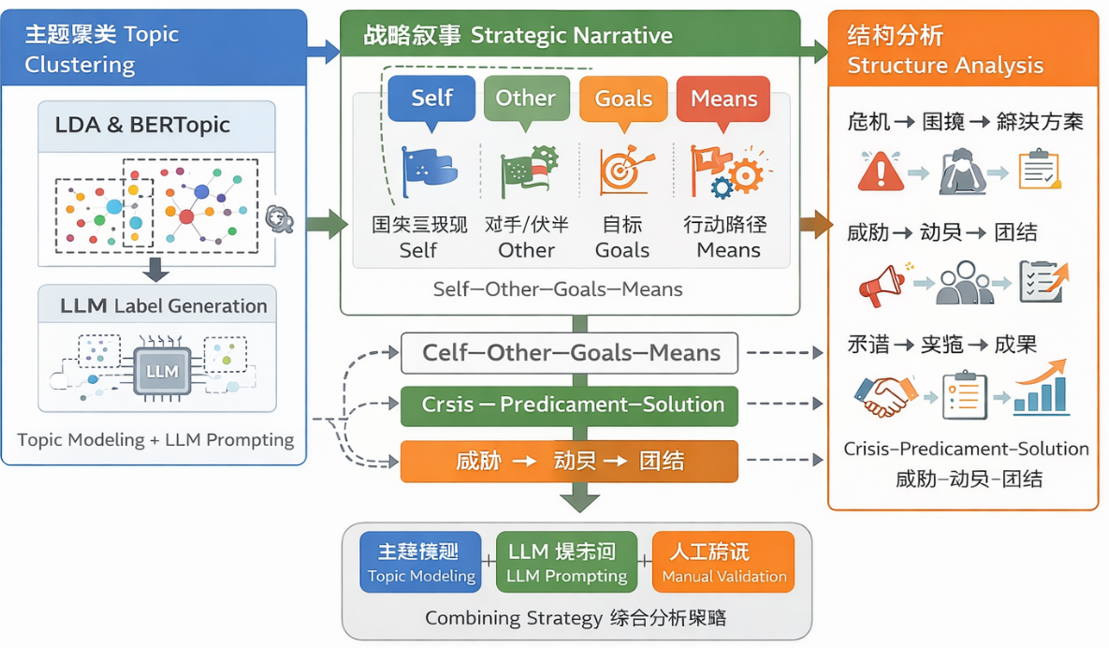
Figure 2 illustrates the overall structure and processing flow of the “Level 1: Macro-Level Strategic Narrative Analysis” proposed in this study. This framework consists of three main modules. First, the Topic Clustering module on the left uses LDA and BERTopic to identify topics within the political speech corpus. After obtaining the potential topics, the system generates unified semantic labels and topic descriptions through the LLM, thereby improving the consistency and interpretability of topic naming. Second, the central component is the Strategic Narrative Element Identification module [16]. This module is based on the “LLM cue-word project” and extracts four core narrative dimensions. Together, these four narrative dimensions constitute the “Self–Other–Goals–Means” strategic narrative model. Finally, the Narrative Structure Analysis module on the right further identifies typical narrative sequences within the text. At the bottom of the diagram, this study integrates topic modeling, LLM-based cue-word extraction, and manual verification into a combined strategy to ensure that the topic structure, narrative elements, and narrative sequences form a consistent analytical framework at the semantic level.

First, LDA and BERTopic are used to perform topic partitioning on the preprocessed text set \(\mathcal{D}=\{d_{1},\ldots,d_{N}\}\). Taking LDA as an example, assuming that each document \(d_{i}\) is generated from a mixture of \(K\) latent topics, the topic distribution of the \(i\)th document can be represented as:
where \(\theta_{ik}\) represents the probability that document \(d_{i}\) belongs to topic \(k\). Correspondingly, the distribution of the \(k\)th topic over the vocabulary \(\mathcal{V}\) is expressed as follows:
In BERTopic, we first compute the embedding vector \(\mathbf{e}_{j}\in\mathbb{R}^{d}\) for each sentence or paragraph \(s_{j}\), thereby forming the following embedding matrix:
Cluster labels \(z_{j}\in\{1,\ldots,K\}\) are then obtained through dimensionality reduction and density-based clustering, such as UMAP combined with HDBSCAN, thereby forming the semantic-space-based topic cluster \(\mathcal{C}_{k}=\{s_{j}\mid z_{j}=k\}\).
To ensure consistency between statistical and semantic topics, this study defines a Topic Consistency Index \(C_{k}\), which comprehensively considers word-distribution coherence and embedding-space compactness:
where \(\bar{\mathbf{e}}_{k} = \frac{1}{|\mathcal{C}_{k}|} \sum_{s_{j}\in\mathcal{C}_{k}}\mathbf{e}_{j}\) is the average embedding vector of the corresponding topic cluster, and \(\alpha\in[0,1]\) is a weighting parameter. Topics with high consistency scores are retained and included in the subsequent narrative analysis, whereas topics with low consistency scores are corrected by merging them with related topics or eliminating them from the analysis.
On this basis, representative keywords and typical sentences from each topic cluster are entered into the LLM, which is asked to provide a semantic label \(L_{k}\) and a topic description \(\operatorname{Desc}_{k}\). Simultaneously, we introduce a “label confidence” score \(r_{k}\in[0,1]\), generated by the LLM to represent the certainty of its labeling judgment. The final Topic Validity Score can be expressed as:
Using \(\tau\) as the threshold, only topics satisfying \(S_{k}\geq\tau\) are retained for the strategic narrative analysis stage.
After determining the topic structure, this study further extracts four narrative elements from each text segment: “Self–Other–Goals–Means.” Let the embedding vector of a text segment \(s\) be \(\mathbf{e}_{s}\). The LLM generates sets of candidate statements for the four elements by using predefined cue words:
These element statements are re-encoded as embedding vectors, and their averages are calculated to obtain the semantic centers of the four narrative elements:
To measure the “salience” of the strategic narrative in a given paragraph, this study defines the Narrative Salience Index (NSI) as follows:
where \(\beta_{1},\ldots,\beta_{4}\) are adjustable weights used to reflect the relative importance of the different narrative elements in the analysis. When \(\operatorname{NSI}(s)\) exceeds a predefined threshold \(\gamma\), the paragraph is considered to contain a strong strategic narrative; otherwise, it is treated as general explanatory or informational text.
Furthermore, to characterize the degree of “Self–Other” opposition, this study defines the Narrative Opposition Degree (NOD):
The closer this value is to 1, the greater the semantic distance between the “Self” and the “Other.” This result indicates that the distinction between the self and a hostile or competitive other is more prominent within the speech.
After extracting paragraph-level narrative elements, this study further examines the narrative structure of the entire speech according to its chronological sequence. Each paragraph \(s_t\), ordered according to its appearance, is mapped to a discrete narrative state \(y_t\in\mathcal{Y}\), where the set of states is defined as:
This narrative state is automatically determined by the LLM in combination with contextual labels and can subsequently be corrected through minimal manual intervention. Therefore, an individual speech can be represented as the following narrative state sequence:
To analyze typical narrative patterns, this study models the sequence above as a first-order Markov chain with the following transition matrix:
On the basis of the theoretical framework, three classic narrative paths are anticipated:
1) Crisis path: \(\mathrm{Crisis}\rightarrow\mathrm{Predicament} \rightarrow\mathrm{Solution}\);
2) Threat-mobilization path: \(\mathrm{Threat}\rightarrow\mathrm{Mobilization} \rightarrow\mathrm{Unity}\);
3) Promise-fulfillment path: \(\mathrm{Promise}\rightarrow\mathrm{Implementation} \rightarrow\mathrm{Outcome}\).
The probability of occurrence is then defined for each narrative path. For example, the average transition probability of the crisis path can be expressed as:
Similarly, indices such as \(P_{\mathrm{threat}}\) and \(P_{\mathrm{promise}}\) can be defined to characterize the intensity and preference of different narrative patterns across different political speeches. In addition, this study calculates the entropy value of each narrative sequence:
where \(\pi_i\) is the probability of state \(i\) occurring under the stationary distribution. The lower the entropy value, the more concentrated and formulaic the narrative structure of the speech becomes. Conversely, the higher the entropy value, the more diverse and dispersed the narrative paths of the speech become.
Following the extraction of macro-level themes and strategic narratives, this study further analyzes the underlying logical structure of political speeches from the perspective of “frames.” The central objective of framing analysis is to reveal how political leaders construct interpretations of particular issues through specific linguistic patterns, semantic markers, and rhetorical devices, thereby influencing public perceptions and policy attitudes. To this end, this study employs a comprehensive analytical approach combining a “Large Language Model (LLM) + Frame Classification Model + Framing Device Extraction.” This approach constructs a systematic analytical framework based on three dimensions: frame-type identification, framing-device extraction, and frame-strength quantification.
Figure 3 illustrates the overall framework and processing flow of the “Framing Analysis.” The left side of the figure first presents the Frame Classification module, which categorizes the common frames appearing in political speeches into five major types: the security frame, economic development frame, moral values frame, livelihood and well-being frame, and international geopolitical frame. Each type relies on semantic prototype vectors generated by a Large Language Model (LLM) to support the semantic similarity calculation of text paragraphs and automatically identify their closest frame types.
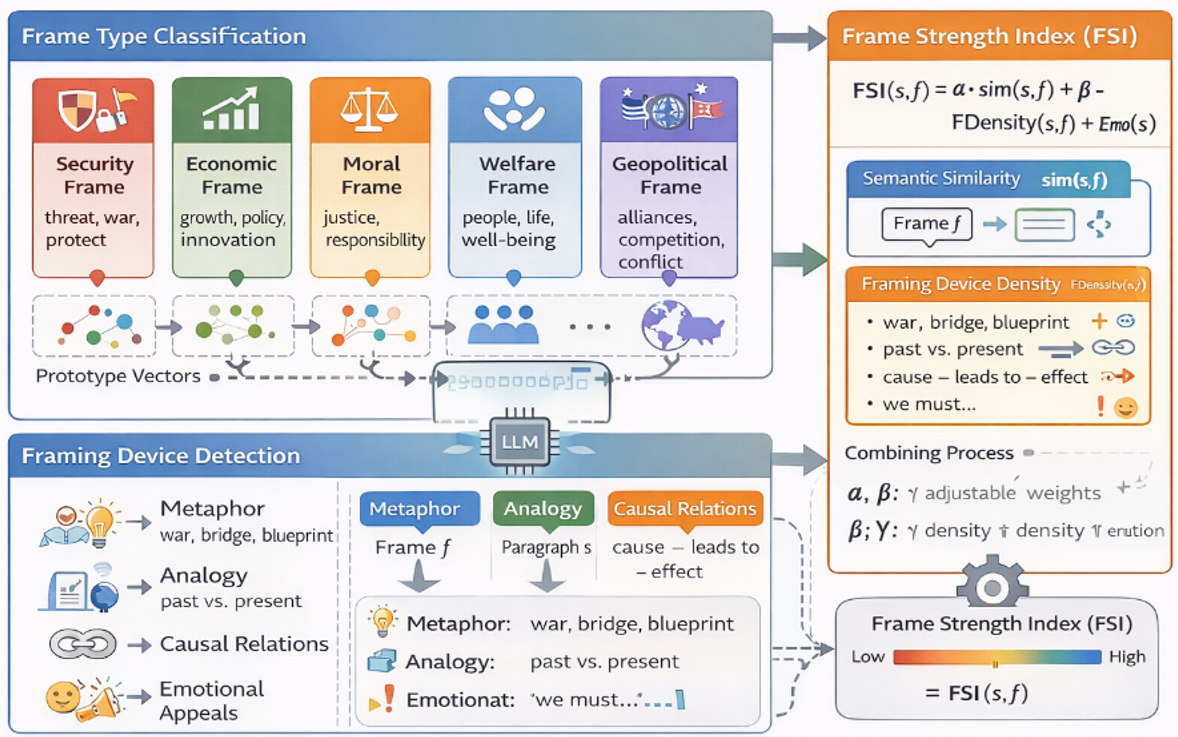
Common frame types in political speeches can be divided into five categories: (1) security frame, (2) economic frame, (3) moral frame, (4) welfare frame, and (5) geopolitical frame. To achieve automated classification, this study first encodes text paragraphs into vectors \(\mathbf{e}_{s}\) and then enters labeled examples of each frame type into an LLM to establish prototype vectors for the different frame categories:
where \(f\in\{\mathrm{security},\mathrm{economic},\mathrm{moral}, \mathrm{welfare},\mathrm{geo}\}\), and \(u_{i}^{(f)}\) represents a typical sentence associated with frame \(f\), automatically generated by the LLM according to the theoretical definition of that frame. The cosine similarity between the text paragraph and the corresponding frame vector is then calculated:
This calculation provides the degree of fit between the paragraph and each candidate frame. The final frame label is determined according to the following rule:
This method combines vector-based semantics with theoretical definitions, making the frame-classification process both interpretable and internally consistent.
Frames are reflected not only through themes and concepts but also through specific framing devices. To capture these implicit semantic features, this study uses the LLM to automatically detect the following four categories of framing devices.
1) Metaphor. Metaphors are used to establish cross-domain conceptual mappings, such as using the concepts of “war,” “blueprint,” and “bridge” to describe abstract policies. The LLM automatically detects metaphorical expressions and their source-to-target domain mapping relationships through metaphor-recognition prompts:
2) Analogy. Analogies strengthen political argumentation through comparisons such as “past versus present” and “another country versus one’s own country.” This study uses the LLM to extract the following analogical structures:
where \(A:B\) represents the source-domain analogical relationship, whereas \(C:s\) represents the corresponding target-domain relationship.
3) Causal Relations. Many policy narratives rely on causal logic expressed through structures such as “because … therefore ….” This study uses the LLM to identify the following causal triples:
where \(c_i\) represents the cause, \(e_i\) represents the resulting effect, and \(r_i\) represents the type of causal relationship, such as leads to, results in, or is caused by.
4) Emotional Appeals. Emotional appeals primarily arise from emphatic language, such as “we must” or “this is a critical moment.” Emotional intensity is calculated using the following affective score:
where \(\operatorname{pos}(s)\) is the positive emotion score, \(\operatorname{neg}(s)\) is the negative emotion score, and \(\operatorname{urgency}(s)\) is the strength of urgency-related vocabulary.
The parameters \(\lambda_i\) are learned from the training corpus or determined by experts according to the analytical requirements.
To quantify the strength of a frame within a particular text segment, this study integrates semantic similarity, framing-device density, and emotional intensity into a “Frame Strength Index (FSI)”:
where \(\operatorname{sim}(s,f)\) represents the semantic similarity between the paragraph and the frame prototype vector; \(\operatorname{FDensity}(s,f)\) represents the frequency of associations between framing devices, such as metaphors, analogies, and causal chains, and frame \(f\); and \(\operatorname{Emo}(s)\) represents the intensity of emotional expression within the paragraph.
The stronger the frame expressed in the paragraph, the higher the corresponding FSI value will be.
By comparing frame strength at different points in time, such as across years or policy cycles, the frame evolution trend curve can be obtained:
where \(S_t\) represents all speech segments observed at time \(t\).
After extracting the thematic structure and strategic narrative framework, this study further examines the dynamic changes in political speeches over time to identify long-term trends and important turning points in narrative content, framing strength, and emotional expression [17], [18]. The core objective of diachronic evolution analysis is to construct a three-tiered time series of “semantics–framing–emotion,” thereby revealing how the political agenda evolves in response to historical contexts, policy environments, and international conditions by quantitatively modeling changes across years, quarters, or major event nodes. To this end, this study proposes a three-stage analytical framework consisting of “topic drift–framing shift–emotion and modality evolution.” It combines time-series modeling, embedding evolution, and key-event comparison methods to construct an evolutionary analysis system for political discourse [19].
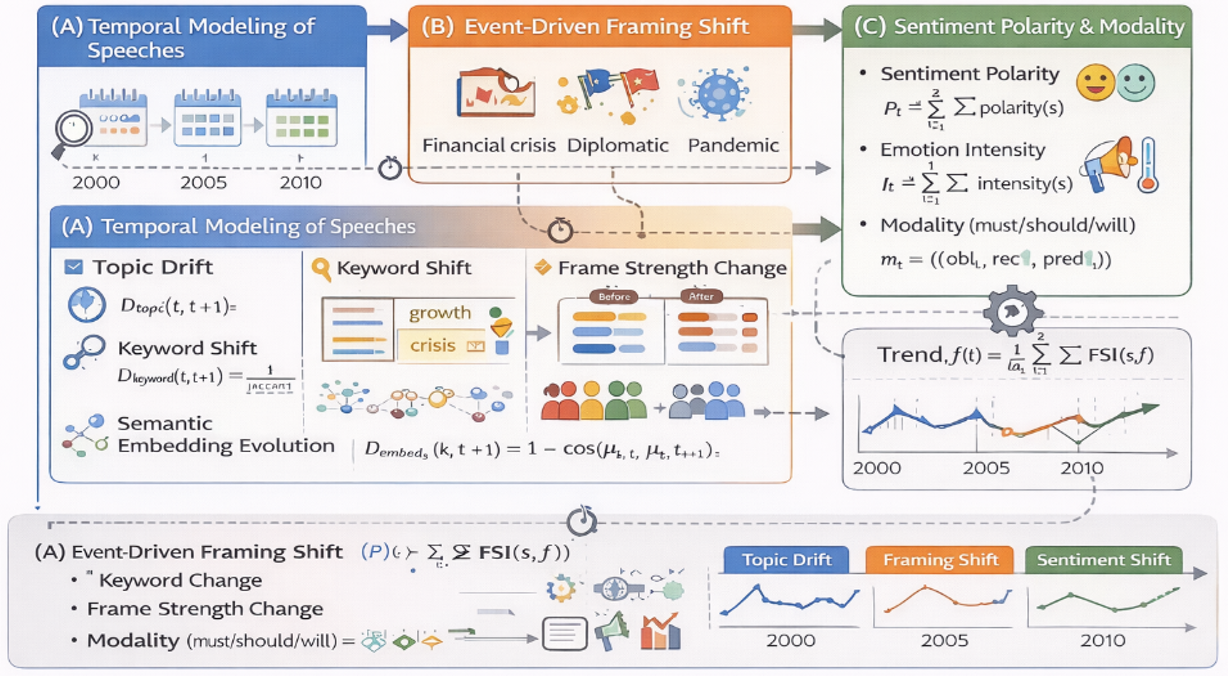
Figure 4 illustrates the overall framework and horizontal workflow structure of the “Diachronic Evolution Analysis.” The left side of the figure presents the Temporal Modeling of Speeches module, which analyzes political speeches from different years or quarters in terms of Topic Drift, Keyword Shift, and Semantic Embedding Evolution to depict continuously changing trends in textual content over time. Topic Drift is measured using the difference between topic distributions in adjacent periods. Keyword Shift uses the Jaccard distance to identify lexical substitutions or changes in topic emphasis, whereas Semantic Embedding Evolution is based on the cosine distance between semantic center vectors from different years, revealing gradual changes in topic semantics over time. The central section of the figure presents the Event-Driven Framing Shift module, which focuses on the influence of specific major events, such as financial crises, diplomatic conflicts, and pandemic outbreaks, on the narrative structures and framing strengths of political speeches. The right side of the diagram presents the Sentiment Polarity and Modality Evolution module, which extracts time-series trends for three indicators: polarity, intensity, and modality. The bottom section of the diagram compares the overall trends of these three groups of time-series indicators—topic drift, framing shift, and sentiment change—demonstrating how the semantic focus, narrative logic, and emotional mobilization patterns of political speeches gradually evolve across different years.
First, this study treats each annual or quarterly time slice as a semantic state at time \(t\) and extracts its topic-distribution vector \(\boldsymbol{\Theta}_{t} = (\theta_{t1},\theta_{t2},\ldots,\theta_{tK})\). Topic drift can be measured using the distance between the topic distributions of two adjacent time slices:
The greater this distance is, the more significant the shift in the central themes of the speeches between the two time periods. Furthermore, this study extracts the keyword sets \(W_t\) and \(W_{t+1}\) and uses the Jaccard distance to measure the degree of keyword change:
Meanwhile, this study constructs an embedding evolution model to represent the semantic center vector \(\boldsymbol{\mu}_{k,t}\) of the same topic across different years as follows:
and defines semantic drift as:
Together, these three indicators present the evolutionary trajectories of themes and semantics over time, thereby providing a foundation for subsequent analyses of framing and sentiment changes.
Changes in political narratives are often closely associated with major events, such as economic crises, diplomatic conflicts, and pandemic outbreaks [20]. To identify frame changes before and after important events, this study uses the Frame Strength Index \(\operatorname{FSI}(s,f)\) as the basis for calculating the difference between the mean frame strength before an event (pre) and after that event (post):
Furthermore, this study compares keyword sets and stance words to analyze whether the “enemy–friend narrative” becomes stronger before or after a particular event. The indicator of increased hostile narration is defined as:
where \(\mathbf{v}_{\mathrm{other}}\) is the semantic center vector of the “Other” narrative, and \(\mathbf{v}_{\mathrm{threat}}\) is the semantic center vector of the threat frame. If \(E_{\mathrm{other}}>0\), this indicates that the negative or threatening framing of the “Other” has become stronger after the event.
Similarly, this study calculates semantic shifts for the “Self” and “Goals” narratives to identify changes in policy visions or role positioning caused by the event. Through this combined analysis, the framework can systematically reveal how political leaders adjust their discourse strategies before and after major events by strengthening threat narratives, expanding mobilization, or shifting toward cooperative narratives.
Emotional expression and modality are important linguistic mechanisms in political persuasion. This study uses a sentiment-analysis model to extract the average sentiment polarity for each time slice:
and calculates the average emotional intensity as follows:
Furthermore, this study maps modal expressions, including “must,” “should,” and “will,” into three modal dimensions: “obligation,” “recommendation,” and “prediction.” The resulting modal representation is expressed as:
and its time-series trend is calculated as:
This method can capture changes in the “mobilization tone” of political speeches. For example, during a crisis, expressions associated with “must” and “need” may increase, whereas during a relatively stable period, predictive expressions such as “will” and “continue” may be used more frequently.
This study systematically validates the proposed three-tiered political discourse analysis framework using a large-scale corpus of political speeches spanning more than two decades. First, we constructed a corpus of 426 official speeches covering 2000–2022 and strictly categorized them by communicative scenario: 84 speeches delivered to parliament or presented as annual reports (including annual policy addresses); 112 speeches delivered on diplomatic occasions (including addresses at international summits and statements on bilateral agreements); 59 crisis-response speeches (mainly addressing economic crises, natural disasters, and public health emergencies); 93 economic-policy speeches (including new policy announcements, economic plans, and industrial strategy speeches); and 78 election and mobilization speeches (including campaign rallies and internal mobilization addresses) [21], [22].
During preprocessing, this study systematically cleaned, parsed, and structured the original texts, ultimately producing a cleaned corpus of approximately 2.3 million tokens, comprising more than 84,000 sentences and more than 21,600 paragraphs. Dependency parsing, NER, and event extraction were performed across the complete corpus, and manual sampling confirmed that the reliability of the annotation results exceeded 95%. Building on this foundation, this study further constructed a multilevel political discourse analysis pipeline that combines LDA and BERTopic clustering, topic labels generated by large language models, the Self–Other–Goals–Means strategic narrative extraction mechanism, prototype-vector modeling of five major frame types, and an automated process for detecting framing devices (metaphor, analogy, causal chains, and emotional mobilization). Through time-series modeling (Topic Drift, Keyword Shift, and Embedding Shift), event-driven framing-shift analysis, and the analysis of sentiment polarity and modality evolution, the framework systematically characterizes dynamic changes in speech content, narrative logic, and linguistic strategies across different periods. This approach enables the systematic observation and quantitative analysis of long-term trends in leaders’ political discourse, mechanisms of narrative reconstruction under the influence of external events, changes in the intensity of frame use across policy cycles, and corresponding changes in sentiment and tone.
Together, these procedures provide a consistent empirical foundation for all subsequent comparisons, interpretations, and longitudinal analyses reported in the following experimental sections.
In terms of model setup and experimental configuration, this study employs a dual-topic modeling strategy and a large language model to enhance semantic interpretation, ensuring the stability of the topic structure and the high reliability of narrative extraction [23].
First, during the topic-modeling stage, we configured two complementary topic models. The first was the classical probabilistic topic model LDA, with the number of topics set to \(K=20\) and the Dirichlet hyperparameters set to \(\alpha=0.1\) and \(\eta=0.01\), which served as the baseline method. The second was BERTopic, which emphasizes semantic representation and uses MiniLM as the embedding encoder and HDBSCAN as the density-based clustering algorithm, thereby capturing potential semantic variations and topic bifurcations in political discourse more accurately. Building on these models, this study further introduced the GPT family of large language models and used prompt engineering to enhance the interpretability of topic clustering and the reliability of narrative extraction. The topic-explanation prompt required the LLM to generate unified topic labels and semantic descriptions from high-frequency words and representative sentences. The narrative-element prompt used a structured template to guide the model in identifying the four elements of Self–Other–Goals–Means. Concurrently, to detect framing devices, this study designed four independent prompts to identify metaphors, analogies, causal relations, and emotional appeals, respectively.
To evaluate the experimental results systematically, this study constructed five systems of evaluation indices. First, Topic Coherence measures the semantic stability of the topic models. Second, Extraction Coverage assesses the completeness of the LLM’s extraction of Self–Other–Goals–Means elements. Third, the Framing Strength Index (FSI), calculated by weighting semantic similarity, framing-device density, and emotional-mobilization intensity, measures the salience of different frames within speeches. Fourth, the Temporal Semantic Drift Indices, including Topic Drift and Embedding Shift, describe the trajectory of each topic’s movement away from the semantic center over time. Fifth, the Event-Driven Change Indices (\(\Delta\)FSI, \(\Delta\)Polarity, and \(\Delta\)Modality) analyze systematic changes in frame strength, emotional polarity, and modal expression in political discourse before and after major events, such as financial crises or pandemics. By combining the configurations described above, LLM prompt engineering, and a multidimensional evaluation system, this study ensures the robustness and interpretability of political discourse analysis at the statistical, semantic, and narrative levels [24].
| Topic Name | Description (Generated by LLM) | Example Keywords | LDA Coherence Score | BERTopic Coherence Score |
|---|---|---|---|---|
| Economic Recovery | Employment, investment, growth, and industrial transformation | employment, recovery, investment, growth | 0.52 | 0.68 |
| Technological Innovation | Digital economy, research and development, and infrastructure construction | innovation, digital, research, infrastructure | 0.55 | 0.74 |
| Security and Defense | Military modernization and border security | defense, security, modernization, border | 0.58 | 0.72 |
| Pandemic Response | Prevention and control measures, public health, and healthcare systems | pandemic, health, control, system | 0.63 | 0.70 |
| Diplomatic Cooperation | Global governance, partnerships, and the international order | cooperation, global, partnership, order | 0.57 | 0.73 |
Table 1 shows the core topics and their coherence scores obtained using the LDA and BERTopic models. Overall, LDA’s average topic coherence is 0.57, while BERTopic’s average coherence reaches 0.71, showing a significant performance difference. This result indicates that in texts with large semantic spans, highly abstract concepts, and cross-domain involvement, such as political speeches, the traditional LDA model, which relies on word frequency co-occurrence mechanisms, has limitations in capturing deep semantic connections. BERTopic, on the other hand, is based on high-dimensional semantic embeddings, which can more effectively identify synonyms, semantic variations, and cross-paragraph semantic chains. Therefore, BERTopic significantly outperforms LDA in terms of topic boundary clarity, semantic clustering quality, and topic label consistency. Especially when dealing with topics with strong semantic diffusion, such as technological innovation and diplomatic cooperation, BERTopic’s topic clustering performance is more stable, forming more interpretable and consistent topic clusters.
| Narrative Element | Paragraph Coverage (%) | Number of Extracted Instances |
Typical Keywords / Phrases | Typical Sentence Patterns Extracted by LLM | Semantic Orientation (LLM Judgment) | Crisis vs. Non-Crisis Change (\({\Delta}\)) |
|---|---|---|---|---|---|---|
| Self | 78.4% | 12,593 | national responsibility, leadership, stabilizing force | “We consistently place the safety of the people as our top priority” | Positive, self-legitimization | +0.34 (enhanced protectiveness and authority) |
| Other | 65.2% | 10,471 | external threats, competitors, international pressure | “The risk of external transmission remains severe” | Negative, intensified threat framing during crises | +0.41 (significant increase in threat construction) |
| Goals | 72.9% | 11,708 | recovery, cooperation, governance reform, containment | “Our goal is to control the spread as quickly as possible and restore order” | Balanced long-term and short-term orientation | +0.29 (stronger short-term focus) |
| Means | 69.7% | 11,200 | mobilization, resource allocation, institutional arrangements, policy measures | “Nationwide coordinated action is adopted to allocate critical resources” | Centralized mobilization and strong execution | +0.38 (marked increase in mobilizational intensity) |
Table 2 integrates quantitative statistics, semantic features, typical expressions, and changing trends for the four types of strategic narrative elements within a single structure. The results show that self-presentation has the highest coverage rate in the overall corpus (78.4%), emphasizing leadership responsibility, national stability, and political legitimacy. Descriptions of the Other show a pronounced tendency toward threatening portrayals during crises, with their semantic polarity shifting from cooperative narratives toward expressions of uncertainty and risk. In crisis contexts, Goals shift from long-term development objectives toward short-term objectives centered on containing risks and rapidly restoring order. The Means element places significantly greater emphasis on centralized mobilization, resource allocation, and unified action mechanisms, exhibiting a structural pattern of “rapid response—unified command.” Together, the changes in these four narrative elements constitute a typical “threat—mobilization—control” narrative chain. This finding indicates that, during major crises, political leaders tend to construct a unified, high-pressure strategic narrative framework by reinforcing their own legitimacy, portraying others as more threatening, focusing on short-term emergency objectives, and strengthening concrete implementation measures.
| Module | Indicator / Type | Value / Proportion | Description / Typical Features |
|---|---|---|---|
| 4.D.1) Distribution of Frame Types |
Security Frame | 22.4% | Shows a significant increase during crises and security-related events |
| Economic Frame | 31.7% | The dominant long-term frame, covering growth, employment, industry, and investment |
|
| Moral Frame | 14.1% | Used more frequently in election and mobilization contexts |
|
| Welfare Frame | 18.6% | Involves education, healthcare, social welfare, and livelihood-related issues |
|
| Geopolitical Frame | 13.2% | Increases markedly in diplomatic conflicts, negotiations, and external statements |
|
| 4.D.2) Framing Device Detection Results (LLM+Manual Validation) |
Metaphor | 86.2% (accuracy) | “War” metaphors are most common in crisis speeches; “blueprint” and “bridge” are frequent in economic discourse |
| Analogy | 79.4% | Often employs historical comparisons and past–present contrasts to strengthen argumentation |
|
| Causal Relations | 92.1% | “Because… therefore…” structures are frequently used to justify policy logic |
|
| Emotional Appeals | 94.5% | Expressions such as “We must…” and “Now is a critical moment” surge during crisis periods |
|
| 4.D.3) Changes in the Frame Strength Index (FSI) |
Security Frame (during crises) | +0.35 | Narrative chains emphasizing threat, mobilization, and control are reinforced |
| Geopolitical Frame (during diplomatic conflicts) |
+0.41 | Significantly elevated within “confrontation–competition” contexts |
|
| Moral Frame (during elections) | +0.29 | Leader image construction and value-based appeals are substantially strengthened |
Table 3 integrates the distribution of frames, the LLM’s performance in detecting framing devices, and contextual changes in the FSI into a unified presentation, thereby clearly revealing the structural characteristics and dynamic trends of frame use in political speeches. First, regarding frame distribution, economic frames have long dominated the corpus (31.7%), reflecting the central role of national development, economic growth, and industrial policy within the overall political narrative. However, during crises such as economic recessions, pandemics, or regional conflicts, the proportions of security and geopolitical frames increase significantly. This pattern indicates that leaders tend to construct crisis narratives and mobilization logics by emphasizing threats and the need for security protection. Second, the LLM’s framing-device detection results show that rhetorical devices such as metaphors, analogies, causal chains, and emotional appeals exhibit different frequencies and functional characteristics across different frames. Metaphors are used extensively in crisis contexts, particularly “war” metaphors; analogies frequently contrast history with current reality to strengthen arguments; causal chains explain and justify the rationale for policies; and emotional appeals substantially intensify expressions of empathy and urgency in crisis speeches. Finally, changes in the Frame Strength Index (FSI) show that the strength of the security frame increased by +0.35 during crises, the geopolitical frame increased by +0.41 during diplomatic conflicts, and the moral frame increased by +0.29 in election-related scenarios.
| Module | Indicator / Change Item | Experimental Results | Explanation / Implications |
|---|---|---|---|
| 4.E.1) Topic Drift Trends |
2008–2009 (Global Financial Crisis) | Significant increase in topic drift | The semantic center shifts from “economic development” toward “crisis response” and “stability” |
| 2020–2021 (COVID-19 outbreak) | Largest magnitude of drift | Topic centers migrate toward “public health,” “prevention and control,” and “security” | |
| Direction of topic focus shift | Crisis, security, public health | Multiple topics converge into a shared crisis-related semantic domain, resulting in highly concentrated topic distributions | |
| 4.E.2) Event-driven Framing Shifts |
Pre- vs. post-financial crisis: frequency of economic growth terms | Significant decrease | Indicates a weakening of growth-oriented narratives and a shift toward stability and protection |
| Pre- vs. post-financial crisis: frequency of stability/protection/recovery terms | Significant increase | During crises, policy discourse emphasizes “stabilization” and “recovery” | |
| Security frame \(\Delta\)FSI | +0.27 | Reflects the strengthening of the security frame during crisis periods | |
| Pre- vs. post-pandemic: semantic distance of negative and threat-related “Other” | Increased | Heightened threat construction and negative portrayal of the “Other” | |
| Pre- vs. post-pandemic: mobilizing expressions (must / need) | +34% | Policy statements become more directive and mobilizational during crises | |
| 4.E.3) Sentiment and Modality Evolution |
Sentiment polarity | Drops to the lowest level during crises | Speeches exhibit a higher proportion of negative emotions and risk signaling |
| Emotional intensity | Increases significantly in the later crisis phase | With intensified mobilization strategies, emotional expression becomes stronger | |
| must (obligatory modality) | Increase | Indicates a marked rise in coercive or mandatory policy language | |
| should (advisory modality) | Slight increase | Suggests limited strategic flexibility, still constrained by crisis conditions | |
| will (predictive modality) | Decrease | Rising uncertainty leads to fewer forward-looking or predictive statements |
Table 4 presents the principal experimental results concerning Topic Drift, Event-Driven Framing Shifts, and Sentiment and Modality Evolution. Regarding Topic Drift, the most dramatic changes occurred during the 2008–2009 financial crisis and the 2020–2021 COVID-19 pandemic, when the semantic center shifted toward a combined “crisis—security—public health” domain. This movement reflects the highly concentrated focus of political narratives during emergencies. Event-driven framing analysis further shows that, across the periods before and after the financial crisis, expressions such as “economic growth” and “open cooperation” decreased significantly, whereas crisis-management terms such as “stability,” “protection,” and “recovery” increased sharply. Correspondingly, the security-frame FSI increased by +0.27. Across the periods before and after the pandemic, semantic distance associated with negative and threatening representations of the “Other” increased. This change was accompanied by a 34% increase in mobilizing expressions such as “must” and “need,” indicating that governments tend to construct narrative structures through “threat intensification—concentrated mobilization” during crises. Sentiment and modality analyses showed that emotional polarity declined and the proportion of negative emotions increased during crises, whereas emotional intensity increased significantly after a crisis entered the mobilization stage. Among modal terms, the frequency of “must” increased, that of “should” increased slightly, and that of “will” decreased significantly. These findings reveal that leaders’ language during crises followed a pattern of “reduced certainty—increased imperativeness.”
Figure 5 comprehensively presents the temporal trend of the FSI and its synchronicity with two indicators of semantic evolution: Topic Drift and Embedding Shift. The blue curve in the main panel shows annual fluctuations in \(\Delta\)FSI across political speeches from 2005 to 2023. Clearly identifiable FSI peaks appear during three periods: the 2008–2009 global financial crisis, the 2014–2015 geopolitical confrontation, and the 2020–2021 COVID-19 pandemic. This pattern indicates that political narratives substantially reinforced security, mobilization, and crisis-response frames during periods of external shock. By contrast, the troughs in the main panel correspond to years of relative political and economic stability, demonstrating that frame strength tends to stabilize under ordinary conditions. The smaller embedded graph further illustrates the overlaid trajectories of Topic Drift and Embedding Shift. Both curves display synchronized increases and prominent peaks during the years associated with the three major events noted above. These synchronized movements indicate that the rapid reconstruction of topic structure, represented by increased Topic Drift, and the concentrated migration of deep semantic representations, reflected by rising Embedding Shift, are closely associated with changes in frame strength.
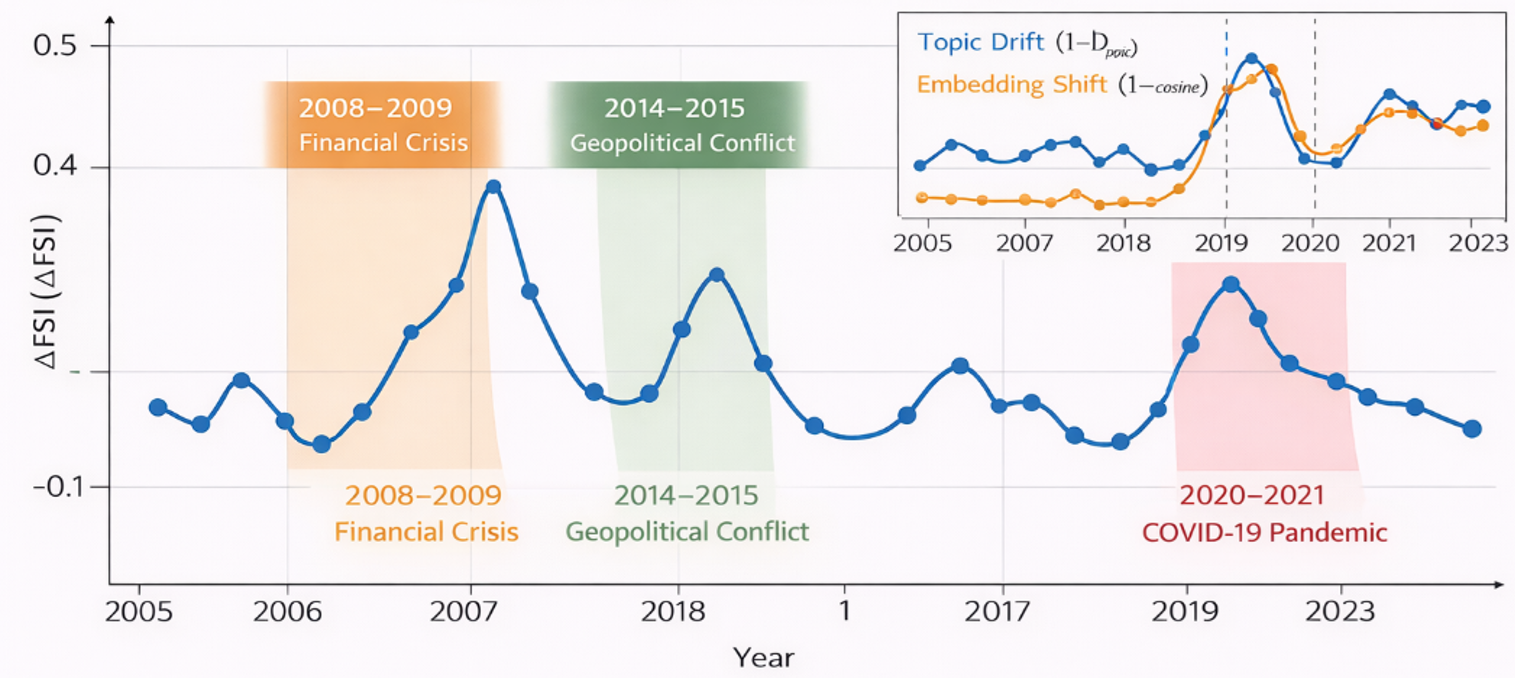
Figure 6 visualizes the topic-embedding vectors of political speeches using UMAP/t-SNE and demonstrates the clustering and separation of topics within the semantic space across different periods. During stable periods, such as 2018 and 2023, represented by the green and blue scatter points, respectively, the topic distribution is relatively dispersed and exhibits broad coverage of the semantic space. This pattern indicates that, in years without major external shocks, the topic structure of political discourse remains comparatively diverse and balanced. By contrast, during the 2008–2009 global financial crisis and the 2020–2021 COVID-19 pandemic, represented by the orange and red scatter points, respectively, topic clusters clearly converge within specific regions of the semantic space, forming distinct “crisis-concentration domains.” This pronounced clustering phenomenon suggests that, during crisis periods, political discourse is rapidly redirected toward a limited number of core issues, particularly “crisis response,” “public health,” and “national security,” resulting in a high-density concentration of semantic embeddings. The clustering ellipses shown in the figure further emphasize differences in semantic distribution across stages: the semantic point cloud is dispersed during stable periods but becomes highly concentrated during crisis periods, reflecting the rapid contraction and concentration of political issues following external shocks.
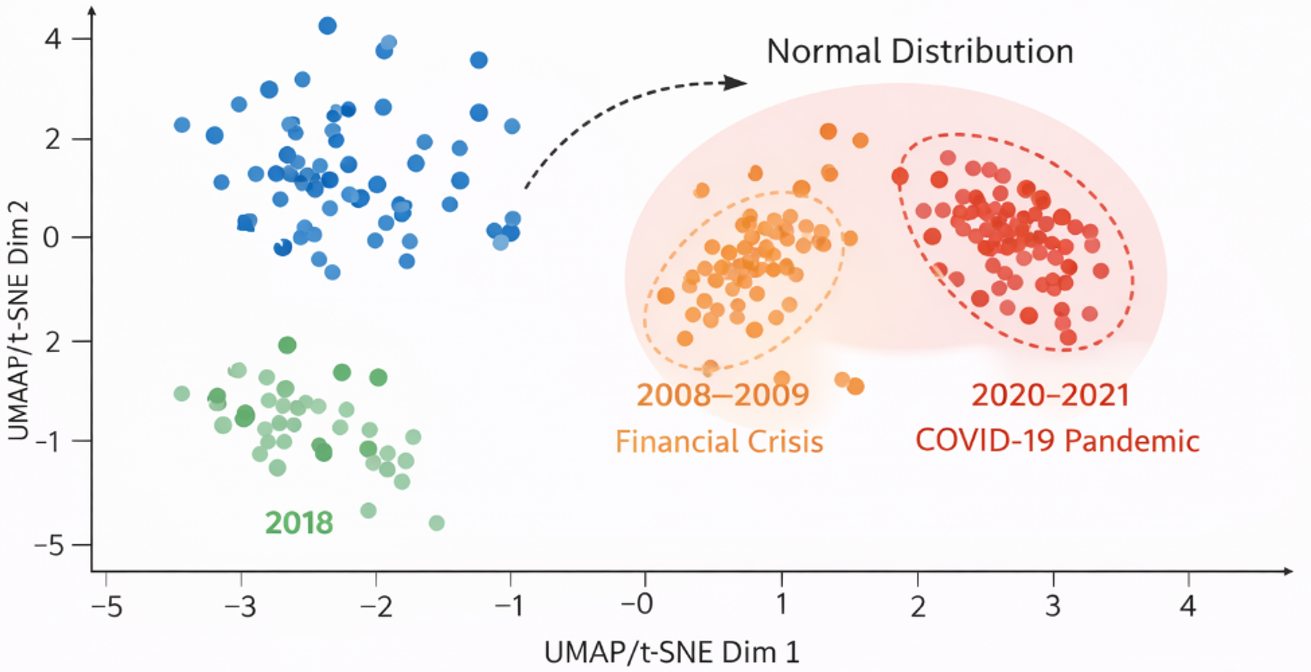
Figure 7 presents a heatmap of the annual frequency of different framing devices in political speeches from 2005 to 2023, thereby revealing the dynamic evolution of rhetorical tools in political narratives. The heatmap’s color gradient ranges from light blue, indicating low frequency, to dark red, indicating high frequency, and therefore reflects the relative intensity of the corresponding rhetoric in different years. The results show that metaphors and emotional appeals produce pronounced red peaks during years of major crises, including the 2008–2009 global financial crisis and the 2020–2021 COVID-19 pandemic. This pattern indicates that leaders facing crises tend to employ forceful metaphors such as “war,” “battle,” and “defense line,” together with mobilizing expressions such as “we must” and “this is a critical moment,” to construct a frame for collective action. By contrast, during years of stable economic growth, metaphorical rhetoric tends toward developmental concepts such as “blueprint” and “bridge,” indicating that governments emphasize long-term development visions and policy planning. Furthermore, causal relations remain frequent throughout all years, reflecting the importance of policy logic and causal explanation in political discourse. Analogies occur more frequently during years of structural reform or foreign-policy adjustment, indicating that leaders often construct arguments by comparing the past with the present or other countries with their own country.
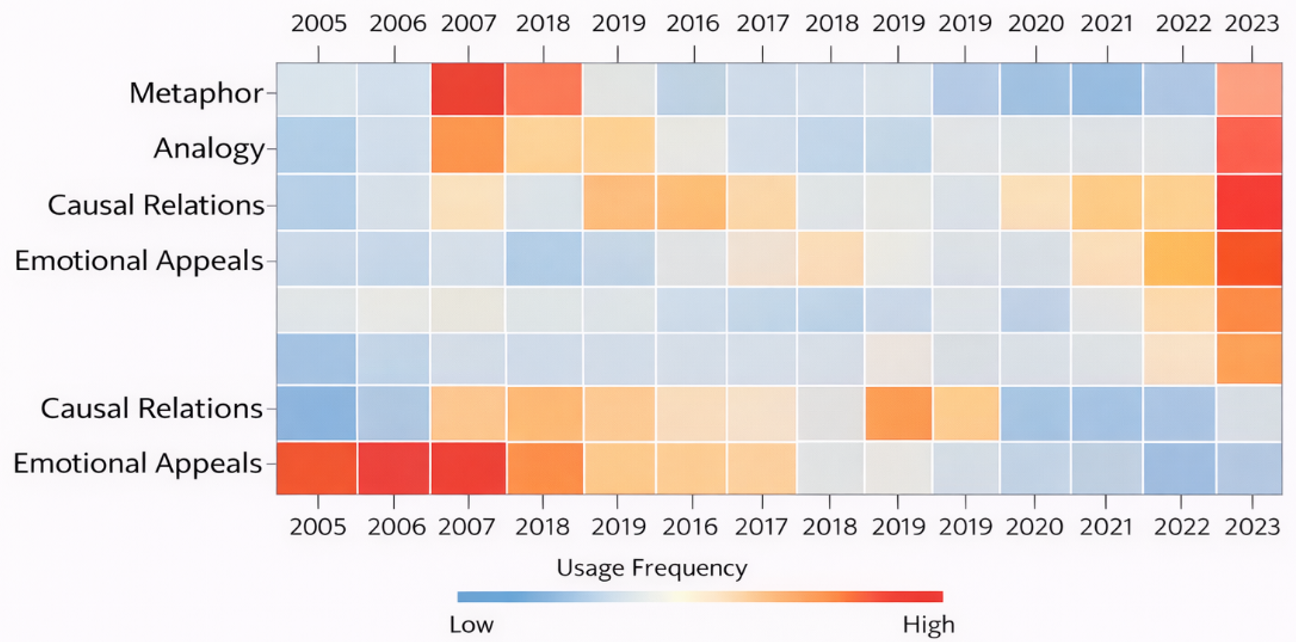
Figure 8 uses two sets of visualizations to illustrate changes in political discourse frames driven by major events and the dynamic evolution of sentiment and modal structures. The upper bar chart presents changes in \(\Delta\)FSI for four frame types—security, economic, moral, and geopolitical—before and after three categories of events. Gray bars additionally represent changes in sentiment polarity (\(\Delta\)Polarity). The results show that the security and geopolitical frames increase significantly after each crisis, whereas changes in the economic and moral frames follow an event-dependent pattern. The economic frame shows a larger increase after the financial crisis, whereas the moral frame displays a more substantial increase after the pandemic. Sentiment polarity falls to negative values after all three categories of events, indicating that political discourse during crises tends to communicate warnings, urgency, and uncertainty more strongly.
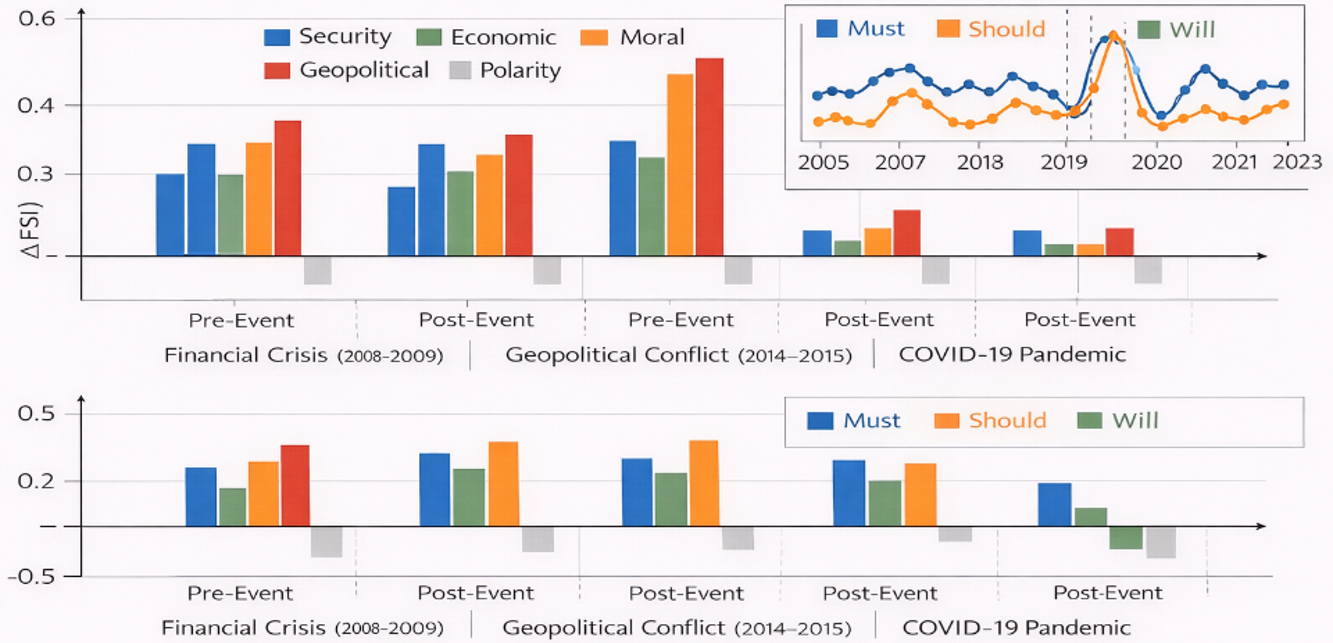
The lower bar chart further illustrates changes in the frequency of modal terms (must, should, and will) before and after the events. The results show that “must,” which conveys obligation, increased significantly after all three event types, reflecting a stronger commanding and mobilizing tone in political leaders’ language during crises. The term “should,” which conveys recommendation, increased slightly, indicating that policy discourse retained a degree of flexibility despite crisis-related pressures. Meanwhile, “will,” which conveys prediction or commitment, decreased significantly after all three event types, suggesting that leaders made fewer explicit future-oriented commitments against a background of heightened uncertainty. The time-series line graph in the upper-right corner further depicts the long-term trajectories of these modal terms from 2005 to 2023. It clearly shows pronounced peaks in the frequency of “must” during crisis years, together with an evident downward trend in the frequency of “will,” thereby forming a characteristic linguistic pattern of “increased command—reduced prediction.”
Figure 9 uses semantic word clouds to present differences among high-frequency terms in political speeches across four typical scenarios: a comparison of crisis and non-crisis periods in the upper-left and upper-right panels, and a comparison of diplomatic-conflict periods with peak-cooperation periods in the lower-left and lower-right panels. Color intensity and word size represent word frequency and relative importance, respectively. The semantic word cloud for crisis periods displays a clear concentration of high-threat terms, including “threat,” “security,” “war,” “defense,” and “people’s protection.” These terms are highlighted in red and appear at high density, reflecting the political narrative’s emphasis on crisis management, emergency action, and national security. By contrast, the semantic word cloud for non-crisis periods is predominantly blue-green and contains terms associated with long-term policy planning, economic growth, and international cooperation, including “peace,” “cooperation,” “prosperity,” “investment,” “development,” and “innovation.” This distribution indicates a more balanced narrative focus and a stronger orientation toward sustained development.
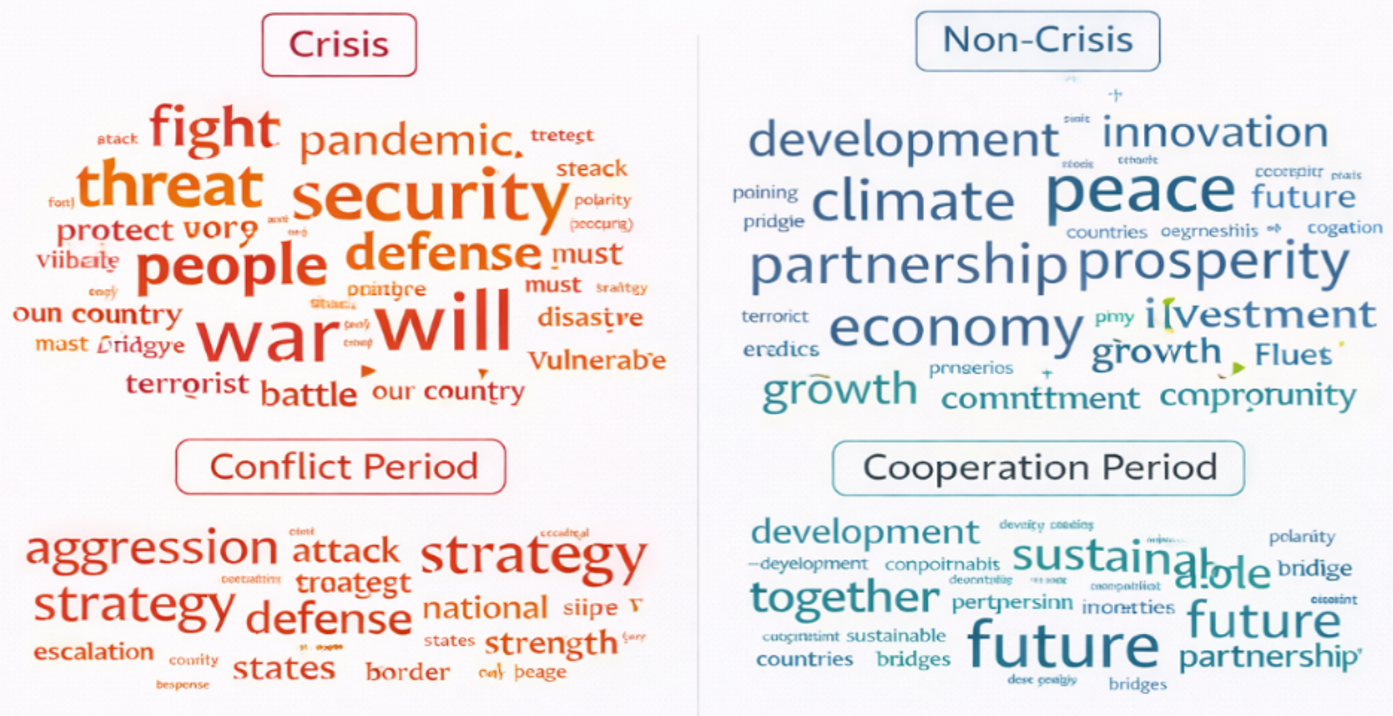
In the lower comparison, the period of diplomatic conflict contains numerous words with confrontational and strategic implications, including “attack,” “tactic,” “defense,” “border,” “escalation,” and “aggression.” The overall semantic pattern therefore exhibits tendencies toward tension, hostility, and strategic deployment. During periods of peak cooperation, the semantic word clouds instead focus on terms such as “common,” “future,” “sustainable,” “partnership,” “community,” and “stability.” This pattern reflects a narrative logic in which leaders emphasize cooperation, unity, the joint construction of a shared future, and peaceful development within the relevant political context.
This study proposes a multilevel political discourse analysis framework that successfully integrates topic modeling, strategic narrative extraction, frame analysis, and temporal evolution modeling, thereby enabling a systematic and quantitative examination of long-term, cross-scenario political discourse. The experimental results show that LDA and BERTopic complement each other in topic identification, while the LLM effectively interprets topic semantics and accurately extracts four narrative elements: Self, Other, Goals, and Means. These capabilities reveal the structural construction of political discourse across different policy contexts. The frame analysis shows that economic frames remain dominant over the long term, whereas security and geopolitical frames are significantly strengthened under the influence of major events, such as financial crises and pandemic outbreaks. The LLM demonstrates high accuracy in identifying framing devices such as metaphors, analogies, causal chains, and emotional appeals, further confirming its potential for detecting complex linguistic strategies. The temporal evolution analysis reveals a synergistic relationship among topic drift, changes in semantic embeddings, and the Frame Strength Index, demonstrating that political discourse exhibits a typical dynamic mechanism of “semantic concentration—narrative reinforcement—modal intensification” during periods of crisis. Overall, this study not only provides an interpretable and scalable computational framework for political discourse analysis but also offers new theoretical insights into the narrative-shaping strategies employed by political leaders during periods of crisis and stability. Future research could extend this framework to cross-national comparisons, differences among media ecosystems, and the political communication effects of LLM-generated texts, thereby further expanding the theoretical boundaries and practical value of political narrative analysis.
All authors contributed equally to this study.
The data supporting the findings of this study are available from the corresponding author upon reasonable request.
This research received no external funding.
The authors declare that they have no conflicts of interest.