
Because of its high energy density, operational efficiency, and relatively low direct carbon emissions, nuclear energy is becoming an increasingly important component of the energy mix in many countries as global energy demand rises and climate-change mitigation becomes more urgent [1]. Nevertheless, the safety of nuclear power generation remains a major concern for the public, regulators, plant operators, and the broader energy industry. This concern is especially important for multi-reactor nuclear power plants (MRPPs), where several units may operate concurrently and where the safety status, maintenance requirements, operating schedules, and resource demands of individual units must be coordinated. Under these conditions, effective safety management and optimization of unit performance are essential for maintaining long-term, stable, safe, and efficient plant operation. With continuing advances in information technology, nuclear power plant operation and management are increasingly incorporating digital tools. In complex multi-reactor operating environments, digital management can potentially improve the timeliness, accuracy, visibility, and consistency of management activities through integrated information, intelligent monitoring, and coordinated decision support [2], [3].
Digital management solutions for nuclear power facilities are developing rapidly on the basis of recent research and industrial practice. Progress has been reported in areas such as intelligent decision support, risk monitoring, process automation, virtual and simulation-based training, equipment-status monitoring, and data integration. However, the complexity of multi-reactor nuclear power plants means that existing management concepts and technological tools still face substantial practical limitations [4]. Coordinated operation of multiple units creates more complicated safety-management requirements, and conventional feedback channels may not transmit abnormal conditions, work conflicts, or cross-unit risks quickly enough for timely intervention. In addition, the effective implementation of safety standards during complicated operations depends not only on written procedures but also on personnel awareness, competence, training, and emergency preparedness [5]. Existing management approaches may also rely on isolated tools rather than a systematically integrated digital framework, making it difficult to implement continuous dynamic monitoring of major risk areas, high-risk work, equipment conditions, and personnel activities.
Using the Haiyang Nuclear Power Plant operated by SDNPC as the research object, this study examines digital safety-management and operational-optimization measures for a cluster-reactor nuclear power plant. The concurrent operation and management of several units at Haiyang provide an important practical setting for exploring the development of multi-unit nuclear power management in China. As the number of operating units and associated production activities increases, unified management of safety risks, equipment status, work planning, and operational-performance requirements becomes more demanding [6]. Traditional management techniques may gradually reveal limitations when applied to a multi-reactor environment characterized by a large volume of operating information, interdependent work activities, complex interfaces, and strict nuclear-safety requirements. It is therefore necessary to determine how the independent operational safety of each unit can be maintained while simultaneously improving coordination, information sharing, resource allocation, and emergency response across the plant [7], [8].
On this basis, the study proposes a set of digitally supported safety-management optimization measures for cluster-reactor operation. The central approach is to integrate a standardized safety production management system into the plant’s routine operational activities and to reinforce the implementation of established procedures through digital information support. During normal operation, the proposed framework provides multilevel and multidimensional safety supervision for the Haiyang Nuclear Power Plant. It is intended to improve the efficiency of safety-management personnel while strengthening the safety awareness and procedural discipline of site operators. Dedicated safety-management points, structured daily safety meetings, centralized monitoring, and coordinated production-management mechanisms are used to standardize management activities and improve the efficiency of the executive level.
The main contents of this paper are organized as follows. First, the implementation of a standardized safety production management system is described, with emphasis on improving the precision of safety control and the effectiveness of daily nuclear power plant management. Second, the study discusses monitoring and analysis of actual operational information and identifies the principal categories of safety risk that may arise in routine production. Third, the paper describes optimization measures for abnormal conditions involving both on-site work and unit operation, including equipment monitoring, personnel supervision, safety meetings, and multidisciplinary collaboration.
Furthermore, digital management of cluster reactors has established a new operating-management paradigm for the CAP group by supporting more effective collaboration through multidisciplinary co-location, centralized production decision-making, intelligent monitoring, and integrated information-management platforms [9], [10]. This approach can reduce fragmentation among organizational units and provide managers with a more complete view of operational status, work risks, and available resources.
The novelty of this study lies in presenting a systematic and standardized management framework that closely links digital management tools with the routine safety production activities of a multi-reactor nuclear power plant. During daily operation, a dedicated safety production management team can supervise high-risk work, personnel activities, and equipment conditions in real time, while the digital platform improves the speed, traceability, and accuracy of information transmission. By combining organizational arrangements, monitoring mechanisms, safety meetings, and digital management functions, the study provides a practical reference for the safety management of similar multi-unit nuclear power projects.
This study develops and applies a safety production management framework to the day-to-day operation of nuclear power units. Standardized production safety management requires continuous implementation, review, and improvement rather than a one-time organizational adjustment. In accordance with routine production-management requirements, a safety production management system suitable for CAP nuclear power units is established. Its objectives are to strengthen daily unit safety supervision, effectively implement the requirements of “strict management and strict supervision,” reduce and eliminate different types of operational nonconformities, and prevent equipment events and personnel injuries. The target values and safety indicators adopted according to the operational requirements are presented in Table 1 [11], [12].
| Item No. | Name of the indicator | Target |
|---|---|---|
| 1 | Unexpected reactor shutdown | 0 |
| 2 | Serious accidents resulting in injury | 0 |
| 3 | Annual power-generation target achievement | 100% |
| 4 | Year-round preventive maintenance and periodic test indicator control | 100% |
The daily production project team uses the work process as its main operational line, planning management as the coordinating mechanism, and risk control as the guiding principle. It is responsible for organizing, planning, coordinating, and controlling production activities during normal operation, load-reduction maintenance, and shutdown or non-switching maintenance activities. The team therefore functions as the command and coordination center for routine production, maintenance, technical support, and safety-related work [13].
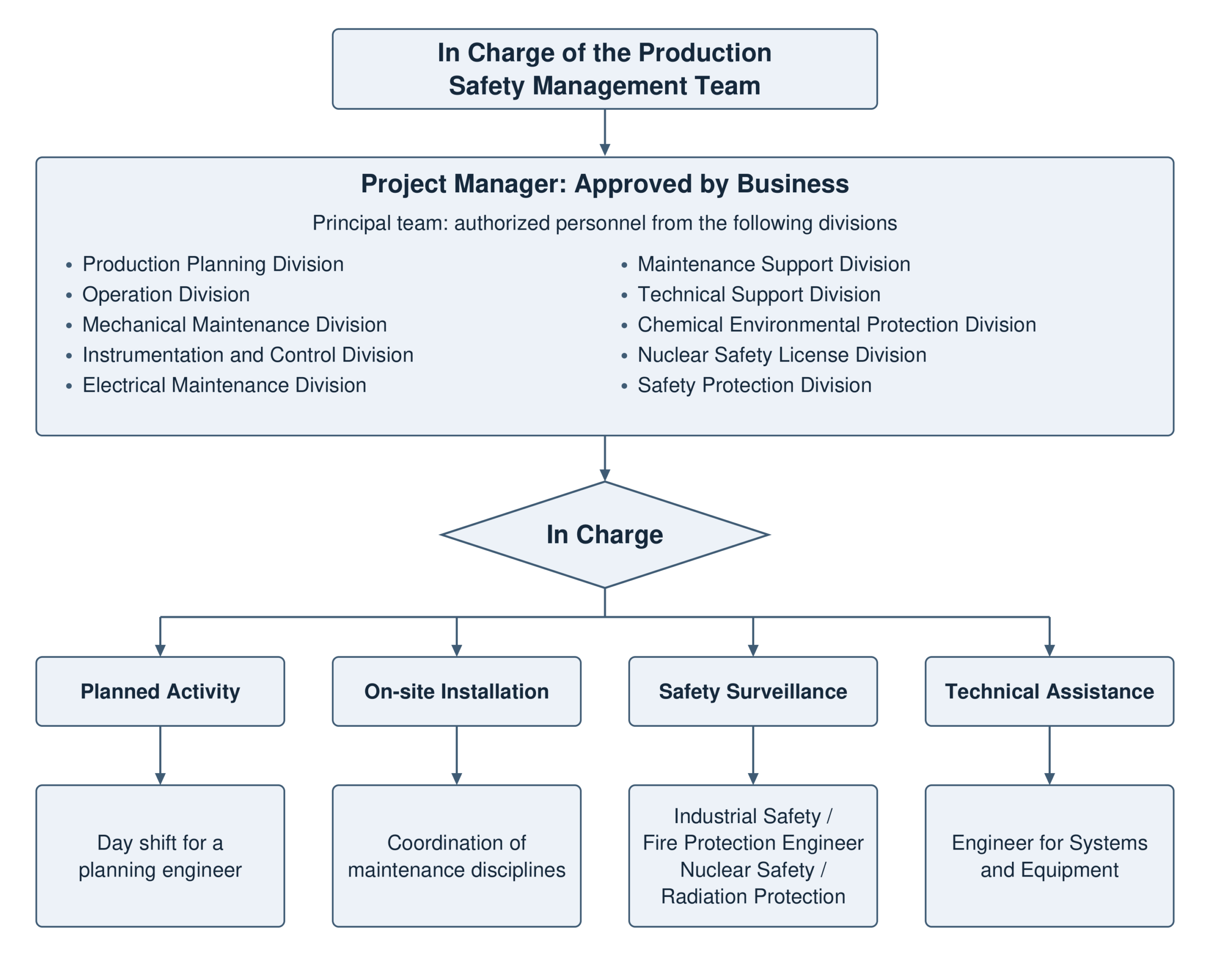
The organizational arrangement contains three levels. First, at the decision-making level, the head of the safety production management team acts as the administrative leader. This level is responsible for proposing the overall objectives of safe production, approving the organizational structure, establishing management rules and procedures, and providing the resources required for normal team operation. Second, at the management level, the daily production project team manager serves as the central coordinating authority. The manager is responsible for developing work procedures, defining organizational relationships, clarifying roles and responsibilities, directing production activities, coordinating resources, and ensuring that the overall safe-production objectives are achieved. The project manager also monitors and evaluates the operation of the daily production project team, identifies deviations or weaknesses, and promotes continuous system improvement. Third, the executive level is led by the shift supervisor and includes personnel responsible for planning, day-shift supervision, maintenance coordination, system and equipment management, nuclear safety, industrial safety, fire protection, radiation protection, and other relevant specialties. This level organizes routine work, collects and analyzes production information, prepares and distributes production orders under the unified production plan, and ensures that activity-specific risks are identified and adequately controlled. The organizational structure of the daily production project team is illustrated in Figure 1.
The production decision center and the operation control center at the CAP Qunluo Intelligent Management Demonstration Center are designed to support coordinated production decision-making. They also provide the infrastructure required for teleconferences, Internet-based video conferences, and wide-area-network video conferences. For the daily production management of the cluster reactor system, the production decision center functions as the principal command and decision-making hub [14]. Its functions include abnormal-condition response, resource coordination, production command, and remote technical support. Data from individual process nodes can be collected through intelligent technologies such as artificial intelligence (AI) and robotic process automation (RPA), after which big-data analysis can be used to support a more comprehensive and informed view of production status and management priorities.
The operation control center provides access to real-time production data from Shandong Nuclear Power and supports centralized daily cluster-reactor management. Its functions include real-time monitoring of personnel and equipment status, remote equipment monitoring or control where authorized, full-process supervision of on-site work, and integrated ticket or work-permit management. Through these functions, the center supports unified command, scheduling, and coordination of production activities across the plant and improves the work efficiency of personnel at the executive level [15].
The CAP Qunluo Intelligent Management Demonstration Center has established a specialized equipment monitoring center to support continuous monitoring of personnel safety behavior and equipment status. Monitoring activities include intelligent video supervision, vibration monitoring, routine remote video inspection, specialized inspection, and other condition-monitoring methods. The center combines on-site supervision with remote monitoring in order to assess equipment reliability, operating parameters, and the status of newly commissioned or recently maintained equipment. When abnormalities are detected, relevant information is promptly transmitted for professional evaluation, coordination, and corrective action.
System and equipment engineers working in the monitoring center track equipment parameters and provide timely feedback to the operation control center when abnormal trends are identified. At the same time, a production-management cockpit and production-data display center are being developed to present safety-management information more intuitively through dashboards, charts, real-time data, and status indicators. The displayed information can include high-risk unit activities, chemical control indicators, unit defects, WANO indicators, TEF indicators, safety-management status, and other matters requiring management attention. The production-data display center can further integrate mechanistic models with big-data and AI methods. When combined with digital-twin and related technologies, these functions can support visual risk monitoring, early warning, intelligent diagnosis, equipment-condition monitoring, and equipment health management. The overall objective is comprehensive real-time awareness of personnel, systems, equipment, major hazards, and other safety-related risk information.
Cameras are installed at strategically important locations throughout the plant, and their signals are transmitted to the CAP cluster-reactor management center. The platform can therefore monitor key plant areas by video while also displaying and analyzing important equipment parameters, such as temperature, pressure, and humidity, in real time. These functions provide additional information for assessing equipment operating conditions and generating early warnings when abnormal conditions are detected [16]. When video monitoring is integrated with electronic-fence functions and operation-control systems, the management of personnel, equipment, and the operating environment becomes more visible and information-based, thereby strengthening real-time monitoring capability in the nuclear power production environment.
Operational behavior can be monitored through recorders, mobile and fixed audio-video acquisition devices, intelligent collection-management cabinets, and AI-based video-analysis technology. By integrating these tools with the central AI platform and production information management system, the implementation of operational tasks can be supervised throughout the work process in real time [17]. The purpose is to strengthen personnel control, identify unsafe behavior, provide intelligent warnings during operations, and support the timely correction of deviations. Effective supervision of operational behavior is particularly important for protecting the safety of work performed at electric-power production sites and for improving the overall standardization and traceability of safety management.
To improve the effectiveness of discussions and decisions concerning daily production defects and to manage the overall risks of on-site work, the production decision center can support wide-area-network video conferences, Internet video conferences, telephone conferences, and other communication formats. When necessary, it can also establish a direct connection with the duty officer. If a significant unit deviation or abnormal condition occurs, the decision center can communicate immediately with the operating unit and provide the duty officer with required technical support. This arrangement reduces part of the coordination burden on the duty officer and allows greater attention to be directed toward unit control. Daily and periodic meetings are also used to respond to on-site safety issues, review operational abnormalities, coordinate resources, and evaluate appropriate solutions for production and safety problems.
At the same time, online systems for completing, displaying, and distributing meeting materials can improve preparation and information sharing. Specialty-specific input pages and automatic data-capture functions allow relevant materials to be prepared and updated more efficiently, while participants can review key information before a meeting begins. This reduces repetitive manual preparation, facilitates real-time sharing of meeting information, and improves the efficiency and focus of production-safety discussions. The principal arrangements for these meetings are summarized in Table 2.
| Meeting title | Moderator | Participants | Issues discussed | Time (place) |
|---|---|---|---|---|
| Daily production planning meeting | Work Week Manager | Operations Division program coordination engineer, partner program coordination personnel, Maintenance Support Division/Technical Support Division/Chemical Environmental Protection Division/Safeguards Division coordination engineers, nuclear safety engineer, and program engineer | 1. The Work Week Manager and Day-Shift Isolation Manager discuss current unit deficiencies and safety precautions; 2. The Day-Shift Isolation Manager provides feedback on functional requalification and, when work is not completed as scheduled, the program reschedules the test window; 3. Work orders with “abort” status that are eligible for restart are rescheduled; 4. Nuclear-safety concerns are reviewed; 5. Safeguards coordination engineers provide preventive and safety measures; 6. Significant problems and their progress are reviewed; and 7. Cross-specialty collaboration requirements are coordinated. | After the morning production meeting (Production Decision Center) |
| The CR Screening Meeting | Head of Weekly Task | Coordination engineers in chemistry, security, and other fields, including the Work Week Manager/daily planning engineer, Operations Support Section isolation manager, nuclear safety engineer, maintenance mechanical/electrical/instrumentation and control/support personnel, and Technical Support personnel | 1. Verify the sequence of CRs; 2. Coordinate CRs when the allocation of the responsible specialty differs; 3. Discuss unclear application closure and extension CRs; 4. Promote the handling of significant defects; and 5. Coordinate CRs requiring implementation by multiple disciplines. | 14:40, Production Decision Center/daily |
| Daily production project team meeting | Manager of the Daily Production Project Team | Core members of the daily production project team or authorized personnel, production shift leaders, and nuclear safety personnel | 1. Report the status of issues discussed in the morning meeting; 2. Report plan deviations; 3. Review daily production project team concerns, main-control-room alerts, and short-term defect developments; 4. Promote the timely handling of programs and review of risk programs, where applicable; 5. Review concerns raised by different specialties; and 6. Provide the daily summary and work arrangements of the production project team manager. | Daily, 15:30, Production Decision Center |
| Weekly/monthly production-safety meeting | Manager of Production Planning | Heads of production-related departments and offices, together with other key organizational leaders | 1. Review action items from the weekly safety and production-management meeting; 2. Receive reports on safety, quality assurance, operation, planning, maintenance, and other areas; and 3. Summarize the meeting and deploy subsequent work. | Weekly/monthly, Production Decision Center |
To supervise the effectiveness of daily production management more systematically, the plant has implemented an operation and management point mechanism within the safety production management group. This mechanism establishes key performance indicators for routine plant management and provides information on good practices, recurring problems, and experience feedback for discussion at monthly production meetings. An online safety-management point statistics system is used simultaneously to improve data transparency and reduce problems associated with labor-intensive manual calculations, including transcription errors and inconsistent statistical processing. Real-time recording of assessment points also makes management performance more visible and supports timely corrective action.
To facilitate one-stop processing of work-related tickets and production tasks, personnel from multiple production specialties work collaboratively within the operation control center. The center can establish immediate video links with the main control room and the morning meeting room, allowing joint production meetings to be conducted when coordination is required. The purpose is to improve communication efficiency, centralize important operational information, and support the coordination of personnel and resources according to plant requirements. The operation center’s large display screen can present the work list and status of critical and high-risk activities in real time. In accordance with business requirements, personnel can also access the main control room and relevant site video-monitoring feeds to support remote monitoring of critical work. Table 3 summarizes the principal task assignments of the co-located specialties.
| Item | Principal specialty area | Responsibilities |
|---|---|---|
| Operations and planning area | 1. Oversee the CRT meeting and coordinate the resolution of issues involving operation, safety work, chemistry, security, and other matters of concern; support the joint planning area of the CAP Cluster Reactor Management Center of Excellence. | |
| 2. The Work Week Manager leads the planning meeting, supports the Weekly Duty Manager in organizing work in the planning area, monitors work-process indicators and management deviations, and promotes continuous optimization of the work process. | ||
| 3. The day-shift isolation manager is responsible for daily unit production activities, periodic test schedules, work-package evaluation, reporting of unit problems, and requirements for defect handling. | ||
| Maintenance area | 1. Standardize remote monitoring of critical maintenance activities performed at the work site. | |
| 2. Identify and assess medium- and high-risk maintenance and testing tasks, communicate associated hazards, and supervise implementation of safety-control measures. | ||
| 3. Track significant defects, safety work, chemical issues, safety problems, and their progress from the previous day, and promote timely response. | ||
| 4. Support work-interface implementation, promote multidisciplinary cooperation in maintenance activities, assist front-line teams in improving efficiency, reduce communication costs, and promote continuous process improvement. | ||
| 5. Coordinate personnel arrangements for unit peak regulation and other important tasks. | ||
| Safety supervision area | 1. Identify daily safety-related deficiencies and propose corresponding handling requirements. | |
| 2. Provide safety-compliance support for routine production activities, assist with defect evaluation, and provide safety-related decision support. | ||
| 3. Use the capabilities of the CAP Cluster Reactor Intelligent Management Demonstration Center to improve anomaly detection, strengthen supervision of medium- and high-risk activities, identify deviations, and support timely corrective action. | ||
| 4. Provide a rapid response to safety-related abnormalities. | ||
| Chemical area | 1. Track and evaluate the chemical characteristics of the unit’s water, steam, and oil systems. | |
| 2. Provide chemical-analysis services for relevant specialties, including maintenance and operation. | ||
| 3. Monitor seawater quality at intake and discharge locations and monitor radioactive effluents from the power plant. | ||
| Technical support | 1. Provide essential technical support for routine production activities, including core-reload design, fuel-reliability evaluation, monitoring and assessment of core operating parameters after refueling, determination of unit peak-regulation and load-reduction strategies, and technical troubleshooting. | |
| 2. Provide technical support by tracking, monitoring, diagnosing, and evaluating the performance, vibration, and condition of significant equipment and by proposing feasible recommendations for reliable and stable operation. | ||
| 3. Manage technical-support activities including eddy-current inspection, corrosion control, and in-service inspection. | ||
| 4. Manage maintenance tasks involving risk assessment, implementation of safety-control standards, monitoring of planned work, coordination of administrative licensing processes, and related technical processing. |
As digital technologies develop rapidly, industrial organizations are increasingly integrating digital management into routine operations. In nuclear power generation, this transformation can improve operational efficiency, strengthen safety-risk control, and enhance the ability of organizations to respond to changing operating conditions. Digital management systems can continuously collect information on environmental conditions, equipment parameters, work progress, and personnel activities. Through Internet of Things (IoT) devices, sensors, intelligent monitoring tools, centralized information platforms, and cloud or local computing resources, large volumes of operational data can be stored, displayed, analyzed, and used to support management decisions. Such real-time, data-driven management can enable earlier identification of abnormal trends, potential equipment failures, unsafe behaviors, and work-process deviations, thereby improving both production continuity and the reliability of safety management.
Digital technologies can also support more effective allocation and coordination of resources such as personnel, equipment, maintenance windows, and materials. Enterprise resource planning (ERP), manufacturing execution systems (MES), and specialized plant-production platforms can reduce fragmented information flows and improve coordination among planning, operation, maintenance, technical support, chemistry, radiation protection, and safety departments. When operational information is integrated across these functions, managers can improve production scheduling, reduce unnecessary delays, and allocate resources according to current plant conditions. Data analytics can additionally support demand forecasting, maintenance prioritization, and the identification of recurring operational problems. Remote-monitoring functions make it possible for authorized managers and technical experts to access important plant-status information promptly and to provide support during abnormal situations.
The digital management platform also facilitates interdepartmental collaboration and information sharing. Efficient data integration among production, maintenance, safety, technical, and administrative systems can improve the flow of information, reduce repeated communication, and enhance coordination among personnel. At the same time, digital management should maintain strong emphasis on regulatory compliance, cybersecurity, information integrity, and nuclear safety. Digital procedures can help reduce human error and strengthen the safety culture by recording operational actions, improving traceability, and supporting verification of compliance with established standards and procedural requirements.
Machine learning and data analytics may further be used to identify abnormal patterns and issue timely warnings when sufficient validated data and suitable models are available. For example, an AI-supported monitoring system may recognize unusual equipment behavior or unsafe operational patterns and notify responsible personnel before a condition develops into a more serious event. However, such systems should function as carefully validated decision-support tools and should not replace qualified operator judgment, approved procedures, or independent nuclear-safety requirements. Their value lies in improving situational awareness, consistency, and response speed while keeping human responsibility and regulatory control clearly defined.
This study presents a digitally supported management-optimization approach for addressing safety-operation and management challenges under the cluster-reactor mode of the Haiyang Nuclear Power Plant, with particular emphasis on the safety production management system used during routine operation. The analysis suggests that a standardized safety production management system can strengthen operational safety management, improve the control of work risks, increase employee safety awareness, and enhance the efficiency of supervision and coordination. A broad safety-supervision network combined with real-time communication can improve the timeliness and accuracy of information transmission and support safe and compliant routine operation. The integration of centralized monitoring, safety meetings, digital information systems, and multidisciplinary co-location can also improve the efficiency with which operating problems are identified, communicated, assigned, and resolved.
Through an analysis of 153 operational facts from routine activities, the study summarizes several elements that influence nuclear power plant safety management, including quality-control requirements for equipment operation and maintenance, control measures for high-risk activities, and identification and correction of personnel violations. On this basis, the study seeks to improve the overall safety of cluster-reactor nuclear power plants by reducing the recurrence of similar problems, strengthening organizational supervision, and providing a data-supported framework for management decision-making. The value of this approach depends on the quality, completeness, and traceability of the underlying operating data and on the consistent application of the management mechanisms described in this paper.
Cluster-reactor and multi-unit operating arrangements are increasingly important in nuclear power plant management, creating additional opportunities for the development and application of integrated digital-management methods. Future work can further strengthen these approaches through more rigorous quantitative evaluation of safety indicators, validation of AI-supported monitoring models, integration of digital-twin technologies, and comparison of performance before and after implementation of the proposed management system. The findings of this study provide a practical reference for safety management in complex multi-unit nuclear power operating environments and may support the further development of standardized, data-driven, and coordinated management practices. In particular, the proposed organizational framework emphasizes continuous monitoring, timely information exchange, clearly assigned responsibilities, and coordinated decision-making as complementary elements of routine nuclear safety management rather than as isolated digital functions.
All authors contributed to the development of the study, critically reviewed the manuscript, approved the final version, and agreed to be accountable for all aspects of the work.
The authors declare no conflicts of interest.
This research received no external funding.
Data supporting the conceptual synthesis are derived from the cited publications; additional coding materials are available from the corresponding author upon reasonable request.